Recruiters skim fast—about 7.4 seconds on an initial resume screen according to a widely cited eye-tracking summary (2018 study coverage via HR Dive). (Confidence: High — consistent reporting across multiple outlets)
Source: https://www.hrdive.com/news/eye-tracking-study-shows-recruiters-look-at-resumes-for-7-seconds/541582/
That single fact changes the “one page vs two pages” debate:
- The goal isn’t to “hit one page.”
- The goal is to make your value obvious in the first 1/3 of page one, while still giving enough proof to pass both ATS parsing and human scanning.
In this guide, you’ll learn:
- When a one-page resume is genuinely best in 2026 (and when it quietly hurts you)
- When a two-page resume is the smarter choice (and how to structure page two so it gets read)
- A simple decision framework by seniority, job type, and industry
- ATS-safe formatting rules that matter more than page count
- A workflow to cut (or expand) your resume without losing impact
What “Best Resume Length” Really Means (and what it doesn’t)
Best resume length is the shortest length that:
- Communicates your fit for this role,
- Survives ATS parsing cleanly,
- Gives enough evidence (metrics, scope, tools, results) to win interviews,
- Stays easy to skim.
It does not mean:
- “One page no matter what”
- “Two pages because I have experience”
- “Stuff everything in and hope they’ll find it”
A useful mental model for 2026:
Page count is an output. Relevance is the input.
The 2026 Reality: What Recruiters Prefer vs. What Works
Research often cited in the one-page vs two-page debate
A ResumeGo study is frequently referenced in career media. The headline result: recruiters/hiring managers were 2.3× as likely to prefer a two-page resume over a one-page resume (for comparable candidates). (Confidence: High — reported by ResumeGo and multiple third parties like CNBC)
Sources:
- ResumeGo: https://www.resumego.net/research/one-or-two-page-resumes/
- CNBC coverage: https://www.cnbc.com/2018/12/19/resumego-hiring-managers-prefer-candidates-with-two-page-resumes.html
Other coverage notes the “two pages can win” effect increases for more senior roles (e.g., managerial positions being more likely to prefer two pages). (Confidence: Medium — consistent in coverage, but role-specific details vary by article)
Source: https://www.fastcompany.com/90271521/are-one-page-or-two-page-resumes-better/
The catch: preference isn’t permission to add fluff
Even if a two-page resume can perform well, it only works when:
- Page one is strong enough to stand alone
- Page two earns its space with proof, not filler
If page two is just extra job duties, older irrelevant roles, or generic skills lists, it becomes a negative signal: “couldn’t prioritize.”
Quick Answer: One Page or Two Pages in 2026?
Use this as your default starting point:
One page is usually best when:
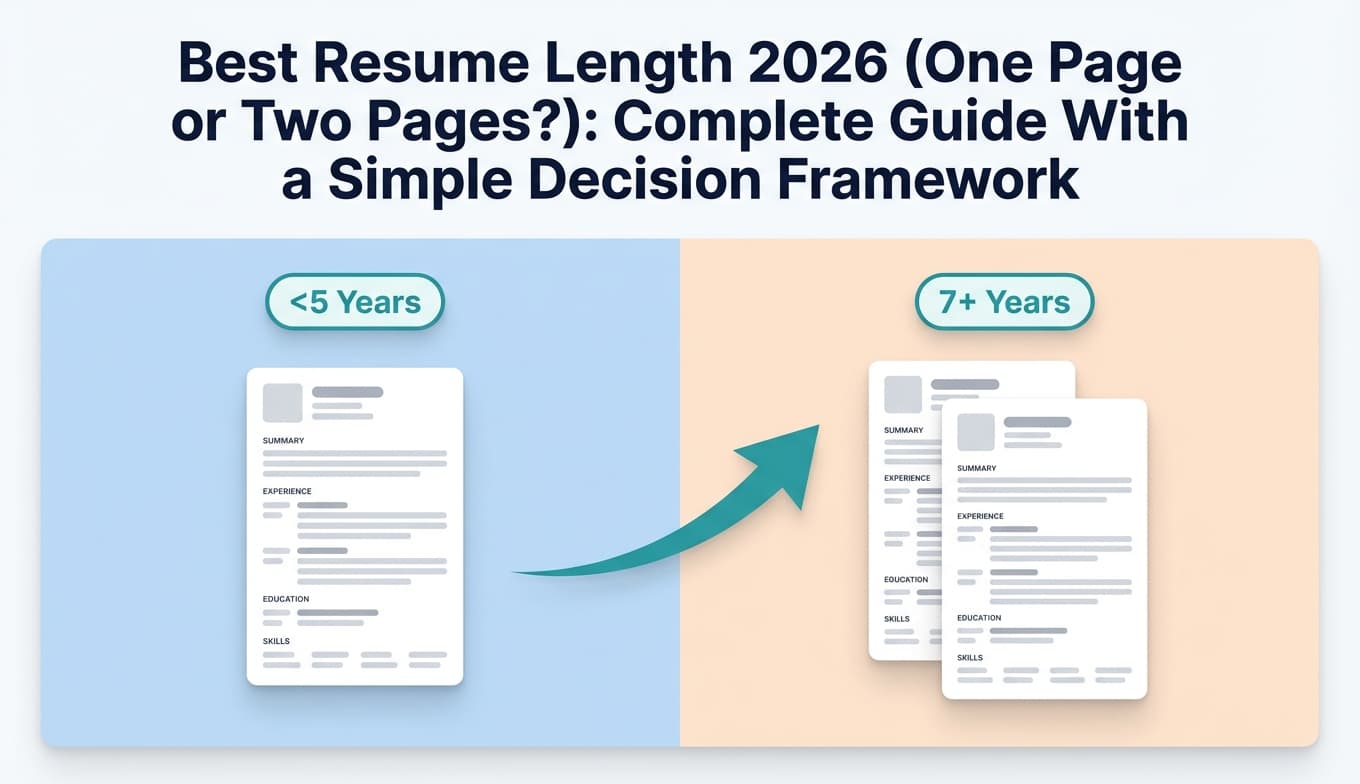
- You’re entry-level / early career (roughly 0–3 years)
- You have 1–2 relevant roles and the story is simple
- You’re targeting high-volume roles where recruiters screen quickly (many junior ops, admin, retail, high-volume customer support)
- You’re a career changer and need a tight narrative, not a long chronology
Two pages are usually best when:
- You’re mid-level (often 5–10+ years) and have multiple relevant roles
- You need space for measurable achievements without shrinking fonts/margins
- You’re applying for roles that require depth: technical, product, program, analytics, management, regulated industries
- You have meaningful extras that matter: publications (non-academic), patents, speaking, certifications, notable projects
The rule that beats both:
If you go to two pages, page one must still be the best page. If page one isn’t compelling, page two won’t save it.
A Simple Decision Framework (Use This Before You Edit)
Answer these in order:
1) What is the job type?
- High-volume hiring: lean one page if you can (speed matters).
- Specialized / senior hiring: two pages often performs better (depth matters).
2) How many “proof bullets” do you have?
Count only bullets that show outcomes, scope, or measurable impact. Examples:
- “Reduced API latency 32% by …”
- “Managed $1.2M budget across …”
- “Increased SQL pipeline reliability …” If you have fewer than ~8–12 strong bullets total, forcing two pages usually creates fluff.
3) What is your seniority for this role (not your total years)?
A 12-year professional applying to an IC role they pivoted into last year may still need a tighter footprint than someone with 8 years directly in-role.
4) Are you applying to federal roles (USAJOBS)?
This is a special case. USAJOBS guidance indicates a two-page limit tied to the Merit Hiring Plan (effective dates are detailed in official guidance). (Confidence: High — official OPM and USAJOBS pages)
Sources:
- OPM guidance: https://www.opm.gov/policy-data-oversight/hiring-information/merit-hiring-plan-resources/applicant-guidance-on-the-two-page-resume-limit/
- USAJOBS page limit FAQ: https://help.usajobs.gov/faq/application/documents/resume/page-limit
If you’re targeting federal roles, optimize for two pages maximum (and read the posting carefully for exceptions).
Why Resume Length Matters in 2026 (Even When People Say “It Doesn’t”)
Even writers who argue “page count doesn’t matter” usually agree on two truths:
-
Recruiters skim. If your key value isn’t clear early, you lose.
(Reinforced by eye-tracking coverage around 7.4 seconds.)
Source: https://www.hrdive.com/news/eye-tracking-study-shows-recruiters-look-at-resumes-for-7-seconds/541582/ -
ATS is everywhere. Many large employers use applicant tracking systems, and ATS usage is widely reported. Jobscan reports extremely high ATS adoption among Fortune 500 companies in earlier research snapshots. (Confidence: Medium–High — Jobscan is a strong category source, but “ATS detection” methodology can vary)
Source: https://www.jobscan.co/blog/fortune-500-use-applicant-tracking-systems/
Additionally, third-party HR tech summaries commonly cite broad ATS usage stats like “70% of large companies use an ATS” and “75% of recruiters use an ATS or another tech-driven tool.” (Confidence: Medium — credible aggregator, but stats originate from mixed studies)
Source: https://www.selectsoftwarereviews.com/blog/applicant-tracking-system-statistics
Bottom line: resume length matters because attention is limited and filtering is automated.
How to Choose the Best Resume Length: Step-by-Step
Step 1: Define the target role (so you know what to cut)
Before you touch formatting, write down:
- Target title (exact)
- 6–10 “must-have” skills/keywords from the job description
- 3–5 outcomes the role is responsible for
If you don’t do this, you’ll keep irrelevant content simply because it happened.
Pro tip: If you’re applying to multiple roles, create two master versions (e.g., “Data Analyst” and “Ops/Program”) rather than endlessly stretching one resume.
Step 2: Build a “proof-first” page one
Your page one should answer, in this order:
- Who are you? (headline + specialty)
- What results do you drive? (2–4 bullet highlights or a tight summary)
- What did you do recently that matches this job? (most recent role with strongest bullets)
A strong page one structure (works for both one-page and two-page resumes):
- Header (name, location, email, LinkedIn/GitHub/portfolio)
- 1-line headline (e.g., “Product Analyst | Experimentation | SQL + Python”)
- 2–4 line summary OR 3 “impact bullets”
- Skills (tight, keyword-aligned)
- Experience (most recent role starts here, not halfway down the page)
Step 3: Decide one page vs two pages using “content pressure”
Use this quick scoring:
If you have…
- 0–3 years experience: strong bias to 1 page
- 4–10 years experience: choose based on relevance density (often 1–2 pages)
- 10+ years experience: 2 pages is commonly acceptable if it’s all relevant (don’t add older irrelevant roles)
Then run the real test:
Can you fit page one without:
- font < 10.5–11
- margins < ~0.5"
- removing measurable achievements
- cramming skills into unreadable blocks
If the answer is “no,” you’re probably a legitimate two-page candidate.
Step 4: If you go to two pages, make page two “supporting evidence” (not a second resume)
Page two should contain:
- earlier relevant roles (condensed)
- selected projects (only if relevant)
- certifications, publications (non-academic), speaking, awards
- technical depth that matters (tools, methods, domains)
Page two should not contain:
- a long generic skills cloud
- repeated bullets
- unrelated early-career jobs (unless they explain the pivot)
Formatting best practice: Put your name + “Resume” (or just name) and page number on page two header if your template supports it—but avoid heavy headers/footers that can complicate parsing in some ATS setups.
Step 5: Validate for ATS readability (more important than page count)
Common ATS-safe guidelines across many resume/ATS resources emphasize avoiding overly complex layouts (columns, tables, graphics) because they can cause parsing issues. One example is Jobscan’s ATS formatting guidance. (Confidence: Medium — ATS behavior varies, but the advice is consistent across tools and career sites)
Source: https://www.jobscan.co/blog/ats-formatting-mistakes/
ATS-safe checklist (practical version):
- Use a single-column layout when possible
- Avoid text boxes, heavy tables, icons, and graphics
- Keep headings standard: “Experience,” “Education,” “Skills”
- Use consistent date formatting
- Ensure the resume reads correctly when pasted into a plain-text editor
Best Practices: The “Right Length” by Career Level (2026)
Entry-level / new grad (0–2 years)
Best length: 1 page
What to include:
- Education + relevant coursework (selectively)
- Internships, co-ops, research (if role-relevant)
- 2–4 projects with outcomes (not just tech stack)
- Skills aligned to the JD
Common mistake: adding unrelated campus leadership to fill space. Include it only if it signals relevant skills (leadership, analytics, marketing, etc.).
Early career (2–5 years)
Best length: usually 1 page; 2 pages only if highly relevant roles/projects
Focus: measurable impact in 1–2 roles, plus core skills.
Common mistake: listing every tool you’ve touched once. Replace tool lists with proof bullets using the tools.
Mid-level (5–10 years)
Best length: often 2 pages if you have enough outcomes and scope
Focus: progression, increasing responsibility, clearer business impact.
Common mistake: keeping older jobs with full bullet lists. Condense earlier roles to 1–2 bullets or a summary line.
Senior / leadership (10–15+ years)
Best length: usually 2 pages; sometimes 3 for executives (industry-dependent)
However, many mainstream resume guides still emphasize 1–2 pages for most candidates (and a CV for academic contexts). For a general-audience baseline, Coursera’s overview is a representative example: “most resumes should be between one and two pages.” (Confidence: Medium — general guidance, varies by industry)
Source: https://www.coursera.org/articles/how-many-pages-should-a-resume-be
What makes a senior resume worth two pages:
- leadership scope (team size, budget, cross-functional ownership)
- major initiatives, measurable outcomes, transformation work
- select board/advisory, speaking, publications (if relevant)
Common mistake: a long “summary” block. Keep it tight—let experience prove it.
Word Count Matters More Than Page Count (A Practical Range)
Many resume resources discuss an “ideal” word-count range. One widely repeated claim is a “sweet spot” of ~475–600 words (often attributed to TalentWorks and popularized via outlets like The Ladders). (Confidence: Medium — frequently cited, but the original dataset isn’t always easily verifiable in full)
Example reference: https://www.theladders.com/career-advice/this-is-the-exact-number-of-words-your-resume-should-be
How to use word count without over-optimizing it:
- 1 page often lands around 450–650 words depending on formatting and role density.
- 2 pages often lands around 800–1,200 words if both pages are genuinely content-rich.
Don’t chase a number; use it as a “fluff detector.”
Common Mistakes to Avoid (That Cause the One vs Two Debate in the First Place)
Mistake 1: Forcing one page by shrinking readability
If your font is tiny or margins are microscopic, you may “win” the one-page rule and lose the interview.
Fix: Move to two pages or cut low-value content (older roles, generic bullets, duplicate skills).
Mistake 2: Using page two as a dumping ground
A weak page two often contains:
- every tool you’ve ever used
- soft skills (“hardworking,” “team player”)
- job duties without outcomes
Fix: Page two should be “evidence”: projects, metrics, certifications, select achievements.
Mistake 3: Listing everything instead of tailoring
High-volume applicants often use the same resume everywhere, then wonder why they’re “getting rejected by ATS.”
Fix: Tailor the top third (headline, summary, skills, most recent bullets) to match the job’s language—without keyword stuffing.
Mistake 4: Confusing a resume with a CV
If you’re applying in academia or research, you may need a CV (often longer). Universities publish clear distinctions: a CV is comprehensive, while a resume is concise and role-targeted. (Confidence: High — consistent across career centers)
Example: UC Davis career center overview: https://careercenter.ucdavis.edu/resumes-and-materials/resumes/resume-vs-cv
Mistake 5: Ignoring special rules (Federal / USAJOBS)
If you’re applying for U.S. federal roles, the two-page limit guidance is explicit in official sources. (Confidence: High)
- OPM guidance: https://www.opm.gov/policy-data-oversight/hiring-information/merit-hiring-plan-resources/applicant-guidance-on-the-two-page-resume-limit/
- USAJOBS FAQ: https://help.usajobs.gov/faq/application/documents/resume/page-limit
Fix: Build a federal-specific resume version that fits the rules and the announcement.
How to Format a Two-Page Resume So It Actually Gets Read
Page one: “decision page”
Your goal is to win the “yes, keep reading” decision.
Include:
- Best, most relevant accomplishments
- Keyword-aligned skills
- The most recent, most similar role
Page two: “proof page”
Your goal is to remove doubt.
Include:
- Additional achievements from prior roles
- One strong projects section (optional)
- Certifications, tools, publications (relevant)
The “no orphan page” rule
If page two has only 3 lines, you probably shouldn’t have a page two. Either:
- cut it back to one page, or
- add meaningful evidence (not filler)
Practical Examples: When One Page Wins vs When Two Pages Wins
Example A: One page is best
Candidate: Marketing specialist, 3 years experience
Resume content:
- 1 full-time role + 1 internship
- 6 strong measurable bullets
- 8–12 relevant skills Best length: 1 page
Why: enough proof to show impact, not enough complexity to justify page two.
Example B: Two pages is best
Candidate: Data analyst, 8 years experience
Resume content:
- 3 relevant roles with progression
- multiple dashboards/automation wins
- certifications + speaking + major projects Best length: 2 pages
Why: forcing one page would remove proof (exactly what hiring managers want at mid-level).
Example C: Federal application
Candidate: Program specialist targeting USAJOBS
Constraint: two-page limit is enforced in USAJOBS guidance (see sources above)
Best length: up to 2 pages, tightly organized around qualifications.
Tools to Help You Get the Right Resume Length (Without Guessing)
You can do this manually in Word/Docs, but tools can help you iterate faster—especially if you’re tailoring for many jobs.
JobShinobi (resume builder + ATS-focused analysis)
JobShinobi supports:
- A LaTeX resume editor with PDF preview (compile to PDF in-app)
- AI resume analysis (scoring + feedback, including ATS-focused guidance)
- Job description extraction and resume-to-job matching (to spot keyword gaps and tailoring opportunities)
- A job application tracker, including an email-forwarding workflow that can auto-log job application emails (this email processing is Pro-gated)
Pricing (be precise):
- JobShinobi Pro is $20/month or $199.99/year.
- The pricing/marketing copy mentions a “7-day free trial,” but trial mechanics aren’t clearly verifiable from billing logic alone—treat as “mentioned,” not guaranteed.
Internal links (if you’re already a user):
- Resume area:
/dashboard/resume - Job tracker:
/dashboard/job-tracker - Subscription:
/subscription
Other helpful options (neutral)
- Google Docs / Microsoft Word: fine for basic versioning and page control
- Plain-text paste test: paste your resume into a text editor to sanity-check ATS reading order
Key Takeaways (One Page vs Two Pages in 2026)
- A resume should be as long as needed, as short as possible—but page one must carry the decision.
- One page is best for most entry-level/early-career candidates if it stays readable and proof-driven.
- Two pages is often best for mid-level+ candidates when it prevents removing measurable outcomes.
- Your formatting and relevance matter more than page count—especially in an ATS-heavy hiring world.
- Federal applications can have specific page-limit rules—always follow the posting and USAJOBS guidance.
FAQ (People Also Ask)
Should resumes still be one page in 2026?
Often for early-career candidates, yes—but it’s not a universal rule. Research and recruiter behavior suggest clarity and relevance matter more than strict page count, and some studies report a preference for two-page resumes in many cases.
Source: https://www.resumego.net/research/one-or-two-page-resumes/
Is a two-page resume OK in 2026?
Yes—if page two adds relevant proof (achievements, scope, certifications, projects) and page one remains strong. A two-page resume is not automatically “too long.”
How many pages should a resume be with 10 years of experience?
Many candidates around 10 years land naturally at two pages, especially if they have multiple relevant roles and measurable achievements. The better question: can you keep it readable and proof-driven without squeezing?
Does ATS care if my resume is one page or two pages?
Most ATS systems focus on parseable structure and relevant content, not a strict page limit. What can hurt ATS performance is complex formatting (columns, heavy tables, headers/footers, graphics) and inconsistent headings.
Example guidance: https://www.jobscan.co/blog/ats-formatting-mistakes/
What is the ideal resume word count?
There’s no universal “perfect” count, but many sources cite a common range like ~475–600 words as a useful benchmark for a dense one-page resume. Treat it as a guideline, not a rule.
Example reference: https://www.theladders.com/career-advice/this-is-the-exact-number-of-words-your-resume-should-be
Can a resume be 3 pages in 2026?
Sometimes (typically executive-level, highly specialized careers, or when a CV is more appropriate). For most non-executive roles, 3 pages is often a signal you haven’t prioritized content.
Should I write “Continued on next page” on my resume?
Usually no. Modern recruiting workflows (ATS + digital review) don’t require it. Instead, use a clean header on page two (name + contact or name + page number).
If I have lots of experience, should I include every job?
Not necessarily. Prioritize roles and achievements that support the job you’re applying for now. Older roles can often be condensed to a single line or a short bullet—unless they’re directly relevant.