If your resume looks polished but you’re still getting ghosted, odds are you’re losing in one of two places:
- Parsing: the ATS can’t reliably read your resume (so your experience/skills show up scrambled or incomplete), or
- Matching: your resume doesn’t mirror the job’s keywords and requirements—in the right sections—so you never surface in recruiter searches.
Here’s why it matters:
- 98.4% of Fortune 500 companies used a detectable ATS in 2024 (492 out of 500), per Jobscan. Confidence: HIGH (first-party dataset + clear methodology). Source: https://www.jobscan.co/blog/fortune-500-use-applicant-tracking-systems/
- Recruiters’ average initial resume review time was measured at 7.4 seconds in The Ladders eye-tracking study. Confidence: HIGH (primary research PDF). Source: https://www.theladders.com/static/images/basicSite/pdfs/TheLadders-EyeTracking-StudyC2.pdf
So the goal in 2026 isn’t just “ATS-friendly.” It’s ATS-readable + recruiter-skim-proof.
In this guide, you’ll learn:
- What “ATS-optimized” actually means (and what it doesn’t)
- The exact, ATS-safe resume format for 2026 (with do/don’t examples)
- A step-by-step tailoring method you can repeat for every application
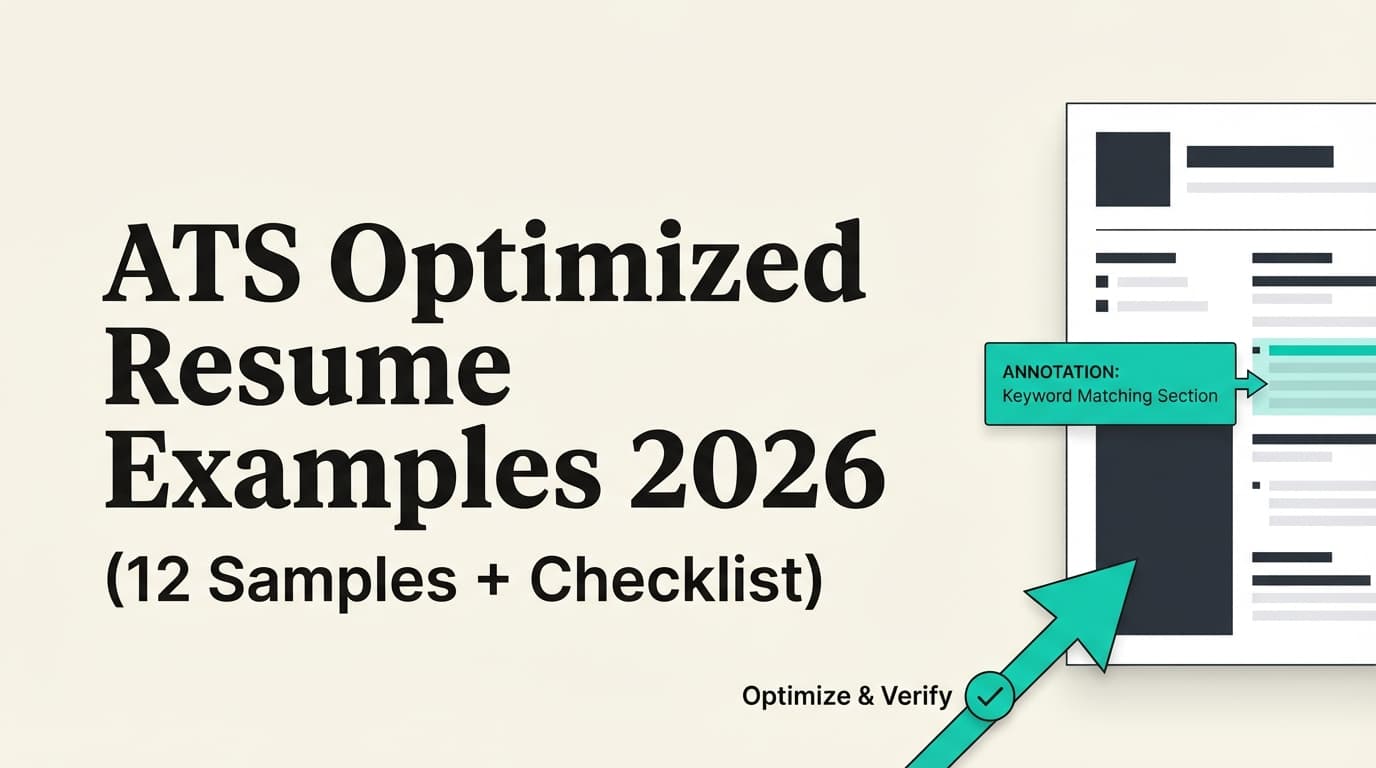
- 12 ATS optimized resume examples (2026) with copy/paste sections and bullet libraries
- Common ATS resume mistakes (tables, columns, headers/footers, file issues) and fixes
- Tools that can speed up your workflow (without overpromising “ATS score” magic)
Table of contents
- What is an ATS-optimized resume?
- How ATS systems read resumes (in plain English)
- Why ATS optimization matters in 2026 (stats + trends)
- The ATS-safe resume format (2026 checklist)
- How to tailor your resume for ATS (step-by-step)
- 12 ATS optimized resume examples for 2026 (copy/paste)
- ATS keyword examples by job family (quick reference)
- Common ATS resume mistakes to avoid (with fixes)
- Tools to help with ATS optimization (honest recommendations)
- Key takeaways
- FAQ
What is an ATS-optimized resume?
An ATS-optimized resume is a resume designed to succeed in two gates:
Gate 1: Machine readability + matching
The ATS needs to:
- extract your info correctly (resume parsing), and
- match you to the role via keywords, titles, and filters.
Workable describes resume parsing as the ATS electronically analyzing text and extracting key data (like names, job titles, and education). Confidence: HIGH (credible HR platform explainer). Source: https://resources.workable.com/stories-and-insights/how-ATS-reads-resumes
Gate 2: Human scan (fast)
Once a recruiter opens your resume, you need:
- an obvious target role,
- proof you’ve done the work they need,
- outcomes (numbers, impact, scope) without hunting.
The Ladders’ study suggests that “first pass” scanning can be seconds, not minutes. Confidence: HIGH. Source: https://www.theladders.com/static/images/basicSite/pdfs/TheLadders-EyeTracking-StudyC2.pdf
What ATS optimization is not
- Not keyword stuffing (a giant skills list with no proof)
- Not hiding keywords in white text (can backfire ethically and practically)
- Not chasing a “100 ATS score” (different tools model ATS differently)
A better mental model:
Structure makes you readable. Keywords make you findable. Outcomes make you hireable.
How ATS systems read resumes (in plain English)
Most ATS resume workflows look like this:
- Ingest: You upload PDF/DOCX → system stores file.
- Parse: ATS extracts text into fields (contact info, job titles, dates, skills).
- Normalize: It tries to interpret sections (“Experience,” “Education,” etc.).
- Search/filter: Recruiters filter by title, location, skills, years, keywords.
- Rank/shortlist: Some systems score or rank based on criteria.
Why formatting breaks everything
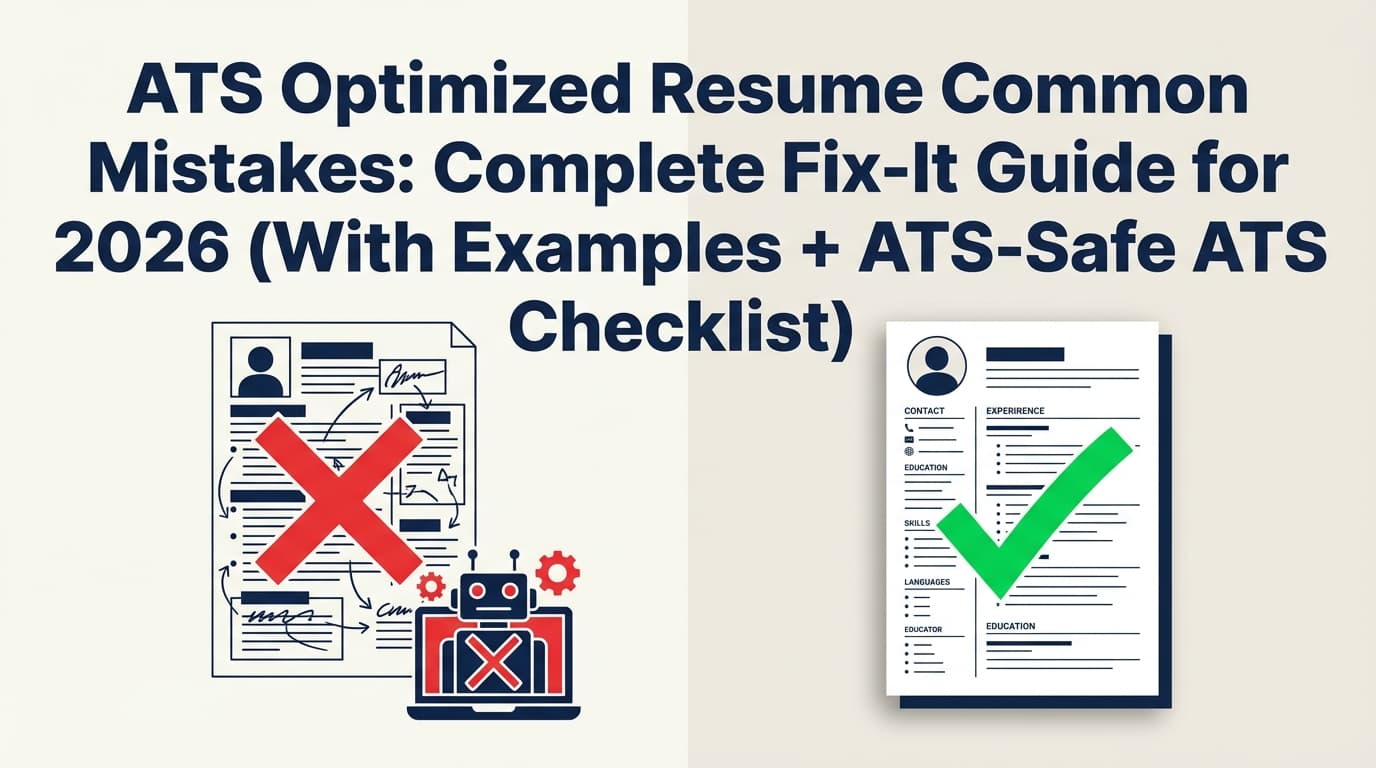
If your content lives inside:
- tables,
- columns,
- text boxes,
- headers/footers,
- images/icons,
…then text extraction can become unreliable (missing words, wrong order, mismatched dates).
That’s why many career resources recommend simple formatting. For example, Cornell Career Services explicitly advises: “Do not use columns” in their standard resume guidance. Confidence: HIGH (university career center). Source: https://career.cornell.edu/resources/cals-standard-resume-template/
Why ATS optimization matters in 2026 (stats + trends)
1) ATS is nearly universal in large-company hiring
- 98.4% of Fortune 500 companies used a detectable ATS in 2024 (492/500). Confidence: HIGH.
Source: https://www.jobscan.co/blog/fortune-500-use-applicant-tracking-systems/
2) Recruiters don’t read—at first, they skim
- 7.4 seconds average initial review time (The Ladders eye-tracking study). Confidence: HIGH.
Source: https://www.theladders.com/static/images/basicSite/pdfs/TheLadders-EyeTracking-StudyC2.pdf
3) Hiring managers reject fast for quality signals (like sloppy writing)
Zippia reports:
- 59% of recruiters reject a candidate because of poor grammar. Confidence: MEDIUM (survey-based; still directionally useful).
Source: https://www.zippia.com/advice/resume-statistics/
4) ATS usage extends beyond the Fortune 500
SelectSoftwareReviews reports:
- 70% of large companies use an ATS
- 20% of small/mid-sized businesses use an ATS
- 75% of recruiters use an ATS or similar recruiting software
Confidence: MEDIUM (third-party compilation; methodology varies).
Source: https://www.selectsoftwarereviews.com/blog/applicant-tracking-system-statistics
Practical takeaway: even if you’re applying to smaller companies, you can’t assume a human will read your resume first—or that the system will interpret a “creative” template correctly.
The ATS-safe resume format (2026 checklist)
Use this checklist like a pre-flight inspection before you apply.
ATS-safe formatting checklist (2026)
Layout (safe defaults)
- Single column
- Left-aligned headings
- No text boxes, no shapes
- Consistent spacing (white space is fine; layout tricks aren’t)
Cornell’s “no columns” guidance is a strong signal for ATS-safe design. Confidence: HIGH: https://career.cornell.edu/resources/cals-standard-resume-template/
Section headings (use boring, standard labels)
ATS systems typically recognize common headings best. Indeed recommends clear section headings and avoiding complex formatting like tables/graphics. Confidence: HIGH.
Source: https://www.indeed.com/career-advice/resumes-cover-letters/ats-resume-template
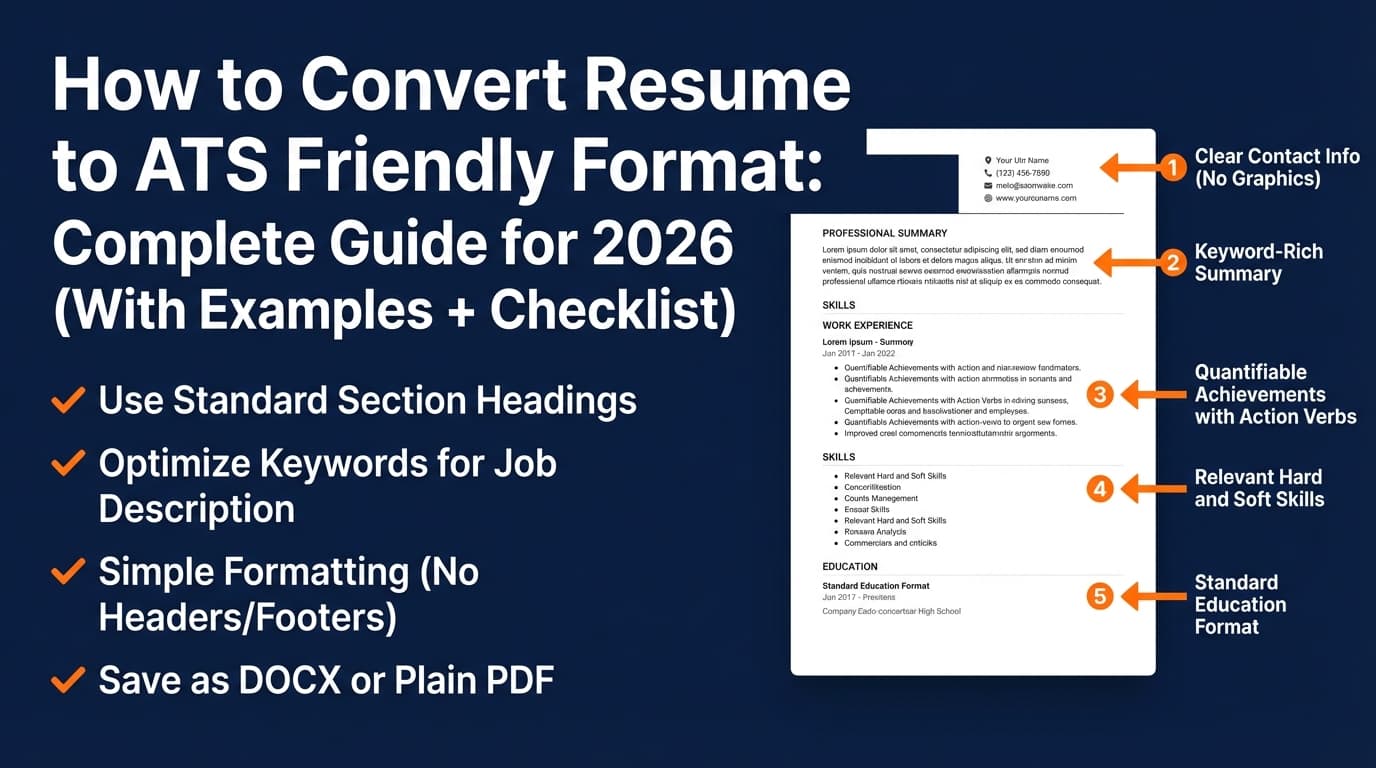
Use:
- Professional Summary (or Summary)
- Skills
- Work Experience (or Experience)
- Education
- Optional: Projects, Certifications, Publications
Avoid replacing headings with creative alternatives (e.g., “Where I’ve Been,” “My Toolkit,” “What I’ve Built”) unless you’re also including the standard heading.
Bullets, dates, and titles
- Use normal bullet points (•)
- Keep job titles clear and standardized
- Use a consistent date format (e.g.,
Jan 2023 – Mar 2025)
Fonts
- Simple fonts (Arial, Calibri, Times New Roman, etc.)
- 10–12 pt body
- Avoid icon fonts and decorative fonts
Graphics and tables: avoid
Jobscan’s guidance emphasizes avoiding formatting that can confuse ATS (tables, columns, headers/footers, graphics). Confidence: MEDIUM (widely corroborated; specific ATS behavior varies).
Source: https://www.jobscan.co/blog/ats-formatting-mistakes/
File type: PDF vs DOCX (what to do)
Different ATS handle file types differently, and advice can vary.
Best practice in 2026:
- Follow the employer’s instructions.
- Keep both versions:
- DOCX (often safest for parsing)
- Text-based PDF (best for consistent appearance)
- Quick test: open the file → copy/paste into a plain text editor. If it becomes scrambled, submit the other format.
(If you want a deeper breakdown, Jobscan has a PDF vs Word discussion. Confidence: MEDIUM because conclusions depend on ATS/version and PDF structure.)
Source: https://www.jobscan.co/blog/resume-pdf-vs-word/
How to tailor your resume for ATS (step-by-step)
This is the repeatable process that gets you closer to the job description without turning your resume into a keyword dump.
Step 1: Lock your target title (and mirror it)
If the job is “Data Analyst,” put “Data Analyst” near the top. If it’s “Backend Software Engineer,” don’t headline yourself as “Full-Stack Ninja.”
Why it matters: recruiters filter and search by titles; ATS categorization can also rely on titles.
Pro tip: If your internal title was weird, use a normalized title:
Customer Success Manager (Client Partner)Software Engineer (Backend)
Step 2: Build a keyword bank from the job description (10 minutes)
Create four buckets:
- Tools / hard skills (SQL, Python, Tableau, AWS, Salesforce, Jira)
- Methods / workflows (Agile, A/B testing, forecasting, ETL, incident response)
- Deliverables (dashboards, roadmaps, SOPs, campaigns, pipelines)
- Domain terms (HIPAA, SOC 2, GAAP, KYC, FDA, etc.)
Then prioritize:
- Tier 1: appears multiple times or sits in “Requirements”
- Tier 2: useful but not repeated
- Tier 3: “nice to have”
Step 3: Map keywords to the right sections
Use this mapping to keep it natural:
- Summary: 3–6 Tier 1 keywords + what you deliver
- Skills: tools/methods (only what you can defend)
- Experience bullets: proof of Tier 1 (with impact)
- Projects: best place for “required tools” you used outside work
Step 4: Rewrite bullets using this ATS-friendly formula
Outcome + Keyword + Evidence + Scope
Bad (no proof):
- Responsible for monthly reporting and dashboards.
Good (keyword + measurable impact):
- Built automated monthly KPI dashboards in Tableau and SQL, reducing manual reporting time by 8 hours/month and improving visibility for 5 departments.
Step 5: Run a 2-minute parsing test before submitting
- Copy/paste your resume into a plain text editor.
- Check:
- headings still exist,
- bullets remain under the correct job,
- dates/company names didn’t scramble.
If it breaks, simplify formatting or switch file type.
Step 6: Keep “versions” (so you’re not rewriting from scratch)
A sustainable workflow for high-volume applying:
- 1 master resume
- 2–3 role versions (e.g., Data Analyst / BI Analyst / Product Analyst)
- Tailor only:
- Summary (2–4 lines)
- Skills ordering
- 3–6 bullets aligned to Tier 1
12 ATS optimized resume examples for 2026 (copy/paste)
Each example below follows:
- single-column structure
- standard headings
- keyword placement in context
- outcome-driven bullets
How to use these examples:
Copy the structure, then swap in your tools, metrics, and keywords pulled from the job post.
Example 1: Software Engineer (Backend) — ATS optimized (2026)
FIRST LAST
City, ST | phone | email | LinkedIn | GitHub
Backend Software Engineer | Java, AWS, Microservices
PROFESSIONAL SUMMARY
Backend engineer with 5+ years building microservices, REST APIs, and AWS infrastructure. Focused on reliability, performance, and measurable outcomes (latency, cost, uptime). Experience with PostgreSQL, Redis, and CI/CD.
SKILLS
Languages: Java, Kotlin, Python
Backend: REST, Microservices, Spring Boot, gRPC
Cloud/DevOps: AWS (EC2, Lambda, S3), Docker, Kubernetes, Terraform, CI/CD
Data: PostgreSQL, Redis, Kafka
Testing: Unit/integration testing, load testing
WORK EXPERIENCE
Backend Software Engineer — Company, City, ST | Jan 2022 – Present
- Designed and shipped REST APIs for billing workflows, improving checkout success rate by 12% and reducing support tickets by 18%.
- Reduced p95 latency from 420ms → 210ms by optimizing PostgreSQL queries and implementing Redis caching for high-traffic endpoints.
- Implemented CI/CD pipeline with automated tests and deploy checks, reducing production rollbacks by 35%.
- Migrated monolith components into microservices on AWS, improving deploy frequency from monthly to weekly.
Software Engineer — Company | Jun 2019 – Dec 2021
- Built event-driven processing using Kafka, handling 3M+ events/day with retry and dead-letter logic to improve reliability.
- Developed monitoring dashboards and alerting, reducing incident resolution time by 25%.
EDUCATION
B.S. Computer Science — University
Example 2: Frontend Engineer — ATS optimized (2026)
FIRST LAST
City, ST | phone | email | LinkedIn | Portfolio
Frontend Engineer | React, TypeScript, Accessibility
PROFESSIONAL SUMMARY
Frontend engineer with 4+ years building accessible, performance-focused web apps in React and TypeScript. Strong in component architecture, UX collaboration, and improving conversion through UI optimization.
SKILLS
React | TypeScript | JavaScript | HTML/CSS | Accessibility (WCAG) | Performance | Testing (Jest/Cypress) | REST APIs
WORK EXPERIENCE
Frontend Engineer — Company | Feb 2022 – Present
- Built and maintained a React component library, reducing duplicated UI work by 30% across product teams.
- Improved Core Web Vitals by optimizing bundle size and image loading, reducing LCP by 25% on key landing pages.
- Collaborated with design to ship A/B test variants, increasing signup conversion by 6% over 8 weeks.
- Implemented accessibility fixes (labels, focus states, keyboard navigation) to meet WCAG-aligned standards and reduce usability defects.
EDUCATION
B.S. — University
Example 3: Data Analyst — ATS optimized (2026)
FIRST LAST
City, ST | phone | email | LinkedIn
Data Analyst | SQL, Tableau, Stakeholder Reporting
PROFESSIONAL SUMMARY
Data analyst with 4+ years using SQL, Tableau, and Excel to build dashboards and decision support for marketing and operations. Strong in KPI definition, data validation, and translating stakeholder questions into metrics.
SKILLS
SQL (PostgreSQL/BigQuery) | Tableau | Excel | Python (pandas) | A/B testing | Data modeling | KPI reporting
WORK EXPERIENCE
Data Analyst — Company | Feb 2022 – Present
- Built a Tableau executive dashboard tracking retention and conversion, improving weekly reporting speed by 60% for leadership stakeholders.
- Wrote optimized SQL to unify product + billing tables, reducing metric discrepancies by 30% after implementing validation checks.
- Analyzed paid acquisition performance and reallocated spend based on CAC/LTV, improving ROAS by 15%.
- Created a standardized KPI glossary and metric definitions, reducing stakeholder clarification cycles by 25%.
Analyst — Company | Aug 2020 – Jan 2022
- Automated monthly reporting in Excel using standardized templates, saving 6 hours/month and reducing manual errors.
EDUCATION
B.A. Economics — University
Example 4: Business Analyst — ATS optimized (2026)
FIRST LAST
City, ST | phone | email | LinkedIn
Business Analyst | Requirements, Process Improvement, Stakeholders
PROFESSIONAL SUMMARY
Business analyst with 5+ years gathering requirements, mapping processes, and delivering reporting that supports operational decisions. Experienced partnering with stakeholders across finance, ops, and product.
SKILLS
Requirements gathering | Process mapping | Stakeholder management | Documentation | SQL (basic) | Excel | Reporting | Agile
WORK EXPERIENCE
Business Analyst — Company | Mar 2021 – Present
- Led requirements workshops and documented user stories and acceptance criteria, improving delivery alignment and reducing rework by 20%.
- Mapped current-state and future-state workflows for intake and approvals, reducing cycle time by 18%.
- Built recurring operational reports and dashboards, improving SLA visibility and reducing escalations by 15%.
- Partnered with engineering to validate data definitions and implement tracking updates.
EDUCATION
B.S. — University
Example 5: Technical Project Manager — ATS optimized (2026)
FIRST LAST
City, ST | phone | email | LinkedIn
Technical Project Manager | Agile, Jira, Cross-Functional Delivery
PROFESSIONAL SUMMARY
Technical PM with 6+ years delivering software projects in Agile/Scrum, coordinating engineering, product, and stakeholders. Strong in risk management, dependency tracking, and predictable releases.
SKILLS
Agile/Scrum | Jira | SDLC | Risk management | Stakeholder management | Release planning | Program reporting
WORK EXPERIENCE
Technical Project Manager — Company | Mar 2021 – Present
- Led cross-functional delivery across engineering/product, shipping 12 major releases with on-time delivery improving from 62% → 88%.
- Implemented capacity tracking in Jira, reducing spillover work by 20% across 3 squads.
- Managed dependencies for platform migration; avoided downtime during cutover and reduced post-release defects by 15%.
- Built stakeholder reporting cadence that reduced escalations by 30%.
EDUCATION
B.S. — University
CERTIFICATIONS PMP / CSM (if applicable)
Example 6: Product Manager — ATS optimized (2026)
FIRST LAST
City, ST | phone | email | LinkedIn
Product Manager | Roadmaps, Discovery, KPI Ownership
PROFESSIONAL SUMMARY
Product manager with 5+ years owning roadmaps, running discovery, and shipping customer-facing features. Experienced with KPI design, experimentation, and stakeholder alignment.
SKILLS
Roadmaps | Discovery | PRDs | User research | A/B testing | Analytics | Stakeholder management | Agile
WORK EXPERIENCE
Product Manager — Company | Jan 2022 – Present
- Owned onboarding roadmap; shipped improvements that increased activation by 9% over two quarters.
- Led discovery interviews (n=25) and converted insights into PRDs with clear success metrics.
- Partnered with analytics to define and instrument KPIs; reviewed weekly performance with leadership.
- Coordinated launches across marketing/support/sales, reducing launch issues by 20% via readiness checklists.
EDUCATION
B.A. — University
Example 7: Growth Marketing Manager — ATS optimized (2026)
FIRST LAST
City, ST | phone | email | LinkedIn | Portfolio
Growth Marketing Manager | Google Ads, Paid Social, GA4
PROFESSIONAL SUMMARY
Growth marketer with 6+ years running paid acquisition and lifecycle experiments across Google Ads, paid social, and email. Strong in CAC/LTV analysis, creative testing, and conversion rate optimization.
SKILLS
Google Ads | Meta Ads | GA4 | A/B testing | Landing pages | Email | UTM governance | Reporting
WORK EXPERIENCE
Growth Marketing Manager — Company | Apr 2021 – Present
- Managed $120K/month budget across paid channels; reduced CAC by 18% through keyword pruning and creative testing.
- Implemented GA4 event tracking and dashboard reporting, improving funnel visibility and speeding experiment decisions by 30%.
- Ran landing page tests, increasing conversion rate from 3.1% → 3.8% over 10 experiments.
- Built a weekly KPI reporting cadence with sales to improve lead-quality feedback loops.
EDUCATION
B.S. Marketing — University
Example 8: Account Executive (B2B Sales) — ATS optimized (2026)
FIRST LAST
City, ST | phone | email | LinkedIn
Account Executive | Full-Cycle Sales, Pipeline Management
PROFESSIONAL SUMMARY
B2B account executive with 5+ years managing full-cycle sales from prospecting through close. Proven performance in pipeline creation, discovery, negotiation, and forecasting.
SKILLS
Prospecting | Discovery | CRM (Salesforce) | Pipeline management | Forecasting | Negotiation | Demos | MEDDICC (if used)
WORK EXPERIENCE
Account Executive — Company | Jan 2022 – Present
- Closed $1.4M ARR in 2024, exceeding quota by 22% through outbound + partner-sourced pipeline.
- Improved forecast accuracy from 70% → 85% by tightening stage definitions and hygiene in Salesforce.
- Increased demo-to-close rate by 10% by standardizing discovery and tailoring proposals to buyer outcomes.
- Partnered with customer success on handoffs, reducing early churn risk signals.
EDUCATION
B.A. — University
Example 9: Customer Success Manager — ATS optimized (2026)
FIRST LAST
City, ST | phone | email | LinkedIn
Customer Success Manager | Renewals, Adoption, QBRs
PROFESSIONAL SUMMARY
Customer success manager with 5+ years driving adoption, renewals, and expansion for B2B SaaS. Experienced running QBRs, success plans, and cross-functional escalations.
SKILLS
Renewals | QBRs | Adoption | Stakeholder management | CRM | Churn risk | Escalations | Enablement
WORK EXPERIENCE
Customer Success Manager — Company | Feb 2022 – Present
- Managed 45 accounts ($2.2M ARR) with 92% gross retention and 18% net expansion.
- Built success plans and ran QBRs with executive stakeholders; increased adoption by 25% for at-risk accounts.
- Reduced escalation resolution time by 20% by improving triage workflows with support and product.
- Created churn-risk playbook and tracking, improving renewal forecasting.
EDUCATION
B.S. — University
Example 10: Operations Manager — ATS optimized (2026)
FIRST LAST
City, ST | phone | email | LinkedIn
Operations Manager | Process Improvement, SOPs, KPI Reporting
PROFESSIONAL SUMMARY
Operations manager with 7+ years improving workflows, SOPs, and cross-functional execution. Strong in process mapping, KPI reporting, and reducing cycle times.
SKILLS
Process improvement | SOPs | KPI dashboards | Vendor management | Excel | Change management | Cross-functional ops
WORK EXPERIENCE
Operations Manager — Company | May 2021 – Present
- Reduced processing cycle time by 28% by redesigning intake workflow and implementing SOPs with training for 30+ staff.
- Built weekly KPI reporting, improving on-time delivery from 84% → 93%.
- Renegotiated vendor SLAs, reducing operational cost by $75K/year.
- Implemented audit checklists that reduced compliance exceptions by 40%.
EDUCATION
B.A. — University
Example 11: Financial Analyst — ATS optimized (2026)
FIRST LAST
City, ST | phone | email | LinkedIn
Financial Analyst | Forecasting, Budgeting, Variance Analysis
PROFESSIONAL SUMMARY
Financial analyst with 4+ years supporting forecasting, budgeting, and variance analysis. Experienced building models and translating financial performance into executive-ready insights.
SKILLS
Financial modeling | Forecasting | Budgeting | Variance analysis | Excel | Reporting | Stakeholder support
WORK EXPERIENCE
Financial Analyst — Company | Mar 2022 – Present
- Built quarterly forecast model and variance reporting, improving forecast accuracy by 12% and reducing close-cycle rework.
- Identified savings opportunities totaling $120K/year through spend analysis and budget tracking.
- Automated recurring reporting templates, reducing reporting time by 30%.
EDUCATION
B.S. Finance — University
Example 12: Recent Graduate / Entry Level — ATS optimized (2026)
FIRST LAST
City, ST | phone | email | LinkedIn | Portfolio/GitHub
PROFESSIONAL SUMMARY
Recent graduate targeting [Role Title] with hands-on experience through internships and projects. Skilled in [Tool 1], [Tool 2], and [Tool 3], with a track record of delivering measurable outcomes in academic and team settings.
SKILLS
Tools: [8–12 keywords from the job description]
Methods: [3–6 workflow keywords]
PROJECTS
Project Name — Tools | Month Year
- Built [deliverable] using [tools], improving [metric] by X%.
- Analyzed [dataset/problem] and presented recommendations to [audience].
INTERNSHIP EXPERIENCE
Intern — Company | Month Year – Month Year
- Supported [keyword area] by [action], resulting in [outcome].
- Created documentation/reporting that reduced manual work by X hours/week.
EDUCATION
B.S. — University | Grad Year
Relevant coursework: [only if it matches Tier 1 keywords]
ATS keyword examples by job family (quick reference)
Use these to speed up Step 2 (keyword bank). Always validate against the job post.
Software Engineering
- Tools: Java, Python, TypeScript, React, AWS, Docker, Kubernetes, Terraform
- Methods: microservices, REST APIs, CI/CD, observability, testing
- Deliverables: APIs, services, pipelines, performance improvements
Data / Analytics
- Tools: SQL, Tableau, Power BI, Excel, Python, BigQuery/Snowflake
- Methods: data validation, KPI design, A/B testing, forecasting
- Deliverables: dashboards, reports, insights, metrics definitions
Product / Project
- Tools: Jira, Confluence, Figma (if applicable)
- Methods: Agile/Scrum, roadmap, discovery, requirements, risk
- Deliverables: PRDs, roadmaps, release plans, stakeholder updates
Marketing / Growth
- Tools: Google Ads, Meta Ads, GA4, HubSpot (if applicable)
- Methods: A/B testing, attribution, segmentation, CRO
- Deliverables: campaigns, landing pages, dashboards, reporting
Sales / CS
- Tools: Salesforce (or CRM), Gong (if applicable), Outreach (if applicable)
- Methods: pipeline management, forecasting, renewals, QBRs
- Deliverables: revenue, retention, expansion, playbooks
Common ATS resume mistakes to avoid (with fixes)
Mistake 1: Two-column layouts
Why it hurts: can scramble text order during parsing.
Fix: one column. Cornell explicitly advises against columns. Confidence: HIGH.
Source: https://career.cornell.edu/resources/cals-standard-resume-template/
Mistake 2: Tables for skills
Why it hurts: ATS may read cells out of order or drop content.
Fix: use simple lists:
- Skills: SQL, Tableau, Excel, Python, KPI reporting
Mistake 3: Headers/footers for contact info
Why it hurts: some parsers don’t consistently capture headers/footers.
Fix: keep contact info in the main body at top.
Mistake 4: Keyword stuffing without proof
Why it hurts: you might pass a keyword filter but fail recruiter review (no evidence).
Fix: for every Tier 1 keyword, include at least one experience bullet showing you used it.
Mistake 5: Vague bullets (“responsible for…”)
Why it hurts: weak signal in fast skim environments (e.g., 7.4-second scans).
Fix: rewrite with outcomes and metrics.
Mistake 6: Non-standard headings
Why it hurts: ATS may not recognize your sections.
Fix: use standard headings (Indeed recommends clear section headings and avoiding complex formatting). Confidence: HIGH.
Source: https://www.indeed.com/career-advice/resumes-cover-letters/ats-resume-template
Mistake 7: File issues (non-text PDFs)
Why it hurts: ATS may not extract text correctly from image-based PDFs.
Fix: ensure text is selectable; keep a DOCX fallback.
Tools to help with ATS optimization (honest recommendations)
JobShinobi (resume building + ATS-focused feedback + job tracking)
If you want one workflow to write, iterate, and track applications, JobShinobi supports:
- LaTeX resume builder with templates and in-app PDF compilation/preview (format control can help maintain clean structure). Confidence: HIGH
- AI resume analysis with ATS/keyword-focused scoring and detailed feedback. Confidence: HIGH
- Resume-to-job matching: paste a job description or job URL → get match analysis and keyword gaps. Confidence: HIGH
- Job application tracker with Excel (.xlsx) export. Confidence: HIGH
- Email-forwarding job tracking that parses job application emails into your tracker (requires Pro). Confidence: HIGH
Pricing (accurate): JobShinobi Pro is $20/month or $199.99/year. Confidence: HIGH
The marketing site mentions a 7-day free trial, but trial mechanics are not clearly evidenced in code, so treat that as unverified. Confidence: MEDIUM
Internal links:
- Resume area: /dashboard/resume
- Job tracker: /dashboard/job-tracker
- Subscription page: /subscription
Other tools (category staples)
- Indeed’s ATS resume guidance (free educational resource). Confidence: HIGH: https://www.indeed.com/career-advice/resumes-cover-letters/ats-resume-template
- Workable ATS parsing explainer (good for understanding what “parsing” means). Confidence: HIGH: https://resources.workable.com/stories-and-insights/how-ATS-reads-resumes
- Jobscan (well-known for ATS keyword comparison; access may vary by page/tool). Confidence: MEDIUM: https://www.jobscan.co/
Tool caution: “ATS scores” are not universal truth. Use them as directional feedback, then verify with human-readability and a parsing copy/paste test.
Key takeaways
- ATS optimization in 2026 is about parsing + matching + human scan, not just aesthetics.
- Use a single-column resume with standard headings and no tables/columns/graphics.
- Tailor with a keyword bank, then prove Tier 1 keywords in experience bullets with metrics.
- Keep both DOCX and text-based PDF versions and test parsing by copy/pasting into plain text.
- If you’re applying at volume, maintain versions instead of rewriting from scratch.
FAQ
What does an ATS optimized resume look like?
A single-column resume with standard headings (Summary, Skills, Experience, Education), simple fonts, and keyword-aligned bullets that include measurable outcomes. Confidence: HIGH (consistent across Indeed + university guidance).
Source: https://www.indeed.com/career-advice/resumes-cover-letters/ats-resume-template
How do I optimize my resume for ATS in 2026?
- Use ATS-safe formatting (one column, standard headings).
- Mirror the job title and Tier 1 keywords.
- Add keyword proof inside experience bullets (metrics + scope).
- Run a quick parsing test (copy/paste into plain text).
Confidence: HIGH
Can ATS read tables and columns?
Not reliably. They can cause scrambled text order or missing fields. Use single-column layouts and simple lists instead. Confidence: MEDIUM (varies by ATS; widely corroborated by career resources).
Sources: https://career.cornell.edu/resources/cals-standard-resume-template/ and https://www.jobscan.co/blog/ats-formatting-mistakes/
Is PDF or DOCX better for ATS?
It depends on the ATS and your PDF structure. DOCX is often the safest for parsing; text-based PDFs can also work well. Best practice: follow instructions, keep both formats, and test readability via copy/paste. Confidence: MEDIUM
Source: https://www.jobscan.co/blog/resume-pdf-vs-word/
How many companies use ATS?
Jobscan reports 98.4% of Fortune 500 companies use an ATS (492/500). Confidence: HIGH
Source: https://www.jobscan.co/blog/fortune-500-use-applicant-tracking-systems/
Do ATS systems automatically reject resumes?
Many ATS platforms primarily organize, parse, and enable filtering/search rather than “auto-rejecting” everyone. But if your resume parses poorly or lacks required keywords, it can effectively become invisible. Confidence: HIGH
Source: https://resources.workable.com/stories-and-insights/how-ATS-reads-resumes
What are the most common ATS resume mistakes?
Using columns/tables, putting key info in headers/footers, non-standard headings, keyword stuffing without proof, and weak bullets that don’t show impact. Confidence: HIGH