Recruiters skim fast. Eye-tracking research reported by HR Dive found recruiters review resumes for about 7.4 seconds on average in an initial scan. (Confidence: High — single study, widely cited; source: HR Dive)
https://www.hrdive.com/news/eye-tracking-study-shows-recruiters-look-at-resumes-for-7-seconds/541582/
That “7.4 seconds” is why resume sections matter so much in 2026: the right sections (in the right order) make your resume scannable and help an ATS (and increasingly, AI screening) understand you quickly.
In this guide, you’ll learn:
- The 2026 “section stack”: which resume sections are essential, which are optional, and when each one helps
- The best order for resume sections based on your experience level and goal (promotion, career change, entry-level, etc.)
- Examples you can copy for summaries, skills, projects, certifications, and more
- A practical decision framework so you stop guessing what to include—and build a resume that gets interviews
What are “resume sections” (and why they matter)?
Resume sections are the labeled blocks that organize your content so humans and software can find what they need—fast. Examples include:
- Contact Information
- Summary
- Skills
- Work Experience
- Education
- Projects
- Certifications
In 2026, sections do three jobs at once:
- Speed-readability for recruiters (headers + spacing + obvious proof)
- ATS parsing reliability (standard headings + simple structure)
- Relevance signaling for AI-assisted screening (keywords + role alignment + measurable outcomes)
Why resume sections matter even more in 2026
1) ATS is still the default for big employers
Jobscan’s ATS usage report states 98.4% of Fortune 500 companies used a detectable ATS in 2024. (Confidence: Medium — strong single source; source: Jobscan)
https://www.jobscan.co/blog/fortune-500-use-applicant-tracking-systems/
Even if not every company uses ATS the same way, the takeaway is consistent: your resume has to parse cleanly.
2) More AI is being used in screening workflows
iHire’s 2025 State of Online Recruiting report notes: 32.1% of employers who use AI are leveraging it to screen applicants and resumes, up from 11.6% in 2024. (Confidence: Medium — single report; source: iHire)
https://www.ihire.com/resourcecenter/employer/pages/the-state-of-online-recruiting-2025
Whether you call it “AI screening” or “automated filtering,” the practical implication is the same: clear sections + role-matched language + measurable proof are increasingly non-negotiable.
3) The resume is becoming a “two-audience” document
In 2026, you’re writing for:
- Machines: ATS parsing + keyword matching + structured extraction
- Humans: recruiters, hiring managers, interview panels
The best resumes are built like a great landing page:
- Clear header
- Strong “above the fold” value proposition
- Proof close to the top
- Optional details pushed lower
The 2026 Resume Section Stack (a simple way to decide what to include)
Most advice says “include X sections,” but that’s not how real hiring works. The better approach is to build a section stack:
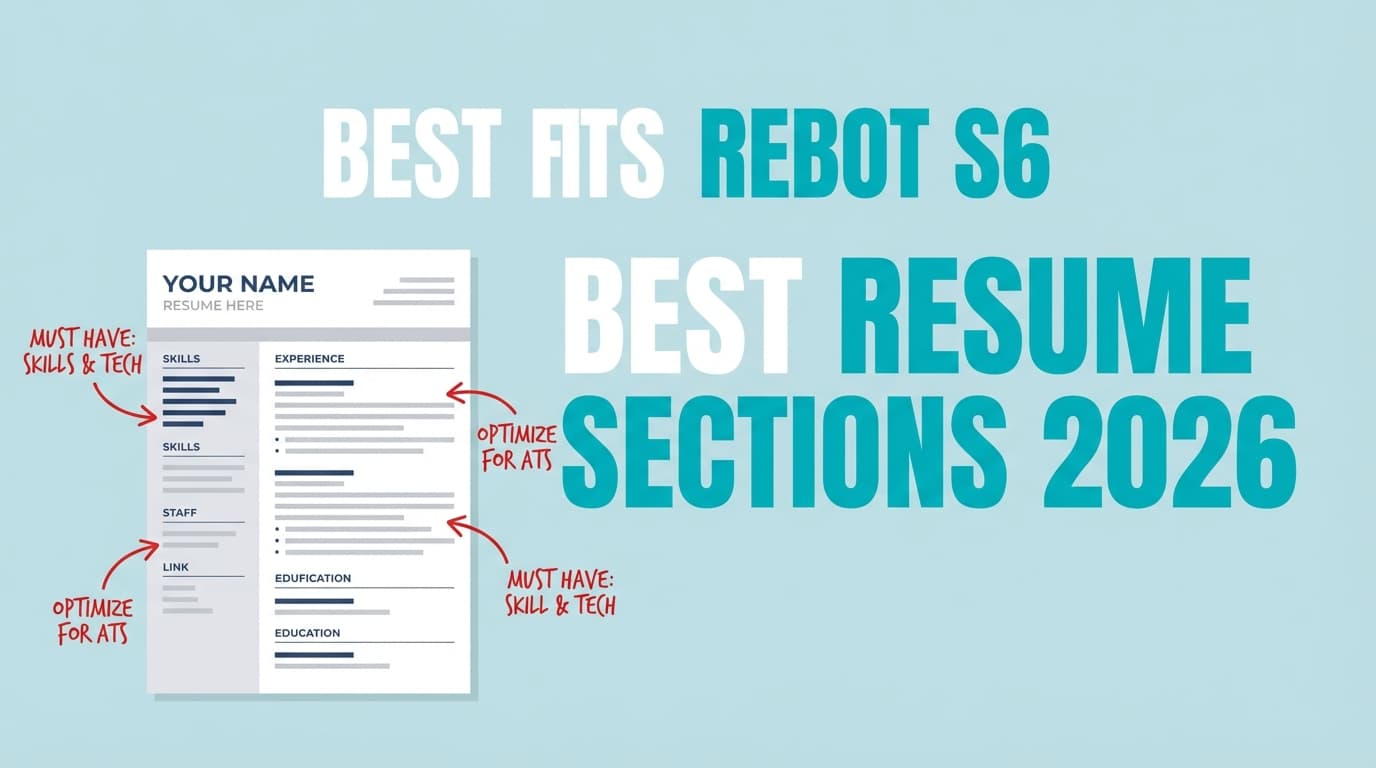
Layer 1: The 5 “must-have” resume sections (almost always)
- Contact Information
- Target Title / Headline (optional but recommended in 2026)
- Summary (or Objective in specific cases)
- Skills (or Core Competencies)
- Work Experience
- Education (yes, that’s 6—because it’s still expected in most fields)
Layer 2: Proof sections (add 1–3 of these if they strengthen your case)
- Projects
- Certifications / Licenses
- Portfolio / GitHub / Publications (role-dependent)
- Awards
- Volunteer Experience (if relevant)
- Leadership / Community / Speaking (if relevant)
Layer 3: Fit & differentiation sections (add only if they’re strategic)
- Professional Affiliations
- Languages
- Relevant Coursework (mostly students/entry-level)
- Interests (rarely; only when it adds signal)
Layer 4: Sections to avoid (or keep off most resumes)
- References
- Full mailing address (usually unnecessary)
- Photo / age / marital status (country-dependent; often discouraged)
- Generic “Responsibilities” blocks without impact
Harvard’s career guidance emphasizes keeping resumes professional and avoiding common pitfalls (like photos and other unnecessary personal details). (Confidence: High — credible career services source; Harvard Mignone Center)
https://careerservices.fas.harvard.edu/resources/create-a-strong-resume/
The best resume sections to include in 2026 (with examples + when to use each)
Below are the sections you’ll most often want in 2026—plus how to write them so they’re ATS-friendly and recruiter-friendly.
1) Contact Information (essential)
Purpose: Make it effortless to contact you and confirm your identity.
Include:
- Full name
- Phone
- City, State (or region)
- LinkedIn URL (customized if possible)
- Portfolio/GitHub (if relevant)
Avoid (in most cases):
- Full street address
- Multiple emails/phones
- Unprofessional email handles
2026 micro-optimization: Put your target job title near your name (as a headline) to improve scan clarity.
2) Target Title / Headline (strongly recommended)
Purpose: Tell the reader what role you’re going for in 2 seconds.
Examples:
- Data Analyst | SQL, Python, Tableau | Experimentation + Stakeholder Reporting
- Product Manager | B2B SaaS | Growth Experiments, Roadmapping, Cross-Functional Delivery
- Software Engineer | Backend | APIs, Microservices, AWS
ATS note: Headline text is easy to parse; just keep it plain text.
3) Summary (or Objective) — the “above the fold” section
Purpose: Give context and relevance fast—especially if you’re competing in a crowded market or pivoting roles.
When a summary helps most in 2026
- You have 2+ years of experience
- You’re applying in a high-volume ATS environment
- You’re pivoting and need to connect the dots quickly
When an objective can still work
- You’re a student / entry-level
- You’re making a major career change
- You need to clarify what you’re targeting (without making claims you can’t support yet)
Summary example (mid-level):
Data Analyst with 5+ years building executive dashboards and automating reporting workflows in SQL + Python. Known for translating messy business questions into measurable KPIs, improving data accuracy and reducing time-to-insight. Seeking analytics roles focused on experimentation, lifecycle, or product insights.
Summary example (engineering):
Backend Software Engineer with 6 years building APIs and data services in Python and Node.js. Shipped reliability improvements, reduced latency, and partnered with product teams to deliver customer-facing features. Looking for backend roles in high-scale SaaS.
Objective example (career changer):
Career switcher transitioning from operations to data analytics after completing projects in SQL, Python, and Tableau. Seeking an entry-level analyst role focused on reporting, KPI tracking, and business insights.
Best practice: Keep it 3–5 lines. If it runs longer, your experience section is probably doing the job the summary should do.
4) Skills (or Core Competencies) — essential in 2026
Purpose: Make keyword matching and role fit obvious.
2026 best practice: Use categorized skills, not a chaotic list.
Example (Data Analyst):
- Analytics: KPI design, cohort analysis, funnel analysis, A/B testing
- Tools: SQL, Python, Tableau, Looker, Excel
- Data: ETL basics, data validation, stakeholder reporting
Example (Software Engineer):
- Languages: TypeScript, Python, Java
- Backend: REST APIs, microservices, authentication, caching
- Cloud/DevOps: AWS, Docker, CI/CD
- Databases: Postgres, Redis
ATS tip: Use standard labels: Skills, Technical Skills, or Core Competencies. Multiple sources recommend standard section headings for ATS clarity. (Confidence: High — widespread best practice; example source: Jobscan ATS-friendly guidance in search results; also echoed across resume guidance sites)
5) Work Experience (essential)
Purpose: Prove you’ve done relevant work—and show outcomes, not just tasks.
The 2026 bullet formula
Use a simple structure:
- Action + what you did + tool/context + measurable result
Bad (task list):
- Responsible for monthly reporting
- Worked with stakeholders
Better (impact):
- Built monthly KPI dashboard in Tableau used by 6-person leadership team, reducing manual reporting time by 8 hours/month.
- Partnered with Sales Ops to define pipeline metrics and improve CRM data hygiene, increasing forecast accuracy.
Harvard’s resume guidance emphasizes clear, action-driven bullet points and strong verbs. (Confidence: High; source: Harvard Mignone Center)
https://careerservices.fas.harvard.edu/resources/create-a-strong-resume/
Work Experience formatting (ATS-safe)
For each role, aim for:
- Company | Location
- Title
- Dates (Month Year – Month Year)
- 3–6 bullets max (prioritize relevance)
Pro tip: If you’re applying broadly, build a “master resume” with everything, then trim per job.
6) Education (essential for most, but flexible order)
Purpose: Confirm baseline qualifications and signal relevant coursework or achievements when needed.
Include:
- Degree, major
- School
- Graduation date (or expected)
- Optional: honors, relevant coursework, GPA (only if helpful)
GPA in 2026: include it only when it helps
Career guidance varies, but a common rule is: include GPA if you’re a student/recent grad and it’s strong. Indeed suggests including it particularly if it’s high (often 3.5–4.0) for students/recent graduates. (Confidence: Medium — single mainstream career site; source: Indeed search result)
https://www.indeed.com/career-advice/resumes-cover-letters/gpa-on-resume
7) Projects (high-impact optional section)
Purpose: Show proof of skills—especially when:
- You’re early-career
- You’re pivoting
- Your best work isn’t obvious from your job titles
- You’re in technical roles (engineering, data, design, product)
Project entry example (data): Customer Churn Dashboard (SQL, Python, Tableau) | 2025
- Cleaned and joined subscription + usage datasets (SQL) and built churn cohorts by tenure and plan type
- Created Tableau dashboard with churn drivers and retention opportunities; shared weekly with GTM stakeholders
Project entry example (engineering): Payments Service Refactor (TypeScript, Postgres) | 2025
- Refactored payment reconciliation workflow into modular services, improving test coverage and reducing failure rate
- Added idempotency safeguards to prevent duplicate charges under retry conditions
Write project bullets like experience bullets. If the project doesn’t have outcomes, add:
- Users (even if it’s “internal team of 5”)
- Scale (“10k records/day”)
- Performance (“reduced load time”)
- Quality (“reduced errors”)
8) Certifications / Licenses (optional, but powerful when relevant)
Purpose: Provide third-party validation for regulated fields or tool-heavy roles.
Include:
- Certification name
- Issuer
- Date earned
- Expiration/valid-through date (if applicable)
- Credential ID (only if requested or relevant)
Indeed notes that if a certification expires, you should include the expiration/renewal date. (Confidence: Medium — single mainstream career site; source: Indeed)
https://www.indeed.com/career-advice/resumes-cover-letters/list-certifications-on-a-resume
Example:
- AWS Certified Solutions Architect – Associate (Amazon Web Services), 2025 — Expires 2028
- PMP (PMI), 2024 — Credential ID available upon request
9) Awards (optional)
Purpose: Add credibility quickly—especially when awards are selective or performance-based.
Examples:
- President’s Club (Top 5% of Sales), 2024
- Dean’s List (4 semesters), 2023–2025
- Internal “Impact Award” for cross-team delivery, 2025
Rule: If the award requires explanation, add one short line of context.
10) Volunteer Experience (optional, but can be a “proof section”)
Best for:
- Career changers
- Early career candidates
- Leadership/community-oriented roles
- Candidates with employment gaps who stayed active
Example: Volunteer Data Analyst | Nonprofit Name | 2025–Present
- Built donation reporting dashboard and streamlined monthly reconciliation process
- Partnered with program lead to define success metrics and reporting cadence
11) Publications / Patents / Research (role-dependent)
Best for: academia, research, ML, biotech, legal, technical writing.
ATS-friendly tip: Put this in a separate section with clear citations (title, venue, date, link/DOI).
12) Portfolio / Links section (optional but recommended in many roles)
Best for: design, engineering, data, marketing, writing.
Example:
- Portfolio: yoursite.com
- GitHub: github.com/yourname
- Case studies: yoursite.com/case-studies
Keep it clean: links are often skimmed fast.
13) Languages (optional)
Include if:
- The job requires it
- You can operate professionally in that language
Example:
- Spanish (Professional working proficiency)
- French (Conversational)
14) Interests (rarely; use only when strategic)
An interests section is polarizing—Reddit and recruiter communities often dismiss it unless it adds signal. (Confidence: Medium — mixed perspectives; sources include Resume Worded + recruiter discussions on Reddit in search results)
Use interests only if it:
- Supports role fit (e.g., “open-source contributor” for dev roles)
- Supports culture fit in a meaningful way (not filler)
- Creates a memorable “human” detail without risk
Good:
- Open-source contributions (tools you’ve contributed to)
- Public speaking / meetups in your field
- Competitive sports with leadership component (if relevant)
Risky/unhelpful:
- Generic hobbies (“reading,” “travel”)
- Anything political, polarizing, or too personal
The best resume section order in 2026 (templates you can copy)
There isn’t one perfect order—there’s the best order for your situation.
Template A: Mid-level / experienced (most common)
- Contact Info
- Headline
- Summary
- Skills
- Work Experience
- Education
- Projects (optional)
- Certifications (optional)
- Awards / Volunteer (optional)
Template B: Entry-level / student
- Contact Info
- Headline (optional)
- Summary or Objective
- Education
- Skills
- Projects
- Internship / Experience
- Awards / Leadership / Volunteer
- Certifications (if any)
Template C: Career changer (skills-forward but still credible)
- Contact Info
- Headline (new target role)
- Summary (bridge statement)
- Skills (categorized)
- Projects (bridge proof)
- Relevant Experience (even if not same industry)
- Education
- Certifications (if role-relevant)
Template D: Technical specialist (engineering/data)
- Contact Info (+ GitHub/Portfolio)
- Headline
- Summary (short)
- Skills (categorized)
- Experience
- Projects (selective, high-impact)
- Education
- Certifications (if relevant)
Why “Skills above Experience” sometimes works: It helps keyword scanning and role alignment—but only if your experience section backs it up with outcomes.
ATS-friendly resume sections: what makes a section “parse-safe”?
Even if an ATS can read your PDF, formatting choices can still scramble content.
ATS-safe section rules:
- Use standard headings (Skills, Work Experience, Education)
- Keep layout single-column
- Avoid tables/text boxes for important content
- Keep dates consistent (Month YYYY)
This aligns with ATS guidance commonly published by ATS-focused sites (e.g., Jobscan’s ATS-friendly template advice in search results) and echoed across career services pages. (Confidence: High — consistent best practice across many sources)
How to choose the “best resume sections” for your 2026 job search (a step-by-step framework)
Step 1: Identify your primary resume goal
Pick one:
- “I need more interviews for the same role”
- “I’m changing roles”
- “I’m early career and need proof”
- “I’m senior and need leadership impact”
Your goal determines your proof strategy (projects vs leadership vs metrics vs scope).
Step 2: Decide your “proof sections”
Choose 1–3 proof sections beyond experience:
- Projects
- Certifications
- Awards
- Volunteer leadership
- Publications
If you can’t pick any, it’s a signal your resume may be too responsibility-heavy and not achievement-focused.
Step 3: Build your “keyword surface area” without stuffing
In 2026, keyword matching still matters, but stuffing hurts readability.
Do this instead:
- Put core tools in Skills
- Mirror role language in Summary
- Prove it in Experience bullets
Step 4: Keep sections lean and relevant
If a section doesn’t make you more hireable for that role, cut it.
Common mistakes to avoid (that quietly kill your resume)
Mistake 1: Adding sections that don’t help you
Examples:
- “References”
- “Objective” that says what you want (not what you offer)
- “Responsibilities” without outcomes
Fix: Every section must answer: why should they interview you?
Mistake 2: Burying your best proof
If your strongest achievements are on page 2 or buried in old roles, most readers won’t see them.
Fix: Bring your most relevant proof higher—via Summary, Skills, and top bullets.
Mistake 3: Turning Skills into a junk drawer
A 40-skill list signals “I’m not sure what I do.”
Fix: Use categories, and only list skills you can discuss comfortably.
Mistake 4: Using inconsistent section headings
Creative headings can confuse ATS extraction.
Fix: Stick to standard labels unless you have a strategic reason not to.
Tools to help with resume sections in 2026 (without guessing)
You can do everything manually, but tools can speed up iteration and reduce blind spots.
JobShinobi (resume building + analysis + job matching)
JobShinobi is built for job seekers who are focused on ATS outcomes and tailoring:
- LaTeX-based resume builder with PDF preview/compilation inside the app (ATS-friendly structure when formatted cleanly)
- AI resume analysis with scoring and detailed feedback
- Job description extraction + resume-to-job matching to help identify keyword gaps and tailoring opportunities
It also includes a job application tracker, and JobShinobi Pro supports email-forwarding job tracking (you forward application emails to a unique address and it logs them). Important: email processing is Pro-gated. (Confidence: High — product constraints)
Pricing (be precise): JobShinobi Pro is $20/month or $199.99/year. The pricing page mentions a 7-day free trial, but trial enforcement is not clearly verified in code. (Confidence: High on pricing; Medium on trial language)
Links:
- Homepage: /
- Login: /login
- Subscription: /subscription
Other helpful tools (general)
- ATS checkers / resume scanners (use them as diagnostics, not as the goal)
- Grammar/style tools (to catch errors before you submit)
Best practice: Don’t chase a perfect “ATS score.” Use tools to find missing keywords and formatting issues, then optimize for clarity and proof.
Best practices checklist: the “2026-ready resume section” audit
Use this as a final review:
Structure & order
- My top third includes: headline + summary + skills (or the best equivalent for my situation)
- The most relevant proof appears on page 1
- Optional sections exist only if they strengthen my candidacy
Experience bullets
- Most bullets include outcomes (metrics or clear impact)
- Bullets start with strong verbs (built, led, improved, shipped, launched)
- I removed filler (“responsible for…”)
ATS & readability
- Standard headings (Skills, Work Experience, Education)
- Consistent date formatting
- No important content trapped in tables/text boxes
- Single-column layout
Key takeaways
- The best resume sections to include in 2026 are the ones that increase scan clarity and prove role fit quickly.
- Start with the essentials (Contact, Summary/Objective, Skills, Experience, Education), then add 1–3 proof sections (Projects, Certifications, Awards, Volunteer, Publications) based on your situation.
- In 2026, optimize for both ATS parsing and human skimming—the same section strategy supports both.
- Use tools to speed up iterations, but keep the resume’s job simple: make it obvious you can do the work.
FAQ (People Also Ask–style)
What should a resume look like in 2026?
A 2026 resume should be:
- Easy to skim (clear headings, strong “above the fold” content)
- ATS-parseable (standard section titles, simple layout)
- Achievement-focused (bullets show outcomes, not just tasks)
The “headline + summary + skills + experience” structure is the most reliable for most job seekers.
What are the 5 sections of a good resume?
A common “core five” are:
- Contact Information
- Summary (or Objective)
- Skills
- Work Experience
- Education
Many strong 2026 resumes add a sixth: Projects or Certifications, when relevant.
What order should resume sections be in?
It depends on your situation:
- Experienced: Summary → Skills → Experience → Education
- Student: Education → Skills → Projects → Experience
- Career change: Summary → Skills → Projects → Experience → Education
Choose the order that makes your strongest proof appear sooner.
Can ATS read columns or tables?
ATS capabilities vary, but many job seekers still experience parsing issues with complex layouts. The safest approach in 2026 is a single-column resume with standard headings and plain text formatting.
Should I include a hobbies/interests section on my resume in 2026?
Usually no—unless it supports your candidacy (role-relevant interests, open-source work, speaking, leadership). If it’s filler, it competes with more important proof sections.
How long should a resume be in 2026?
Most candidates should aim for one page early-career and one to two pages for experienced professionals—long enough to prove impact, short enough to skim fast. When in doubt, prioritize relevance and measurable outcomes over completeness.
Should I put my pronouns on my resume?
This is context-dependent (industry, region, personal preference). If you choose to include pronouns, keep it subtle (near your name/contact info). If you’re unsure, consider whether it helps you be addressed correctly and professionally without introducing risk in your target market.