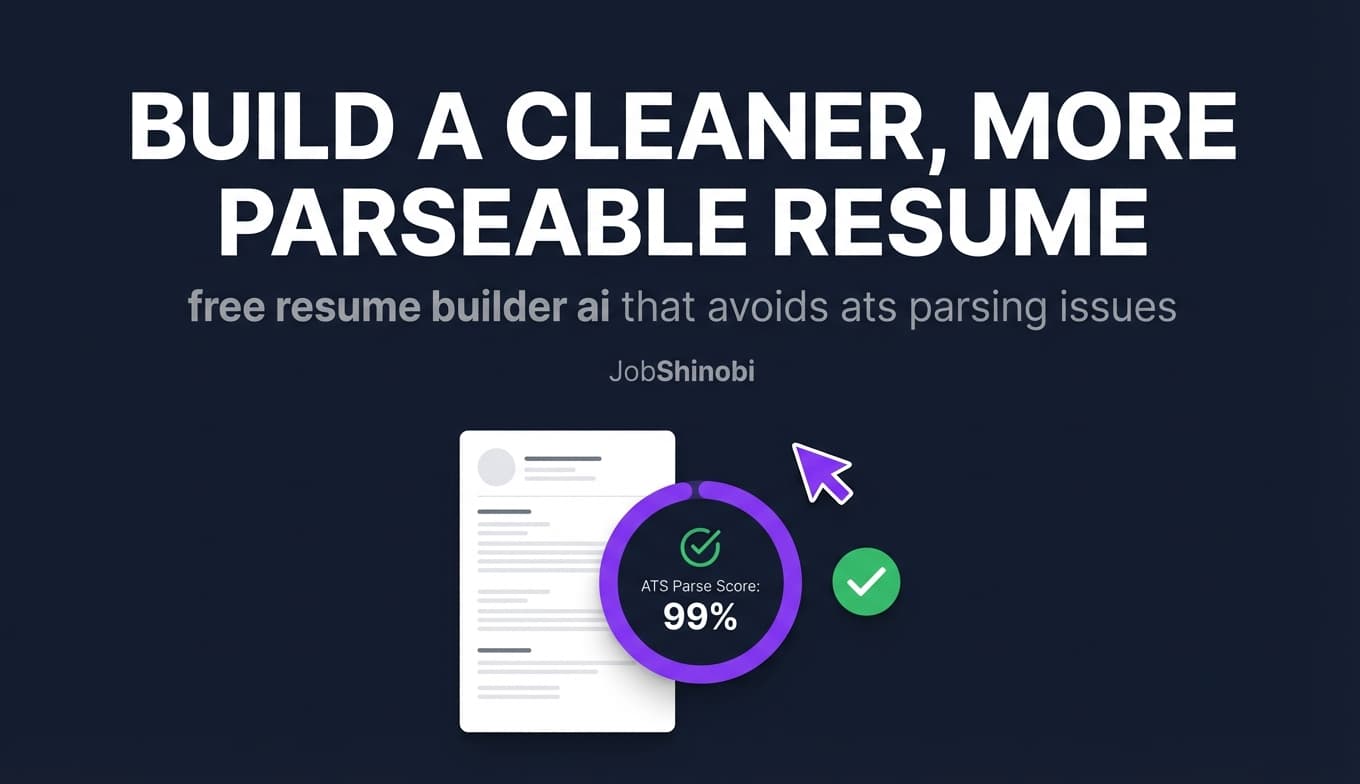
If you’re searching for a free resume builder AI that avoids ATS parsing issues, you’re probably dealing with one of two problems:
- Your resume looks great… but the ATS import scrambles your sections, dates, or bullet points.
- You’re stuck with “pretty” templates that use columns, tables, icons, headers/footers, and other formatting that ATS software can misread.
JobShinobi is built for this exact pain: a LaTeX-based resume builder (structure-first) plus AI Resume Analysis that can surface ATS issues and keyword gaps—and an AI editor that can help you fix them without breaking formatting.
Important note about “free”: JobShinobi is a paid subscription (Monthly $20, Yearly $199.99). This page is optimized for the “free” search because that’s how people look for solutions—but we won’t pretend we’re free.
CTA: Sign in to JobShinobi to start from a template and run your first analysis.
Why “ATS parsing issues” happen (and what to avoid)
Most ATS parsing problems come from layout choices that look fine to humans but can get flattened or mis-ordered when software extracts text. Common culprits include:
- Two-column layouts (content can be read in the wrong order)
- Tables and text boxes (text can get trapped or rearranged)
- Icons and graphics (ATS may ignore them or misread surrounding text)
- Headers/footers (some systems don’t read them reliably—especially for contact info)
- Inconsistent date formatting (can confuse timeline parsing)
- Non-standard section headings (ATS may mis-classify sections)
JobShinobi’s approach is simple:
use a structure-first resume workflow (LaTeX) + run AI checks that explicitly return ATS issues, so you can fix risks before you apply.
Why Choose JobShinobi for “ATS parsing issue” resume building?
Most “AI resume builders” optimize for speed and design. JobShinobi optimizes for parseability, repeatability, and tailoring:
- LaTeX-based Resume Builder: your resume is stored as
latex_source, giving you precise, consistent structure across edits. - Cloud LaTeX compilation + PDF preview: compile and preview as you edit, so you can catch layout problems early.
- AI Resume Analysis (Comprehensive + Enhanced modes): generates scores (including an ATS score) plus a structured list of ATS issues, strengths/weaknesses, and keyword analysis.
- Job Description extraction + match analysis: paste a job URL or job text, extract requirements/keywords, then get a match score with missing vs present keywords.
- AI Resume Editor (streaming): chat-based editing workflow that can update sections, update the whole resume, and even run LaTeX compilation checks as part of the process.
- Version history: resume changes are versioned so you can revert if an edit hurts formatting or clarity.
CTA: If you want to stop guessing, log in and run an analysis on your current resume.
Benefit 1: A structure-first resume workflow (LaTeX), not a fragile “pretty template”
If your current builder relies on columns, graphics, and design widgets, you can end up with:
- scrambled section order during ATS import
- missing bullets (or bullets collapsed into paragraphs)
- dates pulled into the wrong fields
- contact details that don’t map cleanly
JobShinobi resumes are built as LaTeX source with templates you can start from and then control precisely. This reduces the “mystery formatting” effect you get in many WYSIWYG editors.
Benefit 2: AI that flags ATS issues and keyword gaps—then helps you fix them
JobShinobi doesn’t just give you a score. The analysis includes structured fields like:
- ATS score
- ATS issues (explicit list)
- ATS analysis (structured analysis object)
- keyword analysis: present / missing / overused, plus keyword density and contextual usage score
- section scores, bullet analysis, length analysis, benchmarking, role alignment (depending on mode)
Then, you can use the AI Resume Editor to apply targeted changes while keeping your LaTeX valid and compilable.
Benefit 3: Tailor to a job without breaking formatting
Many job seekers fix parsing by “simplifying everything,” but then they lose relevance.
JobShinobi pairs structure + tailoring:
- Extract job requirements/keywords (from URL or pasted description)
- Run resume-to-job match analysis
- Apply suggestions in the editor—without switching tools or reformatting manually
How JobShinobi’s ATS-focused workflow works
Step 1: Start from a resume template (LaTeX)
Go to the Resume Builder area and choose Start from Template.
You’ll be able to:
- browse template cards (templates include categories)
- create a new resume from a selected template
- manage saved resumes (duplicate, delete, open editor)
Best practice for parsing: pick a clean, single-flow layout and avoid adding columns/tables/icons unless you’re confident the target ATS handles them.
Step 2: Edit in the LaTeX editor (manual or AI mode)
In the resume editor, you can work in:
- Code mode (direct LaTeX editing)
- AI mode (chat-based editing)
You can keep edits tight (one section) or do a larger restructure (entire resume). Either way, the goal is the same: maintain a consistent, parseable structure.
Step 3: Compile and preview the PDF as you go
JobShinobi compiles LaTeX using a compilation service and returns a PDF preview. You can catch issues like:
- overflowing margins
- spacing problems that hide content
- inconsistent headings
- broken bullets
You can also export:
- PDF download
- .tex download
Step 4: Run AI Resume Analysis (Comprehensive or Enhanced)
When you analyze, JobShinobi generates:
- overall score
- content / keyword / formatting / completeness scores
- ATS score
- detailed feedback (strengths, weaknesses, missing sections, keyword analysis, ATS issues)
- optional enhanced objects (like semantic keywords and action queue)
If your resume hasn’t changed since the last analysis, JobShinobi can return a cached analysis—useful when iterating.
Step 5: Match your resume to a specific job description
Paste a job description (or a URL) to extract structured job details, then run match analysis:
- match score
- missing keywords vs present keywords
- recommendations and tailored suggestions
This is where you stop optimizing for generic “ATS friendliness” and start optimizing for the job you actually want.
CTA: Sign in → pick a template → run analysis → paste a job description.
Key Features for avoiding ATS parsing issues
| Feature | What It Does | Why It Matters for ATS parsing issues |
|---|---|---|
LaTeX-based resume builder (latex_source) |
Creates and stores your resume as LaTeX | More control over structure than many drag-and-drop builders |
| Template library | Start from a database-backed LaTeX template catalog | Helps you begin with a consistent layout instead of improvising formatting |
| Cloud compilation + PDF preview | Compiles LaTeX and previews the resulting PDF | Lets you catch layout problems early, before you submit |
| AI Resume Analysis (Comprehensive + Enhanced) | Generates scores + detailed feedback including ATS issues | Surfaces formatting/ATS risks and keyword gaps systematically |
| Job extraction (URL or text) | Extracts job details and keywords from a posting | Turns “tailoring” into a repeatable workflow |
| Resume-to-job match analysis | Computes match score + missing/present keywords + suggestions | Helps you add relevant keywords without random stuffing |
| AI Resume Editor (streaming) | Chat that edits LaTeX with tool-based workflows + compilation checks | Helps you revise fast while keeping your resume valid |
| Resume version history | Saves versions tied to manual edits and chat edits | You can revert if an edit hurts structure or readability |
| Job Tracker + Excel export | Tracks applications; exports .xlsx |
Keeps job search organized once the resume is ready |
| Email forwarding → auto-tracking (Pro-gated backend) | Parse forwarded emails to update job tracker automatically | Reduces manual tracking work while you focus on interviews |
“free resume builder ai” vs. a tool that actually reduces ATS parsing risk
Many “free” resume builders work like this:
- pick a design-heavy template
- drag sections around
- download a PDF
- hope the ATS reads it
That’s how you end up with parsing issues that you only discover after uploading into an ATS portal.
JobShinobi is different in two key ways:
1) It’s built around structure (LaTeX) + verification (compile + preview)
Instead of guessing whether the layout survived, you iterate with:
- consistent source format (LaTeX)
- compilation/preview loop
- version history (so you can undo changes safely)
2) It provides ATS-focused analysis outputs (not just “write a summary”)
JobShinobi’s analysis is designed to return:
- ATS score
- ATS issues list
- keyword presence/missing/overuse
- section and bullet analysis data
This is especially useful if you’re applying at volume and need a repeatable checklist.
What JobShinobi can (and can’t) do for ATS parsing issues
What it can do
- Help you build a resume with consistent structure using a LaTeX-based workflow
- Let you preview the compiled PDF as you edit
- Run AI resume analysis that includes ATS-focused feedback (ATS score + ATS issues)
- Help you tailor to a job description with match scoring and keyword gap suggestions
- Provide AI chat editing that works directly on your resume’s LaTeX
What it doesn’t do (so you don’t buy the wrong thing)
- It does not perform image/PDF OCR parsing of resumes (no image-based parsing pipeline).
- It does not auto-apply to jobs or integrate with LinkedIn/Indeed job boards.
- It does not offer a verified “free tier” or verified “free trial” in the pricing logic we can confirm.
If you’re looking for a forever-free builder, JobShinobi won’t be the right fit.
If you’re looking to reduce ATS parsing surprises and iterate faster with analysis + editing, it’s built for that.
Practical checklist: reduce ATS parsing issues before you apply
Use this quick checklist when editing in JobShinobi:
Formatting & structure
- Use standard headings: Experience, Education, Skills, Projects
- Keep dates consistent (e.g.,
MM/YYYYthroughout) - Avoid placing critical info only in headers/footers
- Be cautious with multi-column layouts, tables, and icons
Content (avoid “keyword stuffing”)
- Add missing keywords only where they are true
- Prefer context-rich usage (tools + outcomes) over repeated keyword lists
- Keep bullets scannable: action verb → impact → scope
Verification loop (JobShinobi workflow)
- Edit LaTeX (manual or AI)
- Compile and preview PDF
- Run Resume Analysis
- Paste the job description and run match analysis
- Apply fixes and re-run analysis
JobShinobi vs. “just use Word + a template”
Word can work—especially if you use a simple one-column template and stay disciplined.
But many people still run into:
- formatting drift (one change breaks alignment elsewhere)
- inconsistent spacing across versions
- accidental columns/tables creeping in
- heavy time cost when tailoring across many jobs
JobShinobi is built to make this process more repeatable:
- Templates + LaTeX source keep structure consistent
- PDF preview shows you the exact export result
- AI analysis + match analysis create a repeatable checklist
- Version history makes iteration safer
CTA: If you’re tired of reformatting every time you tailor, try the JobShinobi workflow.
Bonus: Track applications without spreadsheets (optional, but powerful)
Even if your resume is perfect, you still lose opportunities when you don’t track:
- where you applied
- what version of the resume you used
- current status (applied/interview/offer/rejected)
- response rates over time
JobShinobi includes:
Job Tracker
- Track job applications in a dashboard
- Realtime updates via Supabase Realtime
- Export your applications to Excel (.xlsx)
Email forwarding → automatic tracking (Pro membership required for processing)
JobShinobi can process inbound job-related emails (like confirmations and updates) and attempt to associate them with applications via fuzzy matching—reducing manual entry.
You can still use the resume builder features independently, but if you’re applying at volume, the tracking automation becomes a major time saver.
Pricing
JobShinobi offers paid subscriptions via Stripe:
- Monthly: $20.00
- Yearly: $199.99
You can sign in and then choose a plan.
Note: the /subscription page contains a placeholder checkout link; pricing is defined via Stripe payment links for the Monthly/Yearly plans.
CTA: Sign in to JobShinobi to start building, analyzing, and tailoring.
Frequently Asked Questions
Is JobShinobi a free resume builder AI?
No. JobShinobi is a paid subscription product (Monthly $20, Yearly $199.99). This page targets the “free” query because many job seekers start there—but JobShinobi is positioned as a workflow to reduce ATS parsing risk through structure + analysis, not as a free tool.
Can JobShinobi guarantee my resume will pass ATS?
No tool can guarantee you’ll “pass ATS” across every employer system and workflow. JobShinobi helps you reduce avoidable parsing problems by using a structure-first LaTeX resume workflow and providing ATS-focused analysis outputs (ATS score + ATS issues), so you can iterate before applying.
Do ATS systems struggle with tables, icons, or columns?
Many ATS formatting guides recommend avoiding tables, icons/graphics, and multi-column layouts because they can cause text to be read out of order or skipped. If you choose to use them, you’re increasing the risk of parsing inconsistencies across different ATS vendors.
Can ATS parse a two-column resume?
Sometimes—sometimes not. It depends on the ATS, the file type, and how the document is structured. If your goal is to minimize parsing surprises, a single-flow layout is typically safer. In JobShinobi, you can keep structure consistent and validate your export through the compile + preview loop.
PDF vs DOCX: which is better for ATS?
It varies by employer and ATS. Some workflows prefer DOCX, while many modern systems can parse text-based PDFs. The bigger risk factor is often layout complexity (tables, columns, headers/footers) rather than file type alone. JobShinobi outputs a PDF via LaTeX compilation and lets you iterate on structure to keep it clean.
Does JobShinobi parse my existing PDF resume?
JobShinobi’s resume workflow is LaTeX-based and does not include an image/PDF OCR pipeline. The supported workflow is: start from a template or edit LaTeX directly, then compile and analyze.
How does JobShinobi tailor my resume to a job description?
You can paste a job URL or job description text. JobShinobi can extract job details and run a resume-to-job match analysis that returns a match score, missing keywords vs present keywords, and recommendations—then you can apply changes in the editor.
Can I track job applications in JobShinobi too?
Yes. JobShinobi includes a job application tracker with realtime updates and Excel (.xlsx) export. There’s also an email-forwarding workflow that can process inbound job emails to update applications (processing is gated to Pro membership in the backend).
Get Started with JobShinobi Today
If you’re searching for a “free resume builder AI that avoids ATS parsing issues,” you’re already thinking about the right problem: parseability matters. The fastest way to stop guessing is to use a workflow built for structure + verification:
- Start from a LaTeX template
- Edit (manual or AI)
- Compile + preview
- Run ATS-focused analysis
- Match to a job description and tailor confidently
Start here: Log in to JobShinobi