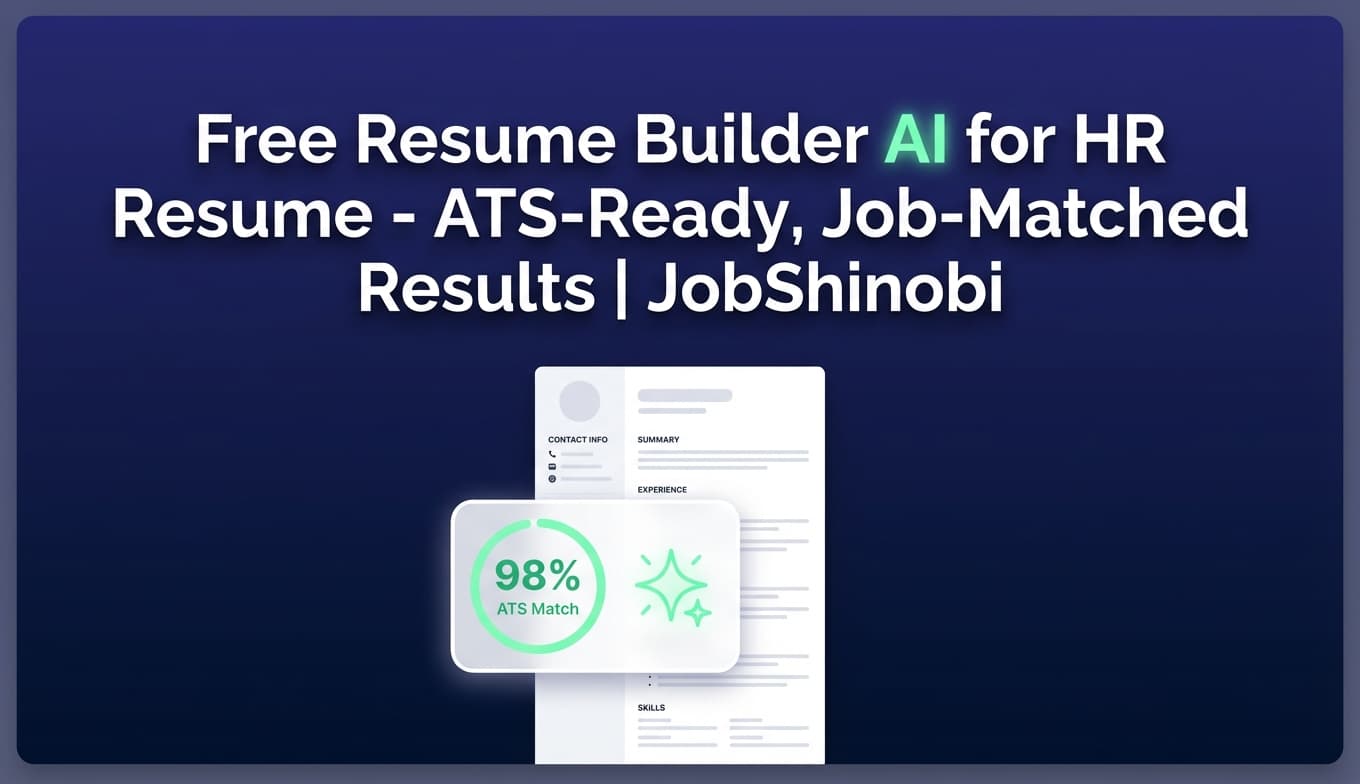
If you searched “free resume builder AI for HR resume”, your intent is clear: you want HR-specific wording, ATS-safe formatting, and a faster way to tailor your resume to each HR role (HR Generalist, HRBP, Recruiter, Talent Acquisition, People Ops, HR Manager).
JobShinobi is a paid product (Monthly $20 / Yearly $199.99)—and it’s built for exactly this high-intent use case: an ATS-focused, LaTeX-based resume builder with AI resume analysis, job-description matching, and a streaming AI editor that can help you iterate quickly while keeping formatting stable.
Primary outcomes for HR candidates:
- Generate an ATS-friendly PDF from a structured LaTeX resume (and download the
.texsource) - Run resume scoring + keyword feedback (with cached results when your resume hasn’t changed)
- Paste a job description (or job URL), extract job details, and run a match analysis to identify missing keywords
- Keep multiple tailored versions with resume version history and easy revert workflows
- Track applications in a Job Tracker (with realtime updates and Excel export)
CTA: Create your HR resume in JobShinobi →
Why Choose JobShinobi for an HR Resume (Even If You’re Comparing “Free” Tools)?
A lot of “free” resume builders are free only at the start—then you hit a paywall at download, keyword matching, or tailoring. JobShinobi takes a different approach: it’s a paid tool that focuses on stable formatting, repeatable tailoring, and workflow speed—especially when you’re applying to multiple HR roles.
Where JobShinobi is especially strong for HR job seekers:
1) ATS-focused resume structure (LaTeX-based, PDF preview)
JobShinobi’s resume builder is LaTeX-based. That matters because LaTeX resumes are typically consistent, structured, and predictable—which helps when you’re tailoring content often and don’t want formatting to break.
Inside the resume editor you can:
- Start from a template (template library exists, with categories)
- Edit either in AI mode or code mode
- Compile to PDF for a live preview (cloud compilation)
- Download:
- PDF (
resume.pdf) - LaTeX source (
resume.tex)
- PDF (
This makes JobShinobi especially useful if you want a resume that stays clean while you iterate across roles like:
- HR Generalist
- HR Business Partner (HRBP)
- Talent Acquisition / Recruiter
- People Operations
- HR Manager / HR Director (depending on your scope)
2) Resume scoring + ATS/keyword feedback you can act on
JobShinobi includes an AI resume analysis workflow that stores results (and can return cached results if your resume hasn’t changed).
You get structured scoring data including:
overall_scorecontent_scorekeyword_scoreformatting_scorecompleteness_scoreats_score
And detailed feedback such as:
- strengths and weaknesses
- missing sections
- keyword analysis (present/missing/overused, plus keyword density and contextual usage signals)
- ATS issues
For HR candidates, this is particularly helpful because HR job descriptions often contain:
- compliance language (employment law, policy, investigations)
- people-program language (engagement, performance management, L&D)
- systems language (HRIS, ATS, onboarding workflows)
- measurable outputs (time-to-fill, retention, program adoption, audit outcomes)
3) Job-description matching (job extraction + match score + missing keywords)
JobShinobi supports a job-tailoring workflow where you can:
- Provide a job URL or job description text
- Extract structured job details (company, position, requirements, keywords)
- Run a resume-to-job matching analysis that produces:
- a match score
- missing vs present keywords (based on your resume content)
- recommendations and tailored suggestions (what to add/remove/reorder)
This is exactly the “tailor my HR resume to this posting” workflow most job seekers want—without juggling spreadsheets, multiple docs, and manual keyword checks.
4) A streaming AI resume editor that edits your resume (and checks LaTeX compilation)
JobShinobi includes a streaming Resume AI editor that can:
- read your latest resume version
- propose and apply edits to specific sections
- update your resume content
- run a LaTeX compilation check as part of the workflow
This is built for iteration: “Rewrite these HR bullets,” “Add missing keywords naturally,” “Improve impact,” “Make this summary match an HRBP role,” etc.
5) Version history for “tailored resumes per job”
If you’re applying to multiple HR roles, you’ll create multiple “flavors”:
- HR Generalist version
- HRBP version
- TA/Recruiter version
- People Ops / Programs version
JobShinobi stores resume versions (resume_versions) and supports revert-style workflows, making it easier to keep tailored versions without losing your baseline.
6) Job tracking that doesn’t live in a messy spreadsheet
JobShinobi also includes a Job Tracker:
- CRUD job applications in a dashboard table
- realtime updates (Supabase Realtime)
- export your job tracker to Excel
.xlsx
And if you’re a Pro member, there’s an additional workflow that can process forwarded job-related emails to create/update job applications automatically (details below).
How JobShinobi Works (Real Product Flow)
Step 1: Start from a resume template (or open a saved resume)
Go to the Resume Builder area and either:
- Choose Start from Template
- Or open a resume from My Resumes
Each resume is stored with a latex_source and a selected template name (e.g., modern template is used as a default fallback).
Tip for HR resumes: pick a clean, conventional layout first—then tailor content for each job.
Internal link: /dashboard/resume
Step 2: Edit in AI mode (or code mode) without breaking formatting
In the resume editor, you can switch between:
- AI mode (chat-based workflow)
- Code mode (manual LaTeX editing)
You can save changes to your resume (creating versions), keeping iteration organized.
Step 3: Compile and preview your resume as a PDF
Click compile to generate a PDF preview using the connected LaTeX compilation workflow.
This helps HR candidates because you can quickly sanity-check:
- clean section hierarchy
- bullet formatting
- consistent spacing
- readability (HR recruiters and hiring managers still care about clarity)
Step 4: Run resume analysis (scores + keyword feedback)
When you run analysis, JobShinobi generates structured scoring and feedback and stores it. If your resume hasn’t changed since last analysis, the system can return cached results to save time.
Use this to:
- identify missing sections (common in HR: certifications, HRIS tools, ER scope, metrics)
- catch formatting or ATS issues
- improve keyword coverage without keyword stuffing
Step 5: Tailor to a job description (extract → match → apply suggestions)
Paste a job description or a job URL and run:
- job extraction (structured job details)
- resume match analysis (match score, missing/present keywords, recommendations)
Then use the AI editor to implement the highest-impact changes.
Step 6 (Optional, Pro): Forward job emails to auto-update your job tracker
If you’re a Pro member, JobShinobi can process inbound job-related emails (e.g., application confirmations, interview invites) and:
- extract job title, company, status, and other details
- create new applications or update existing ones using fuzzy matching
- reflect changes in your tracker
This is especially valuable if you’re applying at volume and want to reduce manual tracking.
Internal link: /dashboard/job-tracker
Key Features for an HR Resume (JobShinobi Feature Map)
| Feature | What It Does | Why It Matters for HR Candidates |
|---|---|---|
| LaTeX-based resume builder | Create resumes from templates with latex_source and stable structure |
HR resumes often get edited repeatedly; stable formatting prevents “resume drift” |
| PDF preview via LaTeX compilation | Compile LaTeX into a PDF preview | Lets you verify layout and readability before submitting |
Download PDF + .tex |
Export your resume as PDF and LaTeX source | PDF for applying; .tex for portability/versioning |
| Resume analysis + scoring | Produces ATS/content/keyword/formatting/completeness scores | Helps you identify gaps HR roles are picky about (scope, systems, metrics) |
| Keyword analysis (present/missing/overused) | Finds keyword gaps against job descriptions | HR postings are keyword-heavy (ER, HRIS, compliance, TA, L&D) |
| Enhanced analysis mode | Deeper analysis objects (semantic keywords, impact analysis, action queue, etc.) | Helps turn feedback into a prioritized HR resume improvement plan |
| Job extraction (URL or text) | Extracts job details/requirements/keywords | Speeds up tailoring to each HR posting |
| Job match analysis | Match score + missing/present keywords + suggestions | Creates a repeatable “tailor this HR resume” workflow |
| Streaming AI resume editor | Chat that can edit resume sections and check LaTeX compilation | Faster iteration without manual rewriting for every bullet |
| Resume version history | Stores versions (resume_versions) |
Keep a baseline and multiple tailored HR versions safely |
| Job Tracker + realtime updates | Track applications with live updates | HR job searches are multi-stage; keep statuses accurate |
| Export Job Tracker to Excel | Export applications to .xlsx | Keep your own system or share a tracker with mentors/coaches |
| Email forwarding ingestion (Pro) | Process forwarded job emails to update tracker | Reduces manual tracking when you apply frequently |
The HR Resume Playbook (What to Put on Your Resume + How JobShinobi Helps)
A strong HR resume is not just “HR tasks.” It’s proof that you can run people systems and programs with measurable outcomes, clear scope, and strong stakeholder alignment.
Below is a practical HR resume framework you can use directly inside JobShinobi (summary → skills → experience bullets), plus exactly how to tailor it using the product.
HR Resume Summary: Patterns That Work (And How to Tailor)
Your summary should do three things in 3–5 lines:
- Anchor your HR lane (Generalist / HRBP / TA / People Ops)
- Define scope (employee population, regions, business units, leadership partnership)
- Prove outcomes (metrics, efficiency gains, cycle-time reductions, retention improvements)
HR Generalist summary example (editable)
HR Generalist with experience supporting employee relations, onboarding, performance management, and policy administration across fast-paced teams. Partnered with managers on day-to-day HR operations, improved onboarding completion and manager enablement, and supported compliance-ready documentation and process improvements.
HRBP summary example (editable)
HR Business Partner with experience supporting managers on org design, performance cycles, employee relations, and talent development. Known for translating business priorities into scalable people programs and improving manager effectiveness through clear frameworks, coaching, and data-informed recommendations.
Talent Acquisition summary example (editable)
Talent Acquisition professional with experience managing full-cycle recruiting across multiple roles and stakeholders. Skilled in intake meetings, sourcing strategy, structured interviews, and offer coordination, with a focus on improving candidate experience and reducing time-to-fill through process optimization.
How JobShinobi helps here: Use the AI editor to rewrite your summary to align with a specific posting, then re-run match analysis to verify keyword alignment.
HR Skills Section: What ATS Usually Looks For (Categories + Examples)
ATS parsing is often literal. HR resumes commonly perform better when skills are grouped into clean categories.
Category 1: Core HR Operations & Programs
Use the terms from the job description when they’re true for you. Common examples include:
- Employee Relations (ER)
- Performance Management
- Onboarding & Offboarding
- Employee Engagement
- Policy Development
- HR Compliance
- Investigations (only if you’ve done them)
- Benefits Administration (scope varies by company)
- Leave of Absence (LOA)
- Workforce Planning
- Compensation Support (if relevant)
- Training & Development / L&D support
Category 2: Recruiting / Talent Acquisition (if relevant)
- Full-cycle recruiting
- Interview scheduling / coordination
- Hiring manager partnership
- Candidate experience
- Sourcing (if relevant)
- Offer process / offer coordination
- Employer branding (if relevant)
Category 3: HRIS / Tools (only list what you actually used)
JobShinobi doesn’t enforce tool lists, but your resume should be honest and job-aligned. HR job descriptions often mention:
- HRIS
- ATS
- Payroll systems
- Case management tools
- Ticketing systems (sometimes)
Category 4: Business & Stakeholder Skills
- Manager coaching
- Change management support
- Cross-functional partnership
- Confidentiality & discretion
- Conflict resolution
- Process improvement
How JobShinobi helps here: The match analysis will show missing keywords; you can then decide whether to incorporate them (truthfully) into skills or experience bullets.
HR Experience Bullets: High-Impact Templates You Can Customize
Most HR resumes fail because bullets are vague: “Supported HR operations.” Better bullets include:
- what you owned
- scale/scope
- the system/process used
- measurable outcomes (when available)
Below are bullet templates you can adapt. Replace bracketed fields with your data.
Employee Relations / ER bullets
- Partnered with managers to resolve employee relations issues, documenting outcomes and ensuring alignment with internal policies and applicable procedures.
- Supported ER case intake and documentation, maintaining confidential records and timely follow-up across stakeholders.
Onboarding / Offboarding bullets
- Coordinated onboarding workflows across HR, IT, and hiring managers, improving new hire readiness and first-week completion of required steps.
- Standardized onboarding documentation and checklists to reduce delays and ensure consistent employee experience across teams.
Performance management bullets
- Supported performance cycle administration (timelines, documentation, manager enablement), improving completion rates and reducing process friction.
- Created manager-facing guidance for goal setting and performance documentation, increasing consistency across teams.
Recruiting / TA bullets
- Managed end-to-end recruiting workflow for [role types], coordinating intake meetings, interview scheduling, and candidate communication.
- Improved recruiting process efficiency by creating standardized templates and structured interview steps, reducing back-and-forth and improving candidate experience.
HR programs / engagement bullets
- Supported employee engagement initiatives by coordinating communications, tracking participation, and consolidating feedback into actionable insights.
- Assisted with program execution and stakeholder updates, ensuring timelines and employee communications stayed on track.
Compliance / policy bullets
- Maintained compliance-ready HR documentation and supported policy updates, partnering with stakeholders to ensure clear rollout and employee understanding.
- Supported audits or documentation requests by organizing records, confirming completeness, and preparing materials for review.
How JobShinobi helps here: Use the streaming AI editor to (a) rewrite bullets to match the job description keywords, then (b) compile and preview the PDF so formatting remains consistent.
HR Resume Formatting: “ATS-Friendly” Without Losing Readability
Most ATS-friendly formatting advice is simple:
- Use standard headings (Summary, Experience, Education, Skills)
- Keep layout consistent
- Avoid overly complex visual elements
- Ensure text is selectable and structured
JobShinobi’s LaTeX approach is built for structure. You’re editing a structured document, compiling to a clean PDF preview, and maintaining consistent formatting across versions.
Suggested HR resume section order (common winning structure)
- Summary
- Skills (grouped categories)
- Experience
- Education
- Certifications (if applicable)
- Tools / Systems (if not in Skills)
- Additional (volunteer work, languages, etc.)
Tip: If your HR experience is broad, grouping skills and clarifying scope in the summary can reduce “HR generalist but unclear” confusion.
HR Resume Tailoring: Step-by-Step (JobShinobi Workflow)
This is a practical, repeatable workflow you can use for each HR application.
Step 1: Choose your baseline resume version
Pick your strongest general HR version first. If you’re applying to HRBP roles, start from your HRBP baseline; if applying to TA roles, start from TA baseline.
Step 2: Add the job description (or URL)
Use the job extraction input:
- paste job description text, or
- provide a job URL
JobShinobi can extract structured job details from your input.
Step 3: Run match analysis
The match workflow produces:
- match score
- missing keywords and present keywords
- recommendations and tailored suggestions (including possible reorders)
Step 4: Update resume content with the AI editor
Use AI editing to implement changes like:
- rewrite summary to reflect the role
- add missing keywords in context (not as a keyword dump)
- adjust bullets to reflect scope (employee count, regions, teams supported)
- tighten language to outcomes and measurable impact
Step 5: Compile + preview PDF, then download
Compile to preview. Download the PDF when ready.
Step 6: Save a version for that job
Save as a new version so you can revert later.
This makes it easy to maintain:
- Baseline HR resume
- HRBP-tailored resume
- TA-tailored resume
- People Ops / Programs-tailored resume
HR Resume Examples: What to Emphasize by Role
Below are quick “emphasis maps” you can use to tailor for different HR job families. Use them as a checklist when you run match analysis and apply edits.
HR Generalist
Emphasize:
- day-to-day HR operations
- onboarding/offboarding
- basic ER support
- policy/process support
- coordination and stakeholder follow-through
Common keywords you may see (varies by posting):
- onboarding, employee relations, policy, performance management, HR operations, compliance, HRIS
HR Business Partner (HRBP)
Emphasize:
- manager coaching
- org change support
- performance cycles
- ER ownership (if applicable)
- partnership with leadership
- translating business needs into people solutions
Common keywords:
- business partnership, org design, workforce planning, performance management, change management, stakeholder management
Talent Acquisition / Recruiter
Emphasize:
- full-cycle recruiting workflow
- intake meetings, sourcing strategy (if you do it)
- interview process, coordination, candidate experience
- hiring manager partnership
- funnel movement improvements (if measurable)
Common keywords:
- full-cycle recruiting, sourcing, pipeline, candidate experience, structured interviewing, time-to-fill
People Operations / HR Programs
Emphasize:
- programs and processes (engagement, onboarding improvements, performance programs)
- process design and documentation
- cross-functional collaboration
- metrics and continuous improvement
Common keywords:
- process improvement, HR programs, employee experience, engagement, onboarding, documentation
How JobShinobi helps here: Match analysis surfaces which of these role-specific keywords are missing from your resume (based on the job description you provide), so you can tailor deliberately.
Job Tracker: A Practical Advantage Most Resume Builders Don’t Offer
Many tools stop at “build a resume.” JobShinobi also supports the operational reality: applying, following up, tracking interviews, and keeping status changes organized.
What the Job Tracker supports
- Track applications in a dashboard UI
- Status management (e.g., Applied, Interview, Offer, Rejected)
- Realtime updates (so changes appear immediately)
- Export your applications to Excel
.xlsx
Internal link: /dashboard/job-tracker
Pro automation: Email forwarding → automatic updates
If you’re a Pro member, JobShinobi can process forwarded emails and attempt to:
- extract job title/company/status/location/salary/job URL when present
- update an existing application using fuzzy matching (company/title similarity)
- log processed emails
This reduces manual entry when you’re getting lots of confirmations and interview emails.
“Free Resume Builder AI for HR Resume” vs. JobShinobi (Honest Comparison)
You searched a “free” keyword—so here’s the straightforward breakdown.
Many “free” resume builders
Often:
- let you create a resume for free
- but charge when you want to download or export
- may prioritize design over stable structure
- may not give you repeatable job-specific tailoring workflows
Many ATS checkers
Often:
- provide a score
- but don’t give you a stable editing environment to implement changes cleanly
- don’t preserve multiple tailored versions
JobShinobi
Designed for:
- stable structure (LaTeX-based workflow)
- analysis + match + editor loop (a real tailoring workflow)
- version history for multiple applications
- job tracking + Excel export
Important: JobShinobi is not advertised here as a free tool. It offers paid subscriptions (see pricing below).
Pricing
JobShinobi offers paid subscriptions via Stripe payment links:
- Monthly: $20.00
- Yearly: $199.99
If you’re applying to HR roles at volume, the fastest way to evaluate fit is to build your baseline resume, run analysis, and test a job match workflow on a real posting.
CTA: Start JobShinobi →
Frequently Asked Questions
Is JobShinobi a free resume builder AI for HR resumes?
No. JobShinobi is a paid product with subscriptions:
- $20/month or $199.99/year.
If you searched “free resume builder AI for HR resume,” JobShinobi is best viewed as a premium alternative focused on stable formatting (LaTeX), AI analysis, job matching, and versioned tailoring workflows.
Can JobShinobi help me tailor my HR resume to a specific job description?
Yes. JobShinobi supports:
- job detail extraction from a job URL or pasted text
- resume-to-job matching with a match score
- missing/present keyword identification
- tailored recommendations you can implement in the editor
Does JobShinobi provide an ATS score for my resume?
Yes. Resume analysis generates multiple scores including an ats_score and provides structured feedback such as keyword analysis and ATS issues.
What file formats can I export?
From the resume editor you can download:
- LaTeX (.tex)
From the job tracker you can export:
- Excel (.xlsx)
Does JobShinobi export to Word (.docx)?
No export to Word is supported in the verified product functionality. Resume export is PDF and .tex.
Does JobShinobi integrate with LinkedIn or auto-apply to jobs?
No. There’s no verified LinkedIn/Indeed “auto-apply” or job board integration. JobShinobi focuses on resume building, analysis, matching, and job tracking.
Can I track my HR applications in JobShinobi?
Yes. The Job Tracker supports tracking job applications in a dashboard table, realtime updates, and exporting to Excel.
How does the email forwarding job tracking work?
JobShinobi supports inbound email processing that can extract job application details from forwarded emails and update your tracker. This workflow is gated to Pro membership in the verified implementation.
Will JobShinobi keep multiple tailored HR resume versions?
Yes. JobShinobi stores resume versions (resume_versions) and supports workflows that allow you to maintain and revert between versions—useful when tailoring for multiple HR roles.
What’s the best way to use JobShinobi for HRBP vs HR Generalist roles?
Create a baseline resume, then for each target role:
- paste the job description
- run job extraction + match analysis
- implement changes via AI editor (summary + top bullets first)
- compile preview PDF
- save a version for that role
Does JobShinobi have a 7-day free trial?
A “7-day free trial” is not verified as implemented in backend logic. This page does not claim a guaranteed trial. The verified pricing model is paid subscriptions ($20 monthly / $199.99 yearly).
Get Started with JobShinobi Today
Build an HR resume that’s designed for iteration: template → tailor → analyze → match → refine → export, without losing structure each time you edit.
- Start from a LaTeX template
- Run resume analysis and keyword feedback
- Match to a job description and close keyword gaps
- Keep tailored versions organized
- Track applications and export to Excel