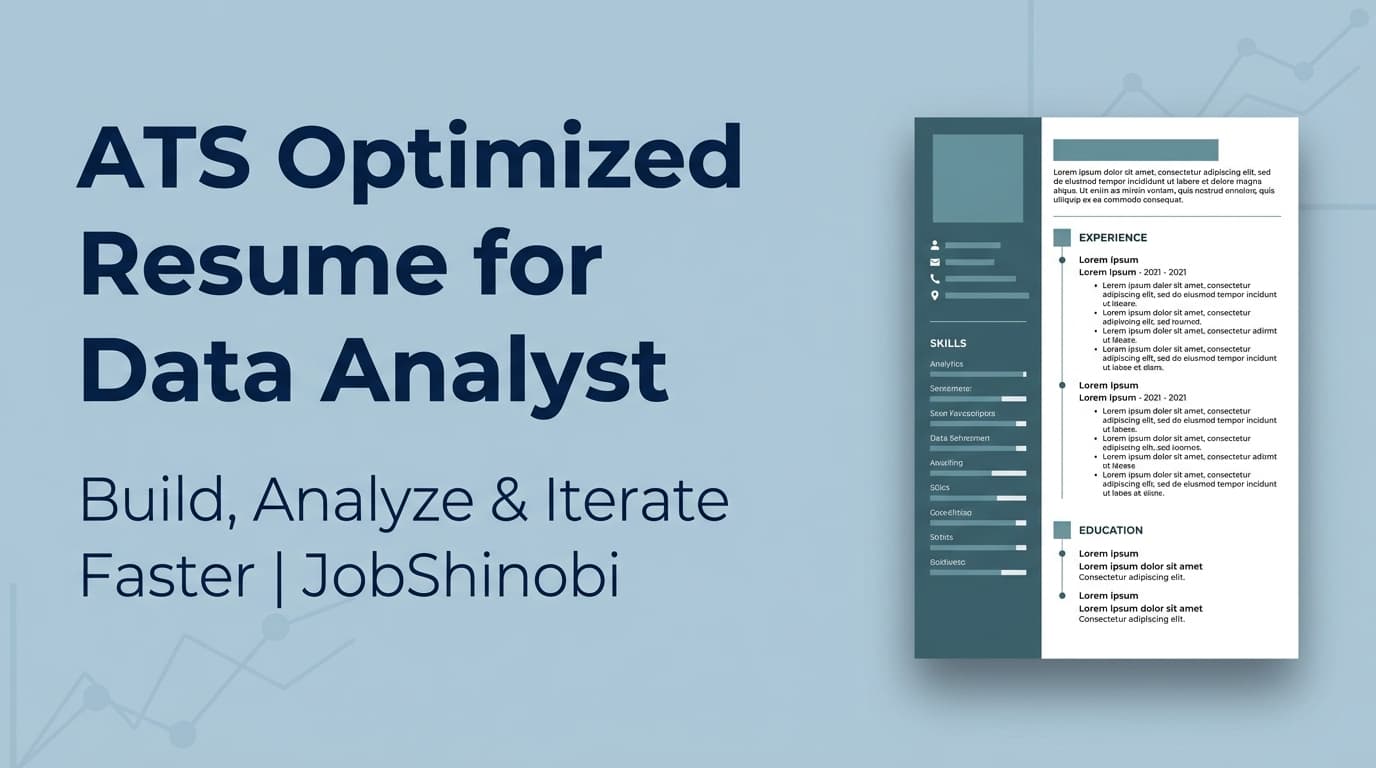
JobShinobi helps you create an ATS optimized resume for data analyst roles using a LaTeX-based resume builder (for consistent structure) plus an ATS-style resume analysis flow where you paste a job description and review match feedback. When you’re applying to multiple roles, you can also track applications by forwarding job-related emails into your JobShinobi job tracker—so your resume iteration and your application tracking stay connected.
Why Choose JobShinobi for an ATS Optimized Data Analyst Resume?
Most “ATS resume” advice stops at formatting rules and generic keyword lists. JobShinobi is built for the real workflow of a high-volume applicant:
- Build a clean, consistent resume structure (LaTeX).
- Analyze your resume against a specific job description.
- Iterate quickly with AI assistance (resume chat).
- Track applications automatically by forwarding emails—then export your job tracker to Excel when you need a clear view of your pipeline.
Instead of guessing whether your resume matches a Data Analyst role, you use a repeatable loop: build → analyze → revise → apply → track.
Purpose-built for tailoring (not just “one perfect resume”)
Data Analyst job descriptions often differ wildly (BI vs. product analytics vs. ops analytics). JobShinobi’s resume analysis experience is designed around that reality: you bring the job description, then evaluate and revise.
Keep your applications organized without spreadsheets
If your inbox is full of “Thanks for applying” and interview scheduling threads, JobShinobi can log job application activity by parsing forwarded emails into your job tracker, with realtime updates and Excel (.xlsx) export when you need reporting.
What “ATS Optimized” Means for Data Analysts (Practical, Not Hype)
An ATS optimized resume for data analyst roles usually comes down to two things:
- Parsable structure: simple, single-column layout; clear section headings; minimal formatting that can scramble text extraction.
- Role-relevant language: skills, tools, and methods that mirror the job description—used naturally in your summary, bullets, and skills.
JobShinobi supports both sides of that equation:
- Structure via a LaTeX-based resume builder (predictable formatting and layout control).
- Relevance via an analyze flow where you compare your resume to a job description and iterate.
How JobShinobi Works (Resume → Analysis → Applications)
Step 1: Build your Data Analyst resume in the LaTeX resume builder
Create or refine a resume with a clean structure that’s easy to keep consistent across versions—especially helpful when you’re tailoring for multiple openings.
Recommended Data Analyst sections (ATS-friendly):
- Professional Summary
- Skills
- Experience
- Projects (optional but powerful for entry-level and career switchers)
- Education
- Certifications (if relevant)
Tip: If you’re applying broadly, create a strong “base” resume first—then tailor per job description using the analysis workflow.
Step 2: Paste the job description and run the resume analysis
In JobShinobi’s resume analysis experience, you:
- Paste the job description
- Review your match analysis (what’s present, what’s missing, and what to improve)
- Iterate your resume content (summary, skills, bullets) to better align with the role
This is where “ATS optimized” becomes specific: not “add more keywords,” but “add the right skills and evidence for this Data Analyst role.”
Step 3: Iterate with AI assistance (resume chat)
When you’re rewriting bullets or tuning your summary, JobShinobi includes an AI-powered resume chat (streaming) to help you iterate faster—especially useful for:
- Turning responsibilities into outcome-focused bullets
- Tightening language while keeping it ATS-parsable
- Drafting alternative versions of a bullet tailored to the job’s priorities
Step 4: Track applications by forwarding emails
After you apply, you can forward application-related emails (confirmations, interview scheduling, updates). JobShinobi parses these inbound emails and upserts the right job tracking records, keeping your pipeline current without manual entry.
Step 5: Monitor changes in realtime and export to Excel
Your job tracker updates in realtime as new items are added/updated, and you can export your tracker to Excel (.xlsx) for:
- weekly review
- response-rate tracking
- sharing with a mentor/career coach
- personal reporting
Key Features for an ATS Optimized Resume for Data Analyst Roles
| Feature | What It Does | Why It Matters for Data Analysts |
|---|---|---|
| LaTeX Resume Builder | Create a consistent, clean resume structure | Helps keep formatting predictable while you tailor content across roles |
| Job Description Input + Match Analysis | Compare your resume against a specific JD | Tailoring beats generic keyword lists—especially across BI/product/ops analyst variants |
| Resume AI Chat (Streaming) | Iterate bullets/summary faster with AI assistance | Helps rewrite content quickly when applying to multiple roles |
| Email-forwarding Application Tracking | Parses forwarded emails and logs job activity | Reduces spreadsheet fatigue and missed follow-ups |
| Realtime Job Tracker Updates | Updates your dashboard as records change | Keeps your pipeline accurate when you’re applying at volume |
| Export Job Tracker to Excel (.xlsx) | Download your pipeline as an Excel file | Easy reporting, filtering, and backup |
ATS Optimization Checklist (Data Analyst–Specific)
Use this checklist alongside JobShinobi’s resume analysis when tailoring.
1) Match the job title and specialization
“Data Analyst” can mean many things. Align your summary and top skills to the type of analyst the company wants, such as:
- Product / Growth Analytics
- Business Intelligence (BI)
- Operations Analytics
- Marketing Analytics
- Risk / Fraud Analytics
2) Put tool keywords where ATS and recruiters expect them
Common Data Analyst keywords often include:
- SQL, Excel, Python (or R)
- Tableau, Power BI, Looker
- Data visualization, dashboards, reporting
- A/B testing, experiment design
- ETL, data cleaning, data modeling
- Stakeholder management, requirements gathering
Don’t paste a giant keyword block. Instead:
- List tools in Skills
- Demonstrate them in Experience/Projects bullets with outcomes
3) Make bullets evidence-based (not task-based)
ATS optimization is not only keywords—strong bullets improve recruiter conversion after the ATS pass.
Task-based (weak):
- “Created dashboards in Tableau.”
Outcome-based (better):
- “Built Tableau dashboards to track weekly retention and reduce manual reporting time by 30%.”
4) Keep formatting simple and scannable
Common guidance across ATS best practices:
- Use clear headings (e.g., “Work Experience,” “Skills,” “Education”)
- Avoid layout choices that can scramble text extraction (e.g., heavy columns/tables/graphics)
JobShinobi’s LaTeX-based workflow helps you maintain a consistent structure as you tailor.
5) Tailor to each job description (fast)
Your fastest path to a more ATS-aligned resume is a repeatable tailoring system:
- Paste JD → analyze → revise summary/skills/bullets → apply
That’s the core loop JobShinobi is designed to support.
ATS Optimized Resume for Data Analyst vs. Using Templates + Guesswork
Template-only approach (common)
Pros
- Quick start
- Looks “professional” at first glance
Cons
- You still guess which keywords matter for each job
- Hard to maintain multiple tailored versions cleanly
- Application tracking usually ends up in a messy spreadsheet
JobShinobi approach (build + analyze + track)
Pros
- Create a consistent resume structure you can iterate on (LaTeX builder)
- Run job-description-based analysis so tailoring is systematic
- Track applications via forwarded emails
- Export your pipeline to Excel when you need reporting
Cons
- Best results come from iterating per job (which is exactly what high-intent applicants do)
Practical “Tailoring Map” for Data Analyst Roles (What to Change First)
| When a JD emphasizes… | Prioritize updating… |
|---|---|
| SQL + dashboards + stakeholder reporting | Skills section + bullets showing SQL queries, BI dashboards, recurring reporting cadence |
| Python + experimentation + product metrics | Projects/experience bullets showing analysis workflow, metrics definition, A/B testing support |
| ETL + data modeling + warehouse | Skills + bullets referencing pipelines, transformations, schema design language |
| Excel-heavy ops / finance analytics | Skills + bullets showing advanced Excel use (models, automation, reporting) |
Use JobShinobi’s job description input and analysis flow to keep your edits focused: you’re not rewriting everything—just the sections that move match relevance fastest.
Pricing
JobShinobi is a paid product with these plans:
- $20.00 monthly
- $199.99 yearly
Billing/checkout is handled via Stripe Checkout.
To review membership status or upgrade, use in-app settings:
If access is currently limited (e.g., waitlist mode), you may see limited entry points until onboarding opens.
Frequently Asked Questions
How do I make an ATS optimized resume for data analyst roles?
Focus on two outcomes: parsable structure and job-description alignment. In JobShinobi, you can build a clean resume structure in the LaTeX resume builder, then paste a job description into the analysis flow to identify gaps and iterate your content.
What keywords should a Data Analyst include for ATS?
It depends on the job description, but common keywords include tools (SQL, Excel, Python/R, Tableau/Power BI), methods (data visualization, A/B testing, statistical analysis), and workflow terms (dashboards, reporting, ETL, data cleaning). The best approach is to match the language used in the specific JD, then prove it in your bullets.
Do ATS systems struggle with tables, columns, or graphics?
Many ATS parsing issues come from complex formatting (columns, tables, text boxes, heavy graphics). A clean structure with standard headings is generally safer. JobShinobi’s LaTeX-based resume building helps you maintain a consistent, straightforward layout while you tailor.
Can JobShinobi help me tailor my resume to each job description?
Yes—JobShinobi includes a job description input and resume analysis experience so you can compare your resume against a specific role and iterate. It also includes AI resume chat to help rewrite and refine bullets more quickly.
How does the email-based job application tracker work?
You forward application-related emails to JobShinobi. The system parses the inbound email content and logs/updates your job tracking records automatically. Your tracker updates in realtime, and you can export to Excel (.xlsx) for reporting.
Can I export my job applications list?
Yes. JobShinobi supports exporting your job tracker to Excel (.xlsx).
Get Started with JobShinobi Today
Build an ATS optimized resume for data analyst roles with a workflow designed for real job searching: structured resume building, job-description-based analysis, fast iteration, and email-forwarding job tracking.