JobShinobi is an AI-powered resume builder built around a LaTeX-first editor—so your resume stays structured while you tailor it to jobs, run ATS/keyword analysis, and export confidently.
Here’s the honest part upfront:
- JobShinobi exports PDF (download
resume.pdf) - JobShinobi exports LaTeX source (download
resume.tex) - JobShinobi does not currently include one-click Word (.docx) export inside the app
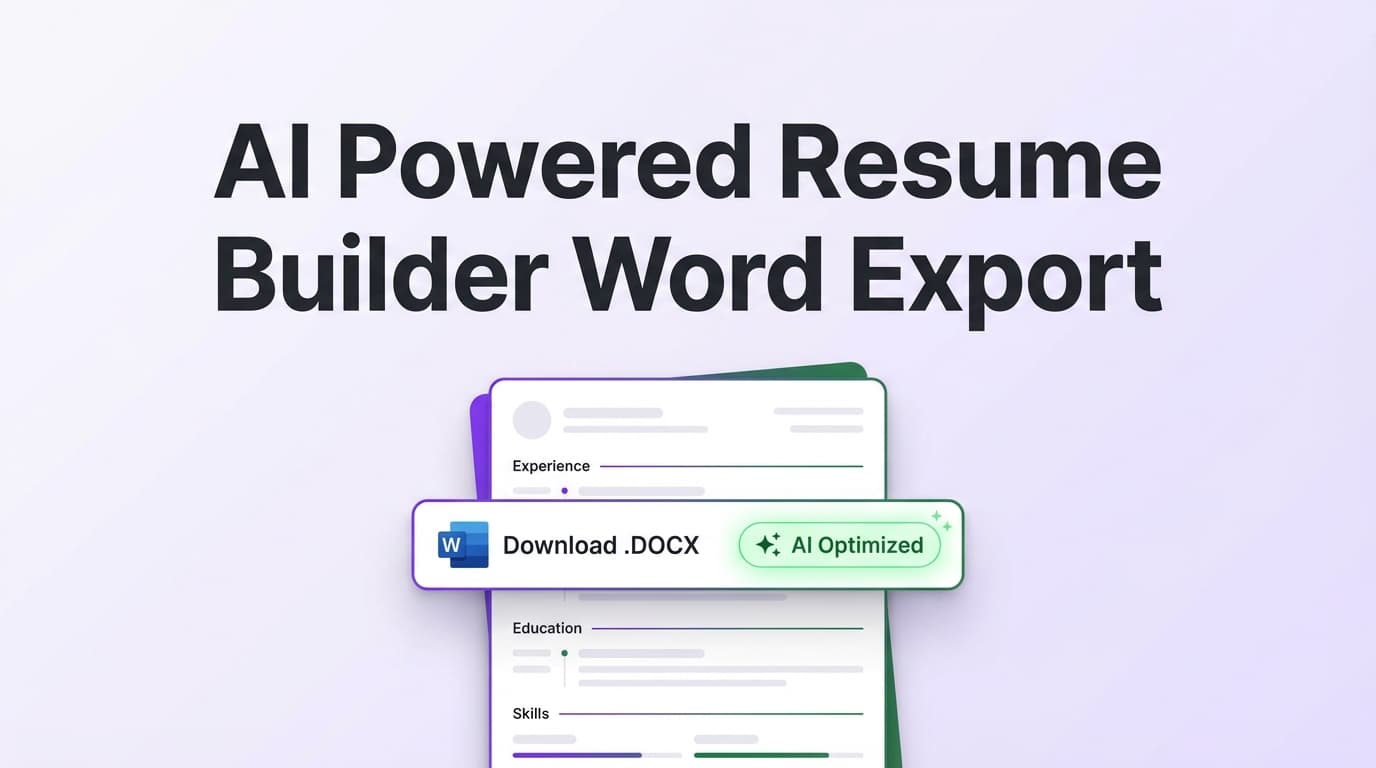
If you searched for “ai powered resume builder word export”, you likely need a Word file for a specific portal or recruiter. JobShinobi supports a reliable, real-world workflow: build + validate in JobShinobi → export .tex → convert to .docx with the tool you trust.
Get started: Sign in with Google → Open the Resume Builder: /dashboard/resume
What you can export today (and why that still solves “Word export” intent)
Most resume builders treat export as a checkbox. In practice, export is where applications get messy:
- PDFs keep layout stable—but some systems request
.docx - DOCX is editable—but formatting can shift or get scrambled
- Copy/paste into an ATS form can destroy spacing and bullets
JobShinobi’s approach is to keep your source-of-truth resume stable in LaTeX, then give you the exports that are actually supported:
Export options in JobShinobi
- PDF export: best for most job applications and consistent formatting
.texexport: best for ownership, versioning, and conversions (including Word)
Word export requirement? Use the supported conversion path
JobShinobi’s .tex export is designed to be portable. If you need .docx, you can convert your .tex file externally (examples below). This lets you keep the high-signal parts of the workflow—AI tailoring, job matching, ATS feedback, version history—without forcing your whole resume process into Word.
Why Choose JobShinobi for “ai powered resume builder word export” Use Cases?
If “Word export” is your only requirement, a Word-first builder may be enough. But many job seekers discover the real problems are:
- tailoring quickly without breaking layout
- keeping versions for different job types
- validating keywords and ATS-readability before sending
- exporting consistently (and having a fallback when Word is required)
JobShinobi is built for that full loop.
LaTeX-based Resume Builder (templates + saved resumes)
Start from templates, then manage multiple saved resumes. Your resume is stored as LaTeX source—clear structure, predictable formatting, and easy to version.
Internal link: /dashboard/resume
AI Resume Agent (streaming chat) for edits that stick
JobShinobi includes a streaming AI resume editor (chat-based) that can update resume content while working with your LaTeX resume. It’s built around editing workflows (e.g., pulling the current resume, making targeted edits, updating the saved resume, and compiling to check issues).
You can also pick between AI model tiers in the UI:
- Shinobi Swift
- Shinobi Turbo
- Shinobi Pro
Resume scoring + ATS/keyword feedback (with caching)
Run resume analysis to get structured feedback (overall and category scores, strengths, improvements, keyword analysis, ATS issues). If your resume hasn’t changed since the last analysis, JobShinobi can return cached results—so you don’t waste time re-running the same scan.
Job matching: tailor to a job description (not generic advice)
Paste a job description and get match scoring, missing/present keywords, and tailored suggestions. Then apply changes in the editor (manually or with AI).
Version history + revert
Tailor without fear. JobShinobi saves versions so you can revert to earlier drafts when you’re customizing for different roles.
How JobShinobi’s export workflow works (real steps)
Step 1: Start from a template (or open a saved resume)
Go to the Resume Builder hub and choose a template or open an existing resume.
Internal link: /dashboard/resume
Step 2: Edit in LaTeX + preview as a PDF
Inside the editor, you can edit your resume and compile it to preview the PDF. This is how you verify layout before exporting.
Internal link: /dashboard/resume/editor
Step 3: Improve content with the AI Resume Agent (optional)
Use the AI chat to request edits like:
- “Rewrite these bullets with clearer impact”
- “Tailor my summary for a Data Analyst role”
- “Strengthen action verbs and reduce repetition”
- “Make my experience section more ATS-readable”
Step 4: Run ATS/keyword analysis (optional but recommended)
Get a score breakdown and keyword feedback before exporting.
Step 5: Export PDF and/or .tex
From the editor, export:
- PDF: downloads
resume.pdf - LaTeX: downloads
resume.tex
Step 6: If you need Word, convert .tex → .docx externally
JobShinobi does not do this conversion inside the app today. But .tex export gives you a clean conversion starting point.
Converting your JobShinobi resume to Word (.docx): practical options
Different employers and recruiters want Word for different reasons (editing, internal formatting, ATS ingestion, or client submission). The most reliable approach is to keep your master resume in JobShinobi and convert only when required.
Option A: Convert with Pandoc (common .tex → .docx workflow)
After exporting resume.tex, many users convert with Pandoc.
Example command (varies by setup):
pandoc resume.tex -s -o resume.docx
Important: LaTeX-to-Word conversion quality depends on your template complexity. If your resume uses advanced LaTeX constructs, you may need light cleanup in the .docx output.
Option B: Keep PDF as default; produce DOCX only when asked
A lot of job portals accept PDF, and PDF preserves layout. A good workflow is:
- submit PDF by default
- maintain a DOCX copy only for systems that explicitly require it
JobShinobi makes the PDF path fast—while still giving you .tex as a conversion-ready source.
Option C: Convert from PDF to Word (last resort)
Some people open a PDF in Word and let Word attempt conversion. This can work, but it’s often the least predictable method for formatting.
If the portal accepts PDF, you typically get more consistent results submitting the PDF you previewed in JobShinobi.
Key Features for “ai powered resume builder word export” intent
| Feature | What It Does | Why It Matters for Export |
|---|---|---|
| LaTeX resume templates | Start from structured LaTeX templates and save resumes | Keeps structure stable across edits |
| PDF compilation + preview | Compiles LaTeX and shows a PDF preview | You verify layout before exporting |
Export PDF (resume.pdf) |
Download a ready-to-submit PDF | Standard for most applications |
Export LaTeX (resume.tex) |
Download your source resume | Best path for ownership + Word conversion |
| AI Resume Agent (streaming) | Chat-based edits that update your LaTeX | Faster tailoring without “layout drift” |
| Resume analysis (ATS/keywords) | Score breakdown + keyword feedback | Helps reduce avoidable ATS mistakes |
| Job description matching | Match score + keyword gaps + suggestions | Tailor per job with measurable feedback |
| Version history | Save and revert resume versions | Manage multiple targeted variants safely |
PDF vs DOCX: which file should you actually submit?
“Word export” searches often come from confusion about what ATS systems prefer. The real answer is situational:
- If the posting says DOCX only → you’ll need DOCX
- If the posting says PDF preferred → submit PDF
- If it doesn’t specify → PDF is often the safest for layout, but some organizations still prefer DOCX for internal editing
A simple decision guide
| Situation | Recommended output |
|---|---|
Job portal explicitly requests Word / .docx |
Export .tex from JobShinobi → convert to .docx |
| You want maximum formatting consistency | Export PDF from JobShinobi |
| You’re applying broadly across many portals | Keep both: PDF for most, DOCX for edge cases |
| Recruiter asks for an editable version | Convert .tex to .docx and send the DOCX |
JobShinobi supports the part you can control: a stable resume source + clear exports (PDF and .tex), plus analysis and matching so the content is competitive.
Why LaTeX helps even when you still need Word
Word files are often requested because they’re editable. But editing in Word can introduce problems:
- spacing and alignment changes after small edits
- bullets and indentation inconsistencies
- layout shifting between versions of Word or different systems
A LaTeX-first workflow reduces those issues by keeping your resume structured and reproducible.
What JobShinobi adds on top of “just using LaTeX”
JobShinobi isn’t just a LaTeX editor. It adds:
- AI-assisted editing (streaming chat) that works with your resume document
- Resume scoring (ATS/keyword feedback)
- Job matching against a description
- Version history so you can tailor safely
- PDF preview so you export exactly what you see
So even if you occasionally must produce a Word file, you can treat it as an output artifact—rather than letting Word be the place where your resume quality and consistency live.
“Word export” alternatives: what JobShinobi does differently
Many resume builders promote Word export as the main differentiator. But in real application workflows, the differentiators are:
- How quickly you can tailor your resume to a job
- How reliably you can keep a clean, ATS-readable structure
- How safely you can create multiple versions without losing your baseline
- How confident you are before you click submit
JobShinobi focuses on those:
Tailor faster (and keep it readable)
- Use job description matching to identify missing keywords
- Use the AI Resume Agent to rewrite bullets and sections
- Compile and preview to catch issues early
Keep versions for different job families
Applying to both “Data Analyst” and “Product Analyst” roles? Maintain separate versions and revert anytime.
Export with a built-in fallback
- PDF export is built-in for fast submission
.texexport is your safety net for conversions (including Word)
JobShinobi vs. common “Word export” resume builder setups
JobShinobi vs. “Word template + ChatGPT”
Word template + ChatGPT can work, but you’re usually stuck doing:
- manual formatting cleanup
- copy/paste errors
- version management in folders like
Resume_Final_FINAL_v7.docx
JobShinobi gives you:
- an editor built around resumes,
- structured feedback (scores/keywords),
- job matching and tailored suggestions,
- and version history.
You still can produce DOCX when required—just via .tex export and conversion.
JobShinobi vs. PDF-only export tools
Some resume tools only allow PDF export (often documented in their support articles). If you need Word occasionally, JobShinobi’s .tex export provides a practical path to .docx without changing your core workflow.
JobShinobi vs. DOCX-export-first tools
Some builders offer direct DOCX export. That can be convenient, but it doesn’t automatically solve:
- keyword targeting,
- ATS/formatting feedback,
- job-to-resume match analysis,
- or safe versioning per role.
JobShinobi is built to optimize the resume quality loop first, then provide exports you can depend on (PDF + .tex).
Bonus: Track applications while you tailor (Job Tracker + Excel export)
If you’re applying at volume, the resume is only one part of your system. JobShinobi also includes a Job Tracker with:
- a dashboard to manage applications,
- realtime updates,
- and Excel export (
.xlsx).
Internal link: /dashboard/job-tracker
This helps you connect:
- which resume version you used,
- what job family you targeted,
- and what results you’re getting over time.
Pricing
JobShinobi offers paid subscriptions via Stripe payment links:
- Monthly: $20.00
- Yearly: $199.99
Stripe checkout links:
- Monthly: https://buy.stripe.com/7sYeV61P10GS310eTy0VO02
- Yearly: https://buy.stripe.com/6oU9AM0KXexIdFE5iY0VO03
Billing management is available via Settings.
Internal link: /dashboard/settings
Frequently Asked Questions
Does JobShinobi export to Word (.docx)?
No. JobShinobi currently exports PDF (resume.pdf) and LaTeX (resume.tex). If you need a Word file, you can convert the exported .tex to .docx using an external converter (for example, Pandoc).
Can I export my resume as a PDF?
Yes. The editor includes Export PDF, which downloads resume.pdf.
What exactly makes JobShinobi “AI-powered”?
JobShinobi includes:
- a streaming AI Resume Agent for editing your resume,
- resume scoring + ATS/keyword feedback,
- and job description matching (match score + missing/present keywords + suggestions).
Can I tailor my resume to a job description?
Yes. You can run job matching with a job description to get a match score, keyword gaps, and recommendations you can apply in the editor.
Do you keep resume versions?
Yes. JobShinobi supports resume version history, including versions created from manual saves and AI chat edits, with the ability to revert.
Should I submit PDF or DOCX to an ATS?
Follow the job posting’s instructions first. If it requires DOCX, use DOCX. If it allows PDF (or doesn’t specify), PDF is commonly used because it preserves formatting—especially when you’ve already validated the PDF layout in JobShinobi. When you do need DOCX, JobShinobi’s .tex export gives you a clean conversion starting point.
Get Started with JobShinobi Today
If you want an AI-powered resume builder that stays stable while you tailor—and you need a realistic path for Word export when a portal demands it—JobShinobi gives you the full workflow:
- start from a LaTeX template
- tailor with AI + job matching
- validate with ATS/keyword feedback
- export PDF for applications
- export
.texfor conversions (including.docx)
Next step: Sign in → Open the Resume Builder: /dashboard/resume