If you’re comparing resume scanners, you’re probably asking a very specific question:
“Which tool gives me the most accurate feedback for getting past ATS—and actually getting interviews?”
That’s the right question—but it’s also the trickiest one. No resume checker can perfectly predict every company’s Applicant Tracking System behavior, because ATS setups differ by employer, configuration, and recruiter workflow. What you can compare is how reliably a tool:
- finds missing keywords and skill gaps,
- flags formatting issues that commonly break parsing,
- provides actionable, job-specific edits (not generic advice),
- and helps you iterate quickly across many applications.
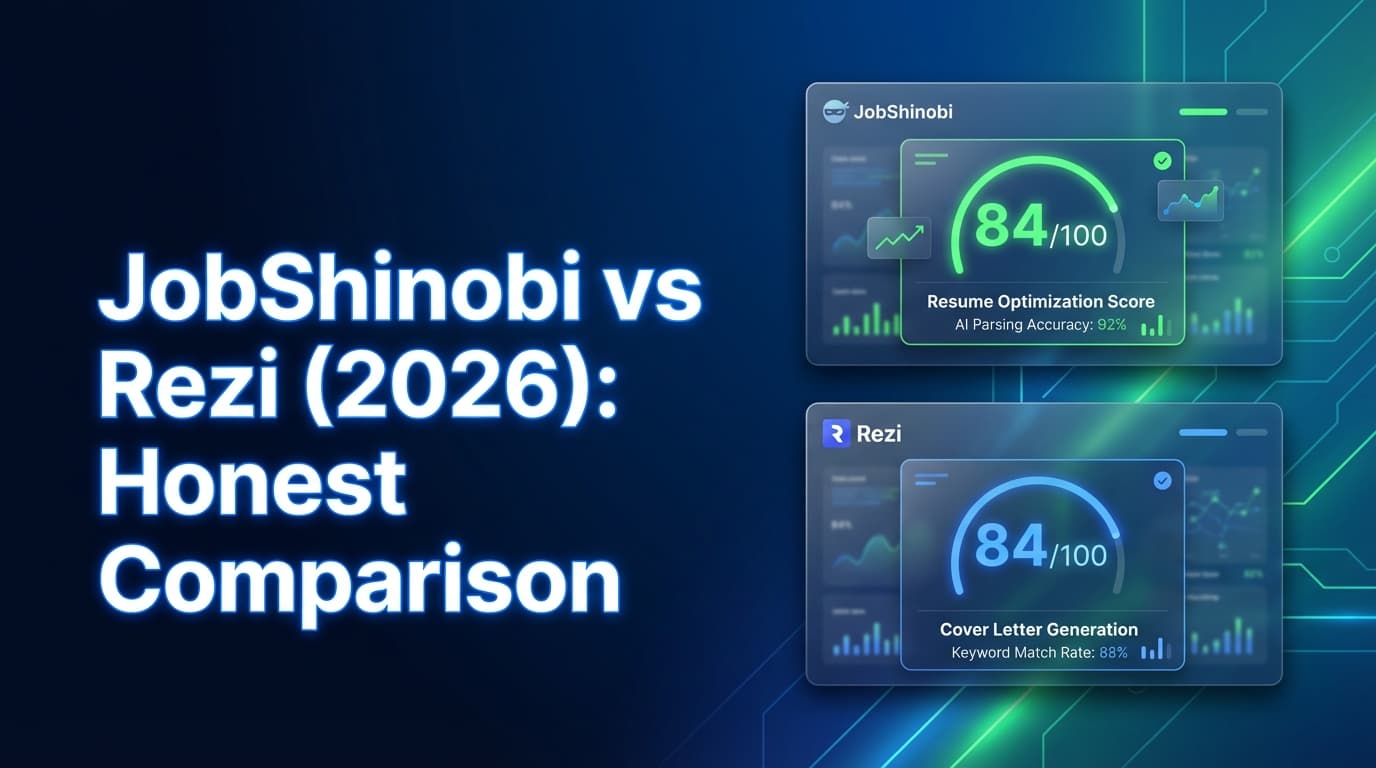
Below is a fair, evidence-based comparison of JobShinobi vs Rezi, with a focus on resume scanner accuracy comparison (keyword matching + ATS-safe structure + usefulness of feedback).
Quick Verdict:
- Choose Rezi if you want a very accessible, content-heavy ATS resume checker with unlimited scans at no cost and a straightforward builder/scoring system.
- Choose JobShinobi if you want a resume scanner + job-description matching workflow paired with a LaTeX-first resume system (structure control) and a unique email-forwarding job application tracker that reduces manual tracking.
TL;DR Comparison
| Feature | JobShinobi | Rezi |
|---|---|---|
| Resume scanner / scoring | ✅ Yes (structured scoring breakdown + ATS/keyword feedback) | ✅ Yes (“Rezi Score” + ATS resume checker) |
| Job description → match analysis | ✅ Yes (resume-to-job matching + missing/present keywords) | ✅ Yes (resume checker focuses on ATS compliance + keyword analysis) |
| “Accuracy” approach | Structure-first (LaTeX templates + compilation) + AI analysis & match scoring | Criteria-based scoring (23 criteria) + “30+ issues” checks + detailed explanations |
| Resume editor | ✅ LaTeX editor + PDF preview (cloud compilation) | ✅ Resume builder (web-based) |
| Version history | ✅ Yes (versioning + undo/redo + revert) | Not a core differentiator on pricing/checker pages |
| Job application tracking | ✅ Yes (email forwarding → auto-tracked applications + analytics) | Not positioned as core on verified pages |
| Starting price | $20/mo | Free (unlimited scans) |
| Paid plan | $20/mo or $199.99/yr | $29/mo or $149 one-time |
| Best for | High-volume applicants who want resume + matching + automated tracking | People who want a fast ATS checker + builder with generous free scanning |
JobShinobi Overview
JobShinobi is an AI resume builder + ATS resume analyzer + job search tracker designed for job seekers who are tired of ATS rejections and manual spreadsheets.
A few things make JobShinobi different from a typical “paste resume + paste job description” scanner:
-
LaTeX-first resume building
Instead of editing a Word-style document, JobShinobi uses a LaTeX resume workflow with a live PDF preview. The idea is to keep formatting consistent and predictable—important for avoiding layout “gotchas” that can confuse resume parsing. -
Resume scoring + job matching
JobShinobi generates a structured score breakdown (including ATS and keyword-focused feedback) and supports job description extraction + match analysis (missing vs present keywords, match score, tailoring suggestions). -
Email-forwarding job tracker (unique)
If you forward job application emails to your dedicated JobShinobi address, JobShinobi can parse the emails and automatically create/update application entries in your tracker (Pro feature). This is a meaningful workflow advantage if you apply to many jobs.
Key Strengths
- Email-forwarding application tracking: forward confirmations → automatic logging and status updates (Pro-gated).
- LaTeX editor + PDF compilation preview: strong control over structure and formatting consistency.
- Job search analytics: response rate / interview conversion insights built from your tracked applications.
Limitations (being candid)
- LaTeX learning curve: if you’ve never used LaTeX, it may feel less “plug-and-play” than a typical resume builder.
- Some core automation is Pro-gated: email parsing/tracking automation requires Pro.
- “Trial” mechanics may depend on billing setup: marketing references a 7-day trial, but trial enforcement may be handled in Stripe rather than in-app logic.
Rezi Overview (Verified)
Rezi positions itself as an AI resume builder with an ATS resume checker and a scoring system called the Rezi Score.
From Rezi’s own pages (verified):
- Rezi’s ATS resume checker states you can run unlimited scans at no cost, with access to 23 evaluation criteria and “unlimited recommendation reports” (no credit card required).
Source: https://www.rezi.ai/tools/resume-checker - Rezi’s pricing page lists plans including $29/month and $149 one-time, and highlights a 30-day money back guarantee.
Source: https://www.rezi.ai/pricing - Rezi also provides a detailed “how it works” explanation on the checker page (including keyword extraction and ranking concepts), which is a trust signal for users evaluating “accuracy.”
Key Strengths
- Very generous free scanning: unlimited scans at no cost (per Rezi’s checker page).
- Clear criteria-based scoring: “Rezi Score” based on 23 criteria; useful for consistent iteration.
- Educational, transparent checker content: the resume checker page includes detailed methodology sections, which can help users understand why it flags issues.
Limitations (based on verified info + common user sentiment themes)
- Scoring ≠ guaranteed ATS outcome: like all scanners, Rezi can’t perfectly model every employer ATS configuration.
- Builder-driven workflow: if you want deeper control over formatting or a strict structure-first approach, a template/builder may feel limiting compared to a code-based system (like LaTeX).
- Some pricing page content quality issues: Rezi’s pricing page contains some placeholder/lorem-ipsum style text in headings, which doesn’t affect product performance but can reduce perceived polish/trust for some buyers.
Feature-by-Feature Comparison (with “Accuracy” in Mind)
1) Resume Scanner Accuracy: Keyword Matching + Relevance
JobShinobi:
JobShinobi supports job description extraction and resume-to-job matching, then stores match results (including missing/present keywords) and provides tailoring suggestions. It’s built for an iterative workflow where you:
- analyze,
- edit,
- re-analyze,
- and track versions over time.
Rezi:
Rezi’s ATS resume checker emphasizes a criteria-based scoring system (23 criteria) and states it checks for “30+ issues” like keywords, spelling, and formatting. The checker page also includes a technical breakdown of keyword extraction/ranking, which suggests the product prioritizes keyword accuracy and explanation.
Winner (accuracy for keyword gap-finding): Rezi for many users—because the checker is free/unlimited and heavily centered on scanning + criteria, making it easy to run many iterations quickly.
Winner (workflow accuracy over time): JobShinobi if you want match analysis + version history + a broader job-application system around those scans.
2) ATS “Parse-ability” Accuracy: Formatting + Structure
JobShinobi:
JobShinobi’s LaTeX-first approach can be a real advantage for ATS readability if you use clean templates and avoid complex layout constructs. The key benefit is consistency and control: the structure is explicit, and you can generate a clean PDF reliably.
Rezi:
Rezi’s checker explicitly evaluates ATS checkpoints, including formatting-related criteria. For many job seekers, this “guardrail” approach reduces the chance of accidental ATS-unfriendly formatting.
Winner: It depends.
- If you want guardrails and a guided system: Rezi.
- If you want maximum control and a structure-first workflow: JobShinobi.
3) Actionability of Feedback (Not Just a Score)
JobShinobi:
JobShinobi combines scoring with a resume editing workflow and (importantly) match analysis tied to a job description. It also keeps version history, so you can test changes without losing prior drafts.
Rezi:
Rezi provides recommendation reports and detailed explanation content on the checker page. The value here is speed + clarity: you can scan, see what’s wrong, and fix it in the builder.
Winner: Tie—Rezi for simplicity and immediacy; JobShinobi for iterative, job-specific optimization with version history.
4) Beyond the Resume: Job Search System Fit
JobShinobi:
This is where JobShinobi clearly differentiates. The email-forwarding workflow can automatically log job applications from confirmation emails, plus you get analytics on response rates and trends.
Rezi:
Rezi is primarily positioned (on verified pages) around building/scoring/checking resumes rather than tracking your entire pipeline.
Winner: JobShinobi
Pricing Comparison (Verified)
| Plan | JobShinobi | Rezi |
|---|---|---|
| Free | Limited (core automation features are Pro-gated) | ✅ Free plan available; resume checker page states unlimited scans at no cost |
| Monthly | $20/month | $29/month |
| Yearly / One-time | $199.99/year | $149 one-time (Lifetime) |
| Guarantee / trial | Marketing references a 7-day trial (implementation may be via Stripe) | Pricing page emphasizes 30-day money back guarantee |
Value Analysis:
- If you only want a resume checker and builder, Rezi’s free unlimited scans and the $149 lifetime option can be strong value.
- If you want a broader system (resume + matching + tracking + analytics), JobShinobi’s $20/month can make sense—especially for job seekers applying at volume who benefit from the tracker automation.
Who Should Choose JobShinobi?
You’ll prefer JobShinobi if you:
- want resume scanning + job matching and a system to manage applications end-to-end,
- apply to many roles and want email-forwarding → automatic job tracking (less spreadsheet work),
- care about format control and are open to a LaTeX-based workflow,
- want version history so you can tailor aggressively without losing your “base” resume.
Who Should Choose Rezi?
You’ll prefer Rezi if you:
- want an ATS resume checker you can run repeatedly without paying (Rezi states unlimited free scans),
- prefer a guided builder and a clear score/criteria checklist,
- like tools that explain methodology and provide structured recommendations,
- want a predictable paid upgrade path like $29/month or $149 lifetime.
A Reality Check: What “Accuracy” Means for Resume Scanners
A fair resume scanner accuracy comparison should acknowledge this:
- Resume scanners can be very accurate at keyword extraction and common ATS formatting rules.
- They are not perfect predictors of “will a recruiter see this resume,” because:
- ATS systems vary widely,
- recruiters may search/filter differently,
- and keyword stuffing can produce false positives (even Indeed notes this risk in automated screening contexts).
Use scanners as optimization tools, not as “guaranteed pass/fail machines.”
Switching from Rezi to JobShinobi
If you currently use Rezi and are considering JobShinobi:
- Data migration: Expect to export your resume content and recreate it in JobShinobi’s template/editor workflow (there’s no verified 1-click import path in the provided product evidence).
- Learning curve: Medium—especially if you haven’t used LaTeX-style editing before.
- Support/workflow: If you value automated tracking, JobShinobi can reduce effort after you’re set up (forward emails → tracker updates).
FAQ
Is JobShinobi really “more accurate” than Rezi?
Not universally. Rezi can be “more accurate” for many people in practice because you can run unlimited scans for free and iterate quickly using its criteria-based scoring. JobShinobi can be “more accurate” in a different way—by emphasizing structure control (LaTeX), job-specific matching, and versioned iteration.
Can I use Rezi for free indefinitely?
Rezi’s resume checker page states you can run unlimited scans at no cost and that no credit card is required. Verify current limits inside your account if you rely on it heavily, since plans can change.
Which is cheaper: JobShinobi or Rezi?
- On monthly pricing: JobShinobi ($20/mo) is cheaper than Rezi ($29/mo) based on verified pricing.
- Long-term: Rezi’s $149 lifetime option may be cheaper if you prefer a one-time payment and your needs fit Rezi’s workflow.
What’s the best way to improve ATS results regardless of tool?
- Keep formatting simple (clean headings, consistent dates, no columns if your target ATS struggles with them).
- Match keywords naturally (avoid hidden text/keyword stuffing).
- Tailor the top third of your resume (summary + skills + most recent role) to the job description.