If you searched “Jobscan resume scanner vs ChatGPT resume prompt”, you’re likely trying to answer a practical question:
- Should you use a resume scanner (like Jobscan) that gives a match score and keyword gaps?
- Or should you use ChatGPT prompts to rewrite and tailor your resume faster?
- And if neither feels complete, is there a tool that combines ATS analysis + tailoring + tracking so you’re not juggling three different workflows?
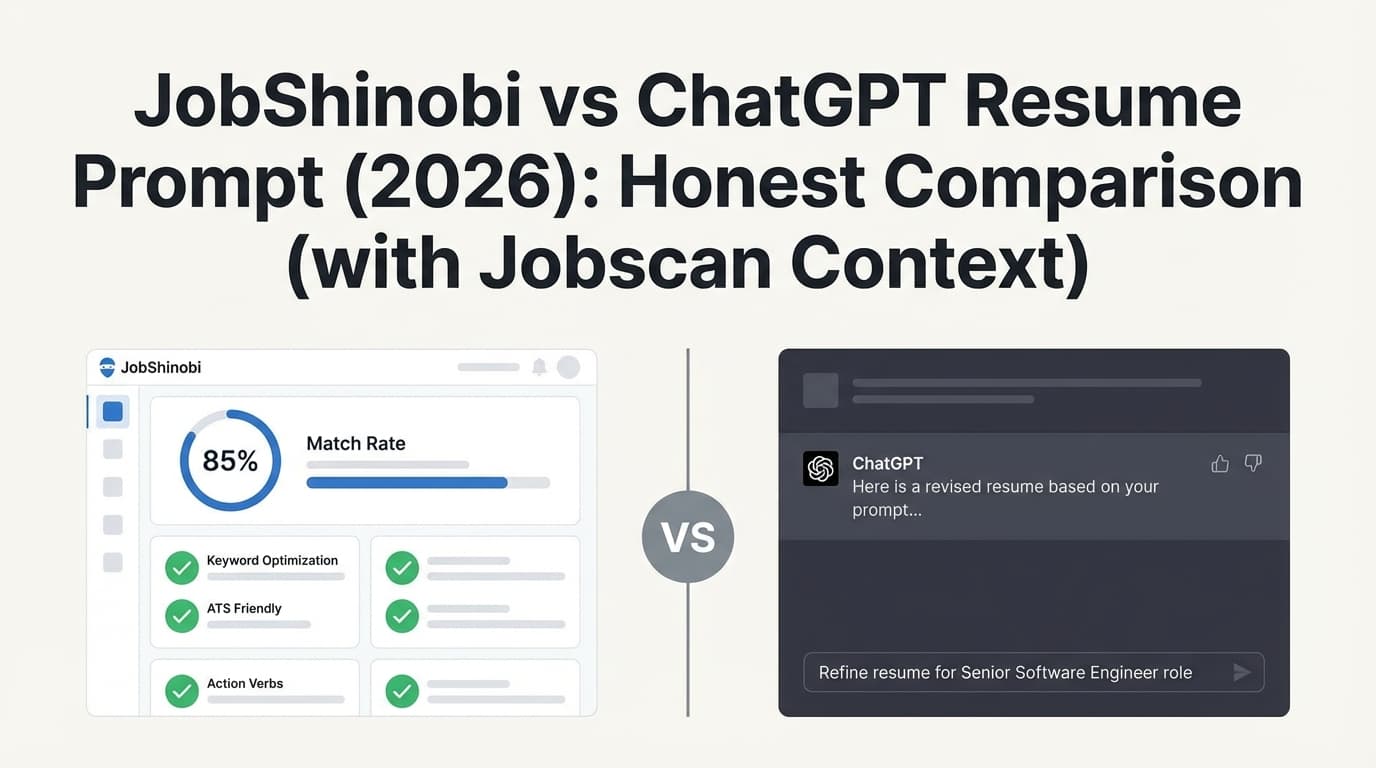
This page compares the approaches behind Jobscan and ChatGPT prompts—and then gives an honest look at JobShinobi, which is built for people who want a Jobscan-style optimization loop plus a real resume editor and job tracking automation.
Quick Verdict:
- Choose Jobscan-style scanning if you want a structured “resume vs job description” match report and a repeatable score-improvement workflow.
- Choose a ChatGPT resume prompt if you primarily want faster writing, brainstorming, and rewrites (and you’re willing to manage formatting and validation yourself).
- Choose JobShinobi if you want ATS scoring + resume-to-job matching + a LaTeX resume builder + resume version history + automated job application tracking via email forwarding in one system.
TL;DR Comparison
| Feature | JobShinobi | ChatGPT Resume Prompt workflow |
|---|---|---|
| Jobscan-style resume-to-job matching | ✅ Yes (match scoring + missing/present keywords) | ❌ Not built-in (you can ask for analysis, but no native scanner score loop) |
| ATS-oriented resume scoring | ✅ Yes (ATS/keyword/formatting/completeness scoring) | ⚠️ Only as guidance (depends on prompt; no native ATS score) |
| Resume builder & formatting control | ✅ Yes (LaTeX templates + editor + PDF preview) | ❌ No (outputs text; you format elsewhere) |
| Version history / revert | ✅ Yes (resume version history + undo/revert) | ❌ Not automatic |
| Job tracking | ✅ Yes (dashboard tracker + analytics) | ❌ No |
| “Forward emails → auto-track applications” | ✅ Yes (unique forwarding address; Pro-gated) | ❌ No |
| Best for | End-to-end: build + optimize + track | Fast drafting + rewriting across many doc types |
| Starting price | $20/mo (Pro) | Free plan available; Plus commonly listed at $20/mo |
Why This Keyword Exists: Jobscan and ChatGPT Solve Different Problems
People compare Jobscan vs ChatGPT prompts because job searching has two separate bottlenecks:
- Targeting / ATS alignment: “Does my resume match this specific job posting?”
- Writing quality / positioning: “Do my bullets sound strong, quantified, and credible?”
- Jobscan is known for the first bottleneck: it compares your resume to the job description and produces a match-style report (often described as a “match score” rather than a literal ATS score).
- ChatGPT prompts are popular for the second bottleneck: rewriting bullets and summaries quickly.
JobShinobi is built to reduce the gap by combining ATS-focused analysis + job matching + a resume editor + tracking—so you don’t have to assemble a workflow from separate tools.
JobShinobi Overview (Our Product)
JobShinobi is an AI resume builder + ATS resume analyzer + job application tracker designed for job seekers who are tired of guessing why they’re getting filtered out and tired of maintaining spreadsheets.
What JobShinobi actually does (core features)
- ATS resume analysis & scoring: A structured breakdown (overall + ATS + keywords + formatting + completeness) with strengths/weaknesses and deeper analysis objects.
- Resume-to-job matching: Paste a job description or URL; JobShinobi extracts job requirements and calculates a match score, including missing vs present keywords.
- LaTeX resume builder: Start from LaTeX templates, edit directly, and generate a PDF preview via a compilation service.
- AI Resume Agent (chat-based editing): An assistant that can modify your resume content and keep versions.
- Resume version history (“unlimited undo”): Resume changes are versioned so you can revert to prior tailored versions.
- Job application tracking dashboard: Add/edit/delete applications, export to Excel, and see response-rate analytics.
- Email-forwarding automation (distinctive): Forward job-related emails to your unique JobShinobi address; it extracts company/title/status and logs or updates applications automatically (Pro-gated).
Key strengths
- One system instead of a tool stack: Resume build + score + match + track applications.
- Real version control for tailoring: Easy to create multiple job-specific variants and revert safely.
- Email-forwarding tracking: Removes manual job-tracker maintenance for many workflows.
Limitations (honest)
- Email automation requires Pro: Email parsing/processing is explicitly gated to Pro membership.
- LaTeX isn’t everyone’s preference: It’s powerful for consistency, but some users prefer a drag-and-drop editor.
- Trial messaging depends on billing configuration: The site messaging mentions a “7-day free trial,” but trial handling may be implemented via Stripe configuration rather than visible code logic.
Competitor Overview: “ChatGPT Resume Prompt” (what you’re really buying)
A “ChatGPT resume prompt” isn’t a dedicated resume product. It’s a workflow where you:
- Paste your resume and a job description into ChatGPT
- Ask it to tailor bullets, summary, and skills
- Copy the output back into your resume document
Key strengths (where ChatGPT honestly wins)
- Best-in-class drafting speed: Great for rewriting bullets, generating variations, and fixing awkward phrasing fast.
- Multi-document help: Resume, cover letter, interview answers, networking outreach—one tool.
- Low barrier to entry: A free plan exists, and many job seekers start there.
Key limitations (common pain points)
- No native resume-scanner score loop: Without a dedicated scanner, you can’t easily measure keyword gaps or formatting risks in a consistent, repeatable way.
- Risk of generic “AI voice”: If you don’t provide strong constraints, outputs can sound vague or over-polished.
- Hallucinations / invented details risk: If you ask for “best possible resume,” models may introduce claims you didn’t provide unless you explicitly restrict them.
- Formatting and ATS safety are still your job: ChatGPT outputs text; the ATS-friendly layout and file formatting happen elsewhere.
Verification note: We attempted to analyze OpenAI/ChatGPT pricing/help pages via an automated page analyzer tool, but those pages returned HTTP 403 on 2026-01-21. Pricing details below are cross-checked via web search results referencing OpenAI Help Center and OpenAI announcement pages.
Feature-by-Feature Comparison
1) ATS/Keyword Feedback: Scanner-like loop vs prompt-only guidance
JobShinobi:
- Provides structured resume scoring (including ATS/keyword/formatting dimensions).
- Supports resume-to-job matching with missing/present keywords and match scoring.
- Caches analysis when your resume hasn’t changed, which encourages iteration without redoing work.
ChatGPT resume prompt workflow:
- Can produce a keyword list or tailoring suggestions if you ask, but results depend heavily on your prompt and what you provide.
- Doesn’t provide a native “scan → score → rescan” workflow unless you build it yourself.
Winner: JobShinobi
If your goal is to systematically improve alignment to a job description, a built-for-purpose scoring + matching workflow beats ad-hoc prompting.
2) Writing quality: bullet rewrites, summaries, and specificity
JobShinobi:
- Includes an AI resume agent that edits within your resume workflow (and preserves versions).
- Strong when you want “tailor this resume to this role” without losing control of what changed.
ChatGPT prompts:
- Excellent for rapid ideation and rewriting.
- Often faster for generating multiple alternate phrasings and experimenting with tone.
Winner: Tie (lean ChatGPT for pure drafting speed)
ChatGPT is hard to beat if your only requirement is “rewrite 10 bullets in 60 seconds.” JobShinobi is stronger when you want drafting plus structure, versions, and ATS scoring in the same place.
3) Formatting control: where ATS problems usually happen
JobShinobi:
- Built around a LaTeX editor + PDF preview, which emphasizes consistency and structure.
- Helpful if your formatting tends to break when you tailor (spacing, alignment, section ordering).
ChatGPT prompts:
- Will suggest formatting best practices, but it can’t guarantee the final resume document is ATS-safe, because it doesn’t control the final layout.
Winner: JobShinobi
If formatting and structure are part of your problem (not just wording), you generally want an actual resume-building environment.
4) Versioning: tailoring without losing good versions
JobShinobi:
- Resume edits are versioned (manual saves and AI/chat-driven changes) with revert/undo.
ChatGPT prompts:
- You can maintain versions manually by saving files (e.g., “Resume - Company A”), but that’s on you.
Winner: JobShinobi
Version history is a practical advantage when you’re applying broadly and need to preserve multiple tailored variants.
5) Job search workflow beyond the resume
This is the part most people ignore until they’re applying to dozens of roles.
JobShinobi:
- Includes a job application tracker and analytics (response rate, interview conversion, trends).
- Unique differentiator: forward application emails and it auto-creates/updates job tracker entries (Pro-gated).
ChatGPT prompts:
- Can help you write follow-ups and thank-you notes, but there’s no tracking system.
Winner: JobShinobi
If your pain is “I’m applying everywhere and losing track,” prompts alone won’t fix that.
Pricing Comparison (verified via web search; some on-page verification blocked by 403)
JobShinobi (from product specs + website snippet)
- $20/month (Pro Monthly)
- $199.99/year (Pro Yearly)
- Site messaging mentions a 7-day free trial.
ChatGPT (for using resume prompts)
Based on web search results referencing OpenAI Help Center and OpenAI announcements:
- Free plan: available (message limits apply; limits can change over time)
- ChatGPT Plus: commonly listed at $20/month
- ChatGPT Pro: referenced by OpenAI announcement pages as $200/month
- ChatGPT Business: OpenAI Help Center pages commonly cite $30/seat/month (monthly) or $25/seat/month (annual)
- Enterprise: custom pricing
| Plan | JobShinobi | ChatGPT (prompt workflow) |
|---|---|---|
| Free | Limited (core automation gated) | $0 (limits apply) |
| Individual paid | $20/mo | $20/mo (Plus, commonly listed) |
| High-end | N/A | $200/mo (Pro, referenced by OpenAI announcements) |
| Team | N/A | $25–$30/seat/mo (Business, per Help Center snippets) |
Value analysis (practical):
- If you only need occasional resume rewrites, ChatGPT Free/Plus can be great value.
- If you want a full “optimize + manage applications” system, JobShinobi can replace multiple tools (resume editing + scoring + job matching + tracking).
Where Jobscan Fits Into This Decision (since your keyword is Jobscan vs ChatGPT)
Jobscan commonly appears in this comparison because it offers:
- a resume-to-job comparison (“match report” / “match rate” style workflow),
- and additional job-search tools (Jobscan also markets things like LinkedIn optimization and cover letter generation).
If your current workflow is:
Jobscan for targeting + ChatGPT for rewriting, JobShinobi is positioned as the “single workspace” alternative: scoring + matching + editing + versions + tracking.
Who Should Choose JobShinobi?
You’ll prefer JobShinobi if you:
- Want ATS scoring + resume-to-job matching and an actual resume builder (not just text output)
- Need version history because you tailor for many roles and don’t want to overwrite good variants
- Want to stop using a spreadsheet and instead track applications automatically (especially via email forwarding)
- Prefer one system over stitching together Jobscan + ChatGPT + a tracker
Who Should Choose a ChatGPT Resume Prompt Instead?
You’ll prefer ChatGPT prompts if you:
- Mainly want faster writing (bullets, summaries, cover letters, outreach)
- Don’t care about a structured match score, or you’re comfortable manually validating keywords and formatting
- Want a general-purpose assistant that helps with job search beyond resumes (interview prep, negotiation, etc.)
- Are budget-sensitive and want to start with free
Where ChatGPT is genuinely better:
- Broad writing tasks across many formats (not just resumes)
- Rapid iteration on tone and phrasing
Switching from ChatGPT Prompts to JobShinobi (or using both)
If you already have prompts you like, you can still use that style of instruction—just in a more controlled workflow.
- Migration: Copy your current resume content into a JobShinobi template (or start from a LaTeX template and fill sections).
- Learning curve: Expect a small ramp if you’ve never used LaTeX, but the PDF preview helps you validate changes quickly.
- Best hybrid workflow: Use JobShinobi for scoring/matching/versioning and use ChatGPT-style prompting for rapid drafting—then lock the final version into JobShinobi for formatting + version history.
FAQ
Is Jobscan better than a ChatGPT resume prompt?
They’re better at different things. Jobscan is designed for a resume-to-job comparison workflow (match-style reporting). ChatGPT prompts are better for fast rewriting and generating content variations. Many people use both.
Is JobShinobi better than using ChatGPT prompts?
If you want structure (ATS scoring, job matching, version history, formatting control, and job tracking), JobShinobi is the stronger fit. If you only want quick rewrites and brainstorming, ChatGPT prompts may be all you need.
What’s the biggest downside of using ChatGPT for resumes?
The biggest risk is unverified content (generic filler or hallucinated details). The safest practice is to force the model to only use information you provide and to treat outputs as drafts.
Can ChatGPT make an ATS-friendly resume?
It can help you write ATS-friendly content and suggest structure, but it’s not a dedicated scanner and it doesn’t control your final document layout. ATS-friendliness still depends on your formatting and file output.
Which option is cheaper?
ChatGPT can be cheaper because there’s a free plan and Plus is commonly listed at $20/month. JobShinobi is $20/month. Jobscan-style tools are often priced higher on monthly plans, especially if you need unlimited scanning during an active search.
If I’m applying to lots of jobs, what should I use?
High-volume applicants usually need (1) a repeatable tailoring workflow and (2) a tracking system. Prompts help with writing, but they don’t track applications. JobShinobi is built to cover both: optimize the resume and manage the pipeline (including email-forwarding automation).