If you searched “free AI resume builder reddit 2026”, you’re probably trying to answer two questions fast:
- Which tool actually helps me get interviews (and not just a prettier PDF)?
- Which tool is “free” enough to be useful without hitting a paywall mid-application?
This page compares JobShinobi and Rezi honestly—where each shines, where each falls short, and which one is a better fit for your workflow.
Quick Verdict:
- Choose Rezi if you want a straightforward, ATS-first resume builder with a clear upgrade path (including a one-time lifetime option) and you don’t need a job-tracking system.
- Choose JobShinobi if you want an all-in-one job search workflow—especially email-based job application tracking, resume scoring + job matching, analytics, and a LaTeX-first resume system for people who care about structure and control.
TL;DR Comparison
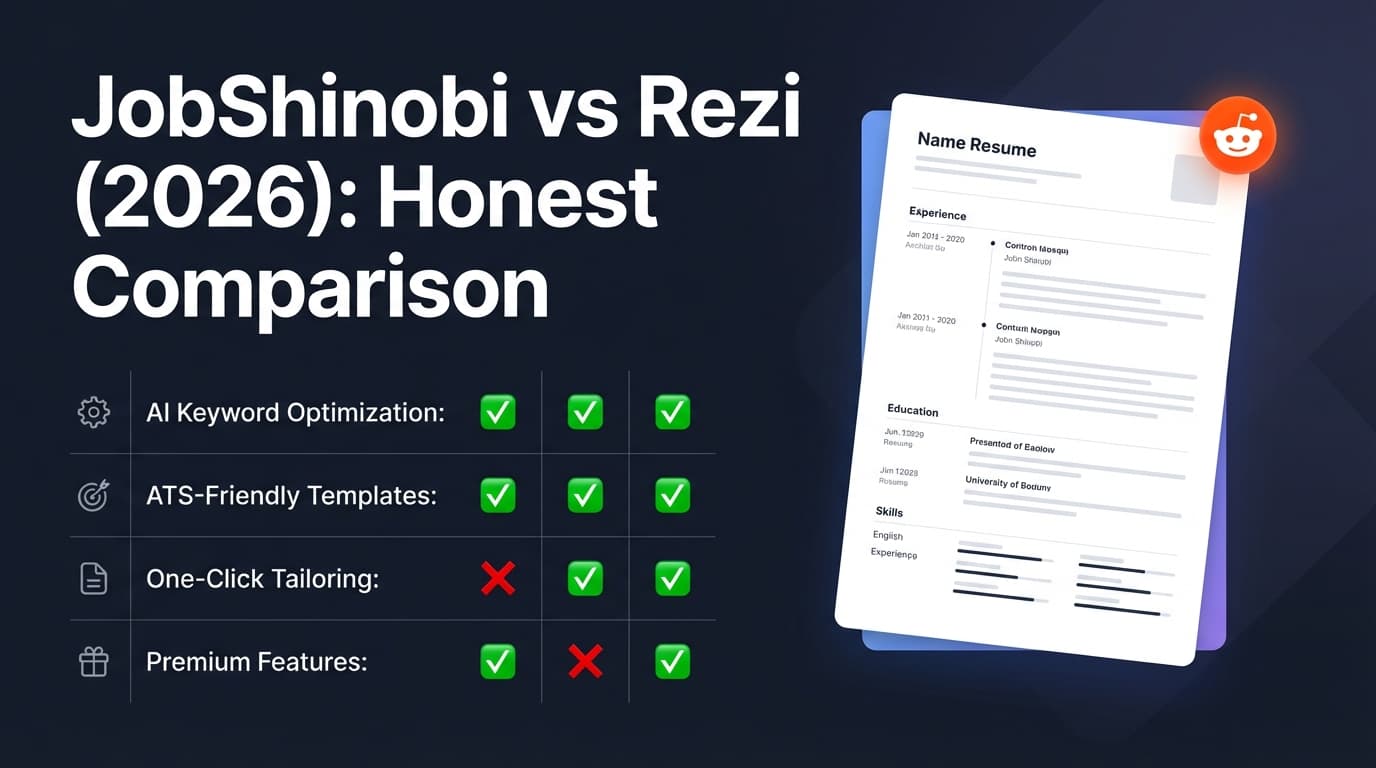
| Feature | JobShinobi | Rezi |
|---|---|---|
| Primary focus | Job search system: resume + ATS analysis + job tracker | ATS-focused resume builder + scoring tools |
| Resume editing approach | LaTeX editor + PDF compile/preview | Form-based builder (ATS-oriented) |
| ATS / resume scoring | ✅ Yes (multi-part scoring + analysis + keyword feedback) | ✅ Yes (“Rezi Score” + ATS checks; resume checker claims 23 checkpoints) |
| Job description matching | ✅ Yes (job extraction + match score + keyword gaps) | ✅ Keyword-focused tailoring (ATS/keyword emphasis) |
| Job application tracking | ✅ Yes (dashboard + email forwarding automation on Pro) | ❌ Not core (resume-focused) |
| Version history / undo | ✅ Version history + “unlimited undo” (implemented via resume versions) | ✅ Resume management features (not positioned as unlimited undo) |
| Export formats | PDF + .tex (LaTeX source) |
PDF/DOCX/Google Drive exports on paid plans (free plan has limited downloads) |
| Starting price | $20/month or $199.99/year (7-day trial marketed) | $29/month or $149 one-time (pricing page) |
| Free plan reality | Limited: core automation (email processing) gated to Pro | Limited: free plan is for trying it; commonly cited limits include 1 resume + 3 PDF downloads |
| Best for | Power users who want tracking + optimization workflow | People who want a clean ATS resume quickly, with simple UX |
What “Free AI Resume Builder” Usually Means (Especially on Reddit)
Reddit threads about resume builders often highlight a pattern:
- Tools that claim “free resume builder” may still limit downloads, AI credits, or tailoring features.
- The “best” tool depends on whether you’re optimizing one resume or running a high-volume application process.
So in this comparison, we’ll separate:
- Free to build vs
- Free to export vs
- Free to tailor repeatedly vs
- Free to manage your whole job search
JobShinobi Overview
JobShinobi positions itself as: “Stop Getting Rejected by ATS | AI Resume Builder That Actually Works.” It’s more than a resume builder—think of it as a job search operating system:
- A LaTeX-based resume builder (structure-first) with cloud compilation and PDF preview.
- An AI resume agent (chat-based editing) that can update your resume and re-compile it.
- ATS/resume scoring with structured feedback (keyword, formatting, completeness, ATS checks).
- Job description extraction + resume-to-job match scoring, including missing keywords and tailoring suggestions.
- A job tracker with analytics—and uniquely, email-forwarding-based job application tracking (forward confirmation emails; the system extracts details automatically). This email processing is Pro-only.
Key Strengths
- Email-forwarding job tracking (unique workflow): Forward application emails to your JobShinobi address and it auto-creates/updates application records (Pro feature).
- LaTeX-first resumes: Great if you want consistent structure and control (often valued for ATS readability when done correctly).
- End-to-end workflow: Tracking + analytics + resume tailoring in one place (less tool-hopping).
Limitations (Honest)
- Not “truly free” for automation: The most distinctive feature—email parsing/job tracking automation—is gated to Pro.
- LaTeX is not for everyone: If you want drag-and-drop visuals or minimal learning curve, Rezi may feel easier.
- Trial details may depend on Stripe setup: The site markets a 7-day free trial, but trial enforcement isn’t clearly visible in the product implementation (could be configured in billing).
Rezi Overview (Verified)
Rezi is an ATS-first resume platform centered on fast resume creation, ATS optimization, and resume checking/scoring.
From Rezi’s verified pages:
- Rezi has a dedicated pricing page with plan options including $29 monthly and $149 one-time (lifetime) and references a 30-day money-back guarantee (pricing page).
- Rezi’s AI resume builder page is content-rich and heavily optimized around “AI resume builder,” with sections focused on keyword matching, AI scoring/feedback, summaries, ATS formatting, and more.
- Rezi’s ATS resume checker positions itself as comprehensive and describes ATS scanning and issue detection (its page content references a deep technical approach; page is schema-marked as an offering).
Key Strengths
- Clear ATS-first positioning: Templates and guidance are geared toward ATS-friendly structure (simple, readable layouts).
- Simple UX for most users: You don’t need to understand formatting systems like LaTeX to produce a clean resume.
- Pricing flexibility: The $149 one-time (lifetime) option can be compelling if you dislike subscriptions.
Limitations (From common user sentiment + plan constraints)
- Free plan limits: Rezi’s free tier is designed for testing; commonly stated limits include one resume and limited downloads (e.g., 3 PDF downloads) (via Rezi’s plan documentation and pricing references surfaced in search results).
- Score-chasing risk: ATS scores can be useful directionally, but users can over-optimize for a number rather than readability and truthfulness.
Feature-by-Feature Comparison
1) Resume Creation & Editing Experience
JobShinobi:
Built around LaTeX templates and an editor that compiles to PDF. This is ideal if you want:
- stable spacing and typography,
- fine-grained control,
- a resume that’s hard to “break” with accidental formatting shifts.
Rezi:
More traditional resume builder flow. Emphasizes ATS-safe formatting and speed—generally easier for most people than LaTeX.
Winner: Depends
- Rezi wins for speed + simplicity.
- JobShinobi wins for control + power-user editing.
2) ATS Checks, Resume Scoring, and Feedback
JobShinobi:
Offers structured scoring and analysis (ATS/keywords/formatting/completeness) and keeps analyses cached when your resume hasn’t changed, which is useful when iterating.
Rezi:
Strong ATS marketing and tooling. Rezi’s resume checker positions itself as a “Free ATS Resume Checker” and describes extensive checks and issue detection, plus “Rezi Score” messaging on-site.
Winner: Tie (different styles)
- If you want deep ATS tool positioning and a conventional resume workflow: Rezi.
- If you want scoring plus job matching plus versioned iteration inside a broader system: JobShinobi.
3) Job Description Matching & Tailoring
JobShinobi:
Designed for tailoring: paste a job description or URL → extract structured job details → compute a match score → show keyword gaps and suggestions you can apply.
Rezi:
Strong emphasis on keyword matching and tailoring content to requirements (as highlighted on its AI resume builder page).
Winner: Slight edge to JobShinobi (workflow breadth)
Rezi is strong on keyword alignment, but JobShinobi combines matching with an integrated editor/agent + broader tracking workflow.
4) Job Application Tracking (Where Most Builders Fall Short)
JobShinobi:
This is the biggest differentiator. You get:
- a job tracker dashboard (add/edit/delete, statuses),
- analytics (response rate, interview conversion, etc.),
- and—most importantly—email forwarding → automatic tracking (Pro feature).
Rezi:
Not positioned as a job application tracker. It’s primarily resume/ATS tooling.
Winner: JobShinobi
If your pain is “I’m applying everywhere and losing track,” JobShinobi is purpose-built for that.
5) Version History & Iteration
JobShinobi:
Versioning is baked in (manual saves + chat-driven saves). Useful if you tailor heavily and want to revert.
Rezi:
Supports resume management; however, JobShinobi is more explicitly designed around version history as part of the workflow.
Winner: JobShinobi (especially for heavy tailoring)
Pricing Comparison (Verified)
| Plan | JobShinobi | Rezi |
|---|---|---|
| Free | Limited (core automation like email processing is Pro-only) | Limited (intended for trying the product; constraints like 1 resume / limited downloads commonly referenced) |
| Monthly | $20/month | $29/month (pricing page) |
| Annual | $199.99/year (site pricing references) | Not the primary positioning (monthly + lifetime emphasized) |
| Lifetime | Not advertised | $149 one-time (pricing page / lifetime page) |
| Refund / guarantee | Not clearly standardized publicly | 30-day money-back guarantee messaging on pricing page |
Value analysis:
- If you want lowest long-term cost for a resume tool and you like Rezi: the $149 lifetime can be a strong value.
- If you want a job search system (not just a resume builder), JobShinobi’s subscription can make sense because it replaces multiple tools and adds automation.
Which Tool Feels More “Free” for Reddit Users?
This is where expectations matter:
- If you want free resume creation and unrestricted exporting, many users get frustrated when “free” means “free until download.” Rezi’s free plan is commonly described as limited on outputs.
- If you want free job tracking automation, JobShinobi’s most unique automation feature is gated to Pro.
So neither is “everything unlimited, forever free.” They’re free in different ways:
- Rezi: free to try, then pay to unlock continuous exporting and unlimited usage.
- JobShinobi: free to access the system, but pay to unlock automation-heavy workflows.
Who Should Choose JobShinobi?
You’ll prefer JobShinobi if you:
- want to track job applications automatically by forwarding confirmation emails (high-volume applicants),
- care about having resume optimization and job search management in one place,
- like the idea of LaTeX-based resumes (or you’re willing to learn for better structure/control),
- want analytics like response rate and trends so you can improve your process, not just your document.
Who Should Choose Rezi?
You’ll prefer Rezi if you:
- primarily want a fast ATS-friendly resume builder, not a full job search tracker,
- want a simpler editing experience than LaTeX,
- like the idea of a one-time lifetime payment instead of a subscription,
- want a dedicated ATS resume checker workflow and you’re optimizing 1–2 core resumes.
Switching (Rezi → JobShinobi)
Data migration:
- Rezi exports resumes (paid plans commonly include DOCX/Google Drive exports; PDFs are typical). JobShinobi’s workflow is LaTeX-based, so migration usually means copying structured content (bullets, roles, metrics) into a JobShinobi template rather than “importing” a file 1:1.
Learning curve:
- Expect a bigger learning curve moving to JobShinobi if you’ve never used LaTeX-style editing. The upside is control and consistency.
Support/iteration workflow:
- If you tailor often, JobShinobi’s version history + job-match analysis can make iteration easier over time.
FAQ
Is JobShinobi or Rezi better according to Reddit?
Reddit doesn’t crown one universal winner—threads usually show that “best” depends on your workflow. Rezi is often discussed as ATS-focused and straightforward. JobShinobi-style tools (resume + tracking) tend to win when the pain is organizing applications and tailoring at scale.
Is Rezi actually free?
Rezi has a free plan, but it’s best understood as a trial tier. Commonly referenced limitations include a single resume and limited PDF downloads. If you need ongoing exporting and repeated tailoring, most users end up upgrading.
Is JobShinobi free?
JobShinobi offers a free tier to access the platform, but key automation—especially email-based job tracking—is Pro-gated. It also markets a 7-day free trial for paid plans.
Which is cheaper long-term?
- If you’ll use a resume tool for a long time and you like Rezi, Rezi’s $149 lifetime can be the cheapest long-term option.
- If you want an all-in-one job search workflow, JobShinobi may still be better value even if it costs more, because it replaces a tracker + analysis tooling.
Do ATS scores guarantee interviews?
No. ATS scores are best used as directional feedback, not truth. Real outcomes depend on role fit, clarity, measurable impact, and honest keyword alignment—not stuffing terms for a higher score.