If you’re comparing JobShinobi vs Rezi, you’re probably not just looking for “another resume template.” You’re trying to answer a more practical question:
Which tool will actually help me get more interviews—without wasting time tailoring, formatting, and tracking everything manually?
This page is a fair comparison based on:
- Verified Rezi pages (pricing, templates, job search, downloads, keyword targeting docs, etc.)
- Public reviews/discussions that show recurring pros/cons (e.g., formatting frustration and download issues)
- Our own product documentation for JobShinobi features and pricing
Quick Verdict:
- Choose Rezi if you want a mainstream, guided resume builder with a strong ecosystem (templates + exports + job search) and the simplicity of a $149 lifetime option.
- Choose JobShinobi if you want an ATS resume tool plus a system for applying at scale—especially if you love the idea of email-forwarded job application tracking that reduces spreadsheet work.
TL;DR Comparison
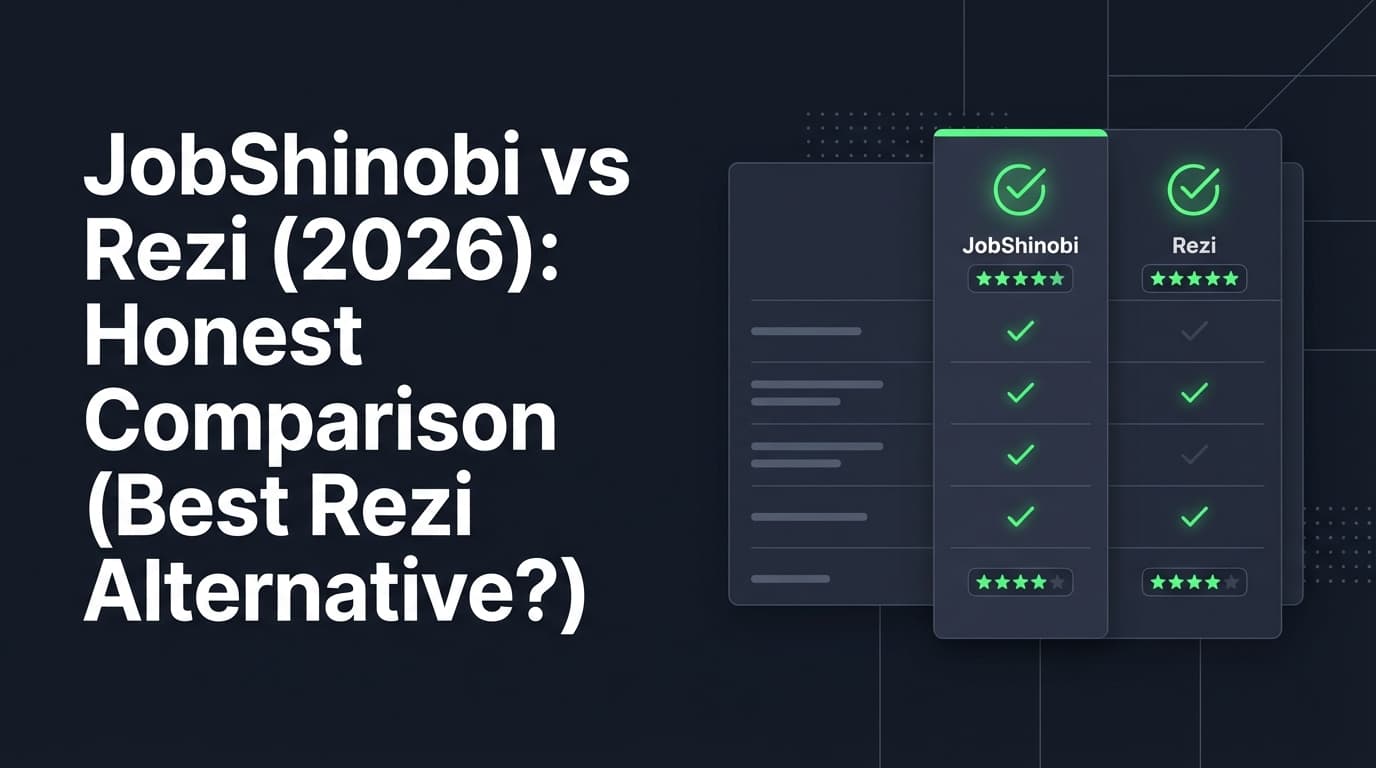
| Feature | JobShinobi | Rezi |
|---|---|---|
| ATS resume analysis + scoring | ✅ Yes (multi-part scoring + ATS/keyword feedback) | ✅ Yes (Rezi Score + real-time analysis ecosystem) |
| Job description → resume matching | ✅ Yes (JD extraction + match score + keyword gaps) | ✅ Yes (keyword targeting to match job requirements) |
| Resume editing approach | LaTeX-first + cloud compile + PDF preview | Guided resume builder + formatting controls |
| Resume exports | ✅ PDF + .tex download |
✅ PDF + DOCX + Google Drive export + “Verified PDF” download (docs) |
| Job tracking | ✅ Yes — via email forwarding automation (Pro) + manual tracker | ✅ Yes — job tracking by stage + job search tool (docs/tool page) |
| Job search tool | Not a core claim | ✅ Yes — Rezi “AI Job Search” tool (Rezi) |
| Starting price | $20/month (Pro) or $199.99/year | Free plan + $29/month Pro + $149 one-time Lifetime |
| Best for | High-volume applicants who want automation + structure | People who want guided resume building + lifetime pricing |
JobShinobi Overview
JobShinobi is an AI resume builder + ATS analyzer that’s built around a simple idea: writing the resume is only half the battle. The other half is applying consistently and staying organized.
Key parts of the product include:
- LaTeX-based resume templates (to preserve structure and avoid “mystery formatting”)
- AI resume scoring with ATS and keyword feedback
- Job description extraction + resume-to-job match analysis
- Resume version history (including AI-assisted iteration)
- A standout differentiator: email forwarding that automatically logs applications into a job tracker (Pro feature)
Key Strengths
- Email-forwarding job tracking (major differentiator): Forward application emails to a unique address and JobShinobi extracts details like company/title/status and logs them automatically.
- Structured tailoring workflow: Analyze a job description, see match gaps, and update your resume with guided changes.
- LaTeX-first formatting: Great if you’re tired of fighting formatting and want repeatable, predictable output.
Limitations (Honest)
- LaTeX is not for everyone: Even with templates and AI help, it can feel more technical than a typical resume editor.
- Automation is Pro-only: Email-based tracking is gated to paid users.
- Template library breadth: If you mainly want huge template libraries and content packs, Rezi may feel more “plug-and-play.”
Rezi Overview (Verified)
Rezi positions itself as an ATS-friendly AI resume builder. Its website emphasizes:
- AI keyword targeting to align your resume with job requirements
- Resume scoring + real-time content analysis (via the Rezi Score ecosystem)
- ATS-friendly formatting and template customization
- Job-search features including job tracking by stage and an AI job search tool
Rezi also stands out for offering both a subscription and a lifetime option.
Key Strengths (Verified)
- Flexible pricing (including lifetime): Rezi lists $29/month (Pro) and $149 one-time (Lifetime), and highlights a 30-day money-back guarantee on its pricing page title.
- Strong resume template ecosystem: Rezi publishes ATS template pages and describes customizable formatting options; its template page positions itself around ATS-friendly templates and includes a 2026 collection.
- Exports and convenience: Rezi’s download docs describe multiple export routes including PDF, DOCX, Google Drive export, and “Verified PDF.”
- Job search layer: Rezi’s “AI Job Search” tool page claims jobs sourced from company websites and includes integrated tracking; its docs note it does not apply automatically for you.
Limitations (From Reviews & Common Feedback Themes)
Based on recurring topics surfaced in review/discussion sources (e.g., Reddit threads and third-party reviews), some users report:
- Formatting frustration when trying to get a resume exactly the way they want (especially after exporting or tweaking).
- Occasional download issues, particularly around DOCX/PDF in some periods (users report errors; some threads indicate fixes later).
The point isn’t that Rezi is “bad”—it’s that if you’re highly sensitive to formatting control and reproducibility, the typical resume-builder approach can become a pain point.
Feature-by-Feature Comparison
1) ATS Optimization & Resume Scoring
JobShinobi:
JobShinobi runs structured resume analysis (including ATS/keyword feedback and multiple scoring dimensions). It’s designed for iterative improvement: analyze → tailor → version → re-analyze.
Rezi (Verified):
Rezi positions Rezi Score + Real-Time Analysis as a core benefit and ties this to improving ATS readiness. Rezi’s ecosystem includes user docs around keyword targeting and content analysis.
Winner: Tie (depends on your workflow)
- Rezi wins for a more mainstream, guided workflow.
- JobShinobi wins if you want analysis tightly integrated with matching + versioning in a more “technical” resume format stack.
2) Tailoring to a Job Description (Keyword Targeting vs Match Scoring)
JobShinobi:
JobShinobi supports job description extraction (URL or paste) and produces a match score plus keyword insights (present vs missing). That makes it easy to tailor with intent.
Rezi (Verified):
Rezi documents AI Keyword Targeting to help users match job requirements and improve ATS performance.
Winner: Slight edge to JobShinobi for “closed loop” tailoring
Rezi’s keyword targeting is strong and straightforward. JobShinobi’s advantage is the structured “match → gaps → apply suggestions → re-check” loop.
3) Resume Editing & Formatting Control
JobShinobi:
LaTeX-first editing with cloud compilation and PDF preview. This is ideal if you care about consistent structure and fewer layout surprises.
Rezi (Verified):
Rezi’s builder supports formatting adjustments and provides a broader template library experience. It also supports multiple export formats, which is useful for different application requirements.
Winner: Depends
- Rezi wins for ease-of-use and “standard resume builder” familiarity.
- JobShinobi wins if you want predictable formatting control and don’t mind (or prefer) a more technical approach.
4) Exports & File Formats (Important for Real-World Applications)
JobShinobi:
Exports include PDF and .tex (LaTeX source), which is useful if you want long-term control and portability.
Rezi (Verified):
Rezi’s docs describe:
- Download PDF
- Download DOCX
- Download to Google Drive
- Download Verified PDF
Winner: Rezi
If your priority is exporting in multiple “employer-friendly” formats (especially DOCX + Drive workflows), Rezi is clearly stronger here.
5) Job Search & Job Tracking (Where the Tools Diverge Most)
JobShinobi:
JobShinobi includes a job application tracker and—more uniquely—email forwarding that automatically logs applications. For high-volume job seekers, this can remove a huge amount of manual admin work.
Rezi (Verified):
Rezi provides job tracking and job search features. Rezi’s Job Search docs also explicitly note that it does not automatically apply for jobs on your behalf—you still submit via the job link.
Winner: JobShinobi for automation; Rezi for “built-in job search”
- If you want automatic tracking from your inbox, JobShinobi is the better fit.
- If you want a job search feature built into the platform, Rezi may be more compelling.
Pricing Comparison (Verified on 2026-01-21)
| Plan | JobShinobi | Rezi |
|---|---|---|
| Free | Limited (core email automation requires Pro) | ✅ Free plan (Rezi pricing/docs) |
| Monthly | $20.00/mo (Pro) | $29/mo (Pro) |
| Yearly | $199.99/yr | (Not confirmed from Rezi pricing analysis; check Rezi pricing for current annual offers if any) |
| One-time/Lifetime | Not listed | $149 one-time (Lifetime) |
| Enterprise | Not listed | ✅ Rezi Enterprise exists (white-label offering). Public page lists pricing model; confirm details directly for orgs. |
Rezi Free Plan Limits (Verified via Rezi pricing/docs snippets)
Rezi’s Free plan is described as allowing one resume and up to 3 PDF downloads, with limited AI access (wording varies by page snippet; confirm inside your account for exact current limits).
Value Analysis
- Best long-term deal: Rezi can be a great value if the $149 lifetime plan covers what you need.
- Best “active job seeker value”: JobShinobi can be more valuable during intense job-search periods because it’s built around tailoring + tracking automation, not just resume creation.
Who Should Choose JobShinobi?
You’ll prefer JobShinobi if you:
- Want the best Rezi alternative (2026) because you need a job-search system, not just a resume builder.
- Apply frequently and want email-forwarded application tracking to reduce manual logging.
- Like the idea of a resume that’s easier to keep stable and consistent (LaTeX-based).
- Care about versioning and iterative improvement: tailor → test → improve → repeat.
Who Should Choose Rezi?
You’ll prefer Rezi if you:
- Want a guided, mainstream resume builder with ATS positioning and lots of supporting content/templates.
- Care about DOCX export, Google Drive export, and download options like “Verified PDF.”
- Want a free plan to test the workflow quickly.
- Prefer a one-time lifetime option instead of paying monthly.
Switching from Rezi to JobShinobi
Common concerns and realistic expectations:
- Can you import directly? Not guaranteed. Resume builders structure data differently. The most reliable approach is exporting your content and rebuilding with a JobShinobi template.
- Learning curve: If you’ve never touched LaTeX, expect a short ramp-up. If you treat the resume as “template + AI-assisted edits,” it’s much easier than hand-writing LaTeX.
- What you gain: Better consistency, version control, and a tracking workflow that can reduce admin overhead (especially if you apply a lot).
FAQ
Is JobShinobi “better” than Rezi?
Not universally. Rezi is strong for guided resume building, templates, and export options—plus a compelling lifetime price. JobShinobi is stronger if you want ATS optimization plus a workflow that supports high-volume applying (especially the email-forwarding tracker).
Which is cheaper in 2026?
- Monthly: JobShinobi ($20/mo) is cheaper than Rezi ($29/mo) (verified on 2026-01-21 via Rezi pricing page/snippets).
- Long term: Rezi may be cheaper if the $149 lifetime plan meets your needs.
Does Rezi support DOCX downloads?
Yes. Rezi’s download documentation describes DOCX download, along with PDF and Google Drive export.
Does Rezi automatically apply to jobs for you?
No. Rezi’s Job Search documentation states it does not automatically apply; you still submit applications through the job link provided.
What makes JobShinobi a strong Rezi alternative?
The clearest difference is workflow automation: forward job emails → JobShinobi logs applications automatically, reducing the “spreadsheet tax” of job searching. Combined with job matching and ATS feedback, it’s built for consistent iteration.