You don’t get unlimited time to “win” a recruiter’s attention. One eye-tracking study found recruiters spent about 7.4 seconds in an initial resume review. (Source: TheLadders eye-tracking study PDF: https://www.theladders.com/static/images/basicSite/pdfs/TheLadders-EyeTracking-StudyC2.pdf; also summarized by HR Dive: https://www.hrdive.com/news/eye-tracking-study-shows-recruiters-look-at-resumes-for-7-seconds/541582/)
That’s why bullet points matter—and why AI can feel like a shortcut.
But here’s the catch: AI is excellent at producing confident, polished sentences… even when those sentences drift away from the truth.
A survey cited by Kickresume suggests:
- 39% of respondents would use an AI-generated “tiny lie” on their CV if they could justify it
- 44% of HR professionals say it’s easy to detect AI use in CVs
(Source: Kickresume resume trends survey: https://www.kickresume.com/en/press/resume-trends-survey/)
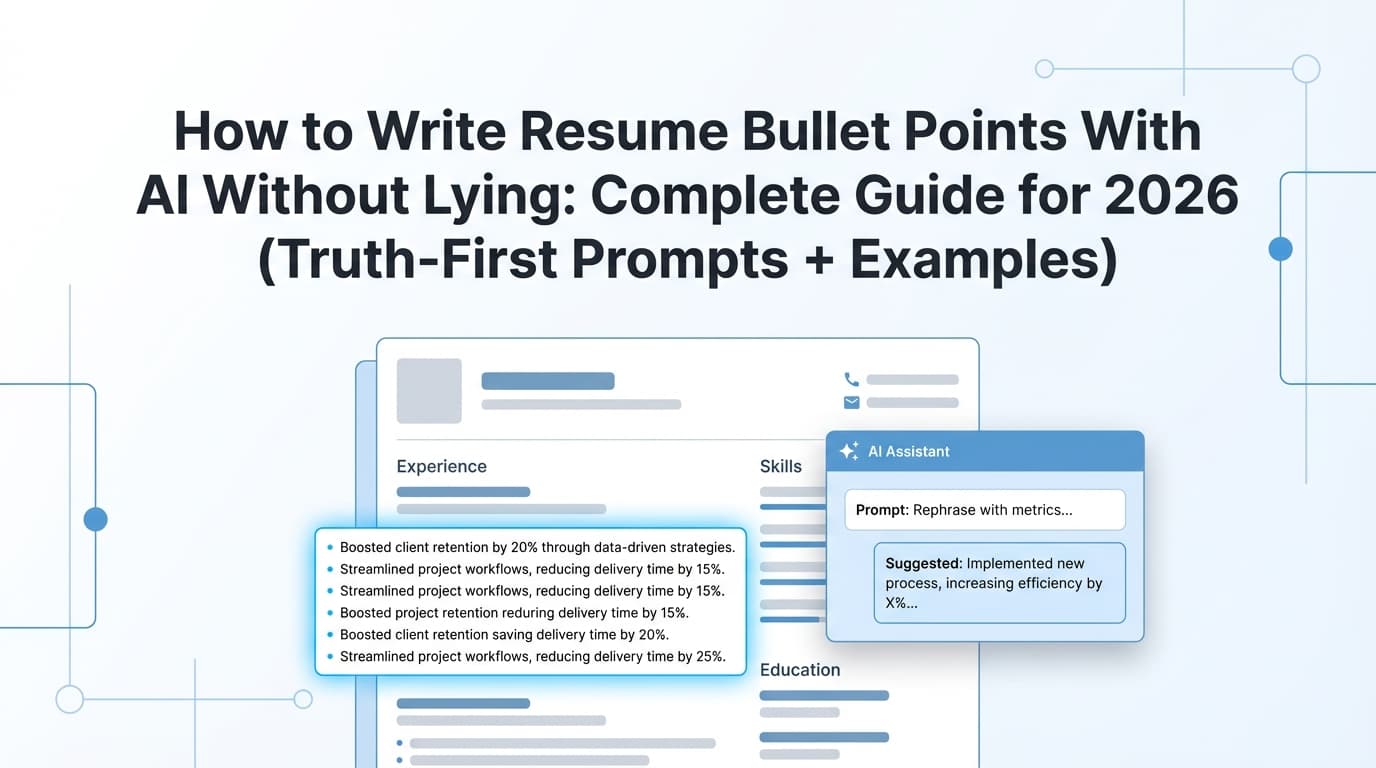
This guide gives you a truth-first, interview-defensible workflow to use AI for resume bullets without lying (or “accidentally lying”)—plus prompts, templates, and examples you can copy.
In this guide, you’ll learn:
- What “lying” looks like in AI-generated bullets (and what doesn’t count as lying)
- A step-by-step system: Fact bank → Guardrails → Draft bullets → Truth audit → Tailor ethically
- How to quantify achievements when you don’t have perfect metrics (without making up numbers)
- Role-based bullet examples (tech, ops, marketing, customer support, student/early career)
- Tools that can help you iterate faster—without overclaiming anything
What Does “Writing Resume Bullet Points With AI Without Lying” Mean?
It means you’re using AI as a writing assistant, not as an experience generator.
A practical definition
Truth-first AI resume writing = you supply the facts, AI supplies the phrasing.
AI can help you:
- Choose stronger verbs
- Tighten wording
- Improve structure (“Action + How + Outcome”)
- Tailor language to a job description (keywords and framing)
AI should not do this:
- Invent metrics (“increased revenue 30%”)
- Add tools you didn’t use (“Snowflake, Tableau, Kubernetes”)
- Inflate your seniority (“led,” “owned end-to-end,” “managed”)
- Create fake projects, certifications, awards, or clients
Why This Matters in 2026 (ATS + Volume + Trust)
ATS is common, so clarity and keywords matter
A roundup of ATS statistics reports:
- 70% of large companies use an ATS
- 20% of small and mid-sized businesses use an ATS
- 75% of recruiters use an ATS or another tech-driven recruiting tool
(Source: Select Software Reviews, “Applicant Tracking System Statistics”: https://www.selectsoftwarereviews.com/blog/applicant-tracking-system-statistics)
Translation: your resume has to work for both parsing and human scanning.
AI adds risk: “Hallucinations” and overconfidence
Career centers increasingly warn that AI can generate inaccuracies and that users must remain critical of output. MIT’s career guidance explicitly discusses setting guardrails, avoiding over-reliance, and considering data protection when using AI in resume writing. (Source: MIT CAPD: https://capd.mit.edu/resources/ai-uses-for-resume-writing/)
AI-generated lies backfire because interviews are “explainability tests”
A bullet point isn’t just a line of text—it’s a promise that you can explain:
- what you did
- how you did it
- what changed because of it
- how you know
If you can’t explain it, it’s a liability.
Lying vs. Strong Framing (A Clear Boundary Guide)
Lying (don’t do this)
These are the most common “AI resume lies,” both intentional and accidental:
- Invented numbers: “Reduced costs by 25%” (no basis)
- Tool laundering: adding tools from the job post you never used
- Role inflation: “Led cross-functional team” when you were a contributor
- Outcome inflation: claiming revenue/customer impact you can’t attribute
- Scope inflation: “Enterprise-wide” when it was a small internal pilot
Truthful (and effective) framing (do this)
You can improve language without changing reality:
- Replace weak verbs with accurate strong verbs (e.g., “helped” → “supported,” “contributed,” “delivered,” “implemented”)
- Make scope explicit (stakeholders, frequency, volume)
- Use estimated ranges only when you can defend them and communicate them honestly (“~”, “about,” “10–15”)
If you want a quick rule:
If a hiring manager asked, “How do you know that?” you should have a calm, factual answer.
How to Write Resume Bullet Points With AI Without Lying: Step-by-Step System
Step 1: Create a “Fact Bank” (Source of Truth)
Your fact bank is the antidote to AI hallucinations. It’s also the fastest way to write better bullets—because you stop starting from a blank page.
For each role/project, write:
A) What you did (deliverables)
- Built / launched / analyzed / improved / migrated / documented / trained / supported
B) How you did it (tools + methods)
- Tools you actually used (be specific: SQL, Python, Excel pivot tables, Looker Studio, Jira, HubSpot, Zendesk, etc.)
- Methods (A/B tests, stakeholder interviews, QA checklist, automation scripts)
C) What changed (impact)
- Metrics if you have them (time saved, error rate, conversion rate, cycle time, CSAT)
- If you don’t: qualitative outcomes + scope (“reduced manual work,” “improved reliability,” “standardized reporting”)
D) Proof points
- Performance review bullets (sanitized)
- Dashboards/reports you built (don’t paste confidential data)
- Project artifacts (docs, SOPs, GitHub links if public)
Data safety note: Many career centers advise being careful about what you share with AI tools; don’t paste sensitive/confidential information. (See MIT CAPD guidance on thoughtful AI use and data protection: https://capd.mit.edu/resources/ai-uses-for-resume-writing/)
Step 2: Add Guardrails (So AI Can’t “Improve” You Into a Lie)
Copy/paste these guardrails into your prompt every time:
- Do not invent metrics, tools, job titles, certifications, clients, or outcomes.
- Use only the facts I provide.
- If a metric is missing, either:
- write the bullet without a number, or
- mark it as [METRIC NEEDED].
- Do not inflate seniority (“led,” “managed,” “owned end-to-end”) unless explicitly stated.
- Bullets must be interview-defensible.
These rules dramatically reduce “confident nonsense.”
Step 3: Use a Truth-First Bullet Prompt (Copy/Paste)
Prompt 1 — Generate bullet options from your fact bank
You are a resume writer. Write 8–12 resume bullet point options for the role below.
Hard rules:
- Do NOT invent metrics, tools, job titles, certifications, clients, or outcomes.
- Use ONLY the facts I provide. If a metric is missing, write the bullet without a number OR mark it as “[METRIC NEEDED]”.
- Do NOT exaggerate seniority (don’t say “led” unless I explicitly led).
- Each bullet must be interview-defensible and specific.
Format rules:
- 1–2 lines each
- Start with a strong action verb
- Prefer “Action + What + How + Outcome”
- Avoid buzzwords (“synergy,” “dynamic,” “results-driven”)
My fact bank:
[Paste facts]Target job (optional):
[Paste job description or top requirements]
Step 4: Run a “Truth Audit” Prompt (Catch Accidental Lies)
Prompt 2 — Bullet-by-bullet claim extraction + risk flags
Audit these bullets for accuracy risk. For each bullet:
- List every factual claim (tools, scope, numbers, ownership, outcomes).
- Flag anything not supported by my fact bank.
- Rewrite the bullet to remove/soften unsupported claims while keeping it strong.
Bullets:
[Paste bullets]
Fact bank:
[Paste facts]
This is where most people skip—and where most AI resume lies slip through.
Step 5: Turn Duties Into Achievements Without Faking Metrics
If your bullets sound like a job description, you’re usually missing one of these: scope, specificity, or impact.
Use structured frameworks to force clarity.
Option A: CAR (Challenge–Action–Result)
CAR is widely taught for resume bullets. (Example reference: Indeed’s CAR method overview: https://ca.indeed.com/career-advice/resumes-cover-letters/challenge-action-result-resume)
Template:
- Challenge: what problem existed?
- Action: what you did
- Result: what changed
Bullet skeleton:
- “Resolved [challenge] by [action], resulting in [result].”
Option B: STAR (Situation–Task–Action–Result)
Especially helpful for:
- internships
- projects
- student orgs
- career changes
Option C: XYZ
Common in tech:
- “Accomplished X as measured by Y, by doing Z.”
No metric? You can still use XYZ honestly:
- “Accomplished X by doing Z,” then add scope or quality.
Step 6: Quantify Ethically (Even If You Don’t Have Numbers)
You don’t need to invent numbers to write strong bullets. If you have no metrics, you can quantify with ranges, frequency, and scope, as long as it’s defensible.
Helpful guidance on using ranges when exact numbers aren’t available:
- The Muse suggests using a range when you don’t know exact figures. (Source: https://www.themuse.com/advice/how-to-quantify-your-resume-bullets-when-you-dont-work-with-numbers)
Ethical quantification ideas (choose what’s true):
- Frequency: daily/weekly/monthly
- Volume: “processed 30–50 tickets/week”
- Stakeholders: “supported 6 hiring managers”
- Coverage: “across 3 departments”
- Duration: “within 2 weeks”
- Scale: “dataset of ~200k rows” (if you can verify)
- Risk reduction: “reduced errors,” “improved compliance,” “standardized process”
Safe language for estimates:
- “~” (approximately)
- “about”
- “roughly”
- “10–15” (range)
Never do:
- precise numbers you can’t trace
- financial impact you can’t attribute
Step 7: Tailor to a Job Description Without Keyword Fraud
Ethical tailoring = mapping real experience to job needs.
A simple 3-pass method:
Pass 1: Extract the job’s “must-have language”
- Tools
- Deliverables
- Competencies (stakeholder management, experimentation, forecasting)
- Domain terms
Pass 2: Map to your fact bank
- If you truly did it, say it.
- If you didn’t, don’t claim it.
Pass 3: Swap language, not reality
- “Built reports” → “Built KPI reporting” (if true)
- “Worked with stakeholders” → “Partnered with Sales/RevOps stakeholders” (if true)
Avoid hacks (hidden keywords, white text, stuffing). They can harm readability and credibility—and sometimes show up as suspicious formatting.
Step 8: Format Bullets So ATS and Humans Can Read Them
Formatting isn’t the focus of this guide, but it matters because bad formatting can scramble content.
MIT’s ATS-friendly resume guidance explicitly advises avoiding:
- graphics/icons/images
- tables/text boxes
(Source: MIT CAPD “Make your resume ATS-friendly”: https://capd.mit.edu/resources/make-your-resume-ats-friendly/)
Practical bullet formatting tips:
- Keep bullets 1–2 lines where possible
- Start with verbs
- Keep tense consistent (past tense for past roles)
- Avoid long “multi-clause” sentences
A “Truth-First” Bullet Point Template You Can Reuse
Use this template to create bullets from scratch (or to rewrite AI output):
Action verb + what you did + how you did it + scope + outcome
Examples:
- Implemented X using Y for Z stakeholders, reducing A by B
- Built X to support Y, improving Z and enabling A
- Standardized X across Y, reducing errors and improving consistency
If you’re missing the outcome metric:
- Implemented X using Y to improve Z [METRIC NEEDED]
Then you either:
- add the metric later, or
- keep it without numbers but with scope
Before/After Examples: Strong AI-Assisted Bullets That Stay Honest
Below are examples you can model. In each, the “After” is what AI should help you write after you provide truth inputs.
Example 1 — Software Engineer (performance improvement)
Before (vague):
- Worked on backend services and improved performance.
Truth inputs:
- Implemented Redis caching for Node.js API
- p95 latency from ~900ms to ~400ms (Datadog)
- You owned the implementation
After (truthful + strong):
- Implemented a Redis caching layer for a Node.js API, reducing p95 latency from ~900ms to ~400ms and improving responsiveness under peak traffic.
Example 2 — Data Analyst (dashboards + time saved)
Before:
- Responsible for reporting and dashboards.
Truth inputs:
- SQL queries feeding KPI dashboard
- Stakeholders: Sales + RevOps (~12 users)
- Saved ~3 hours/week of manual reporting
After:
- Built SQL-based KPI reporting and dashboards for Sales and RevOps stakeholders (~12 users), reducing manual weekly reporting by ~3 hours/week through automated refresh and standardized definitions.
Example 3 — Marketing (no perfect numbers)
Before:
- Managed social media and increased engagement.
Truth inputs:
- Managed weekly content calendar
- Ran A/B tests on newsletter subject lines
- No exact engagement metrics
After (no fake numbers):
- Built and maintained a weekly content calendar across social and email, enabling consistent publishing and faster iteration through A/B-tested messaging.
Example 4 — Customer Support (ticket volume + quality)
Before:
- Helped customers with issues.
Truth inputs:
- Resolved 30–45 tickets/week in Zendesk
- Improved macros/knowledge base articles
- Reduced repeat questions (no metric)
After:
- Resolved 30–45 Zendesk tickets per week while improving support macros and knowledge base documentation to reduce repeat questions and speed up resolution.
Example 5 — Operations/Admin (coordination without overclaiming)
Before:
- Helped with scheduling and office tasks.
Truth inputs:
- Coordinated interviews for 6 hiring managers
- Standardized email templates
- No formal metric
After:
- Coordinated interview scheduling across 6 hiring managers, standardizing email templates and scheduling workflows to reduce back-and-forth and keep candidates moving through the pipeline.
Example 6 — Student / early career (project experience)
Before:
- Did a class project about data.
Truth inputs:
- Cleaned dataset, built regression model, wrote report, presented results
After:
- Cleaned and analyzed a real-world dataset and built a regression model to evaluate key drivers, summarizing findings in a written report and presentation for a non-technical audience.
The “Truth Stretch” Zones (So You Don’t Accidentally Cross the Line)
Green zone (safe, commonly defensible)
- Built, created, implemented, analyzed, improved, automated, standardized, documented
- Partnered with, collaborated with, supported, contributed to
Yellow zone (use carefully)
- Led, owned, spearheaded (only if true)
- Reduced/increased by % (only with real data or transparent estimate)
- “Enterprise-wide,” “company-wide” (only if it truly was)
Red zone (avoid)
- Expert in (unless you can demonstrate it)
- Generated $X revenue (unless attributable and provable)
- Any tool you didn’t use
- Any metric you can’t explain
A Resume Bullet “Defensibility Checklist” (Use Before You Apply)
For each bullet, confirm:
- Tool check: Did I actually use each tool mentioned?
- Ownership check: Does this reflect my real role (not inflated)?
- Metric check: Can I explain where the number came from?
- Scope check: Are stakeholders/volume/timeframe accurate?
- Outcome check: Is the impact plausible and not exaggerated?
- Consistency check: Matches LinkedIn/job titles/dates?
- Interview test: Can I explain it in 30–60 seconds?
If any answer is “no,” revise the bullet.
Prompt Library: AI Prompts That Keep You Honest
Prompt A — “Interview me first” (reduces hallucinations)
Ask me 12 clarifying questions to write accurate resume bullets for this role. Prioritize measurable outcomes, scope, tools, and my level of ownership. Do not write bullets until I answer.
Prompt B — “Metric mining” (no invented numbers)
I don’t have metrics. Suggest 12 ethical ways to quantify impact for this role (time, cost, quality, speed, volume, adoption, risk). Do not invent numbers—only suggest what to measure and how to estimate.
Prompt C — “Keyword mapping without fraud”
Here is a job description and my fact bank. Create a keyword map:
- Keywords present in my experience (quote the supporting fact)
- Keywords missing (suggest truthful substitutes or learning language)
Then rewrite my bullets using only present keywords and truthful substitutes.
Job description: [paste]
Fact bank: [paste]
Prompt D — “Make it less AI-sounding”
Rewrite these bullets to sound more human and specific. Keep meaning unchanged. Remove buzzwords. Keep them interview-defensible.
Bullets: [paste]
Common Mistakes When Using AI for Resume Bullets (And Fixes)
Mistake 1: Copy/paste AI output without auditing claims
Fix: Run the Truth Audit prompt and the defensibility checklist every time.
Mistake 2: Keyword stuffing or hidden keywords
Fix: Use keywords naturally where they fit your real experience; prioritize readability.
Mistake 3: “Leadership inflation”
AI loves “led” and “spearheaded.”
Fix: Use accurate alternatives: “coordinated,” “drove,” “owned,” “contributed,” “partnered.”
Mistake 4: Using AI with sensitive info
Fix: Remove client names, internal codenames, proprietary metrics, or confidential details. (See MIT CAPD guidance on thoughtful AI use and data protection: https://capd.mit.edu/resources/ai-uses-for-resume-writing/)
Mistake 5: Optimizing for a single “ATS score”
Fix: Use scanners as feedback, not as truth. Optimize for: clarity, relevance, and defensible outcomes.
Tools to Help You Write Honest AI Resume Bullet Points
You can do this with general-purpose AI, but resume-focused tools can speed up iteration.
JobShinobi (resume building + AI analysis + job matching)
JobShinobi can help you iterate on bullets and alignment by offering:
- A LaTeX resume editor with in-app PDF preview/compilation
- AI resume analysis (scores + detailed feedback)
- Job description extraction (from URL or pasted text) and resume-to-job matching (to surface keyword gaps)
- An AI resume editing chat/agent workflow for resume revisions (you still must verify facts)
Pricing:
- JobShinobi Pro is $20/month or $199.99/year.
The pricing page/marketing copy mentions a “7-day free trial,” but trial enforcement isn’t fully verifiable from product logic alone—so don’t treat it as guaranteed.
Related internal pages:
- Resume workspace: /dashboard/resume
- Job tracker: /dashboard/job-tracker
- Subscription: /subscription
Key Takeaways
- AI should improve writing, not invent experience.
- The safest workflow is: Fact bank → Guardrails → Draft → Truth audit → Ethical tailoring → Defensibility check.
- You can quantify impact without lying by using scope, frequency, ranges, and transparent estimates.
- ATS is common (e.g., SSR reports 70% of large companies and 75% of recruiters use ATS/tech tools), but optimizing for humans still matters. (Source: https://www.selectsoftwarereviews.com/blog/applicant-tracking-system-statistics)
- If you can’t explain a bullet in an interview, it’s not ready.
FAQ (People Also Ask)
Do employers check resumes for AI?
Some recruiters and hiring teams say AI-written content can be noticeable (especially if it’s generic). Survey data summarized by Kickresume suggests 44% of HR professionals say it’s easy to detect AI use in CVs. (Source: https://www.kickresume.com/en/press/resume-trends-survey/)
In practice, the bigger risk is usually inaccuracy or generic bullets that don’t match the role.
Is it ethical to use AI to write your resume?
Generally, yes—if you use AI for brainstorming/editing and keep everything truthful. Career centers often emphasize thoughtful use, verification, and guardrails. (Example: MIT CAPD: https://capd.mit.edu/resources/ai-uses-for-resume-writing/)
How do I avoid AI hallucinations in resume bullets?
You can’t eliminate them completely, but you can reduce them:
- Provide a structured fact bank
- Add guardrails (“don’t invent metrics/tools”)
- Run a truth audit that extracts claims
- Keep only bullets you can defend
MIT CAPD explicitly discusses staying critical of AI results and setting guide rails. (Source: https://capd.mit.edu/resources/ai-uses-for-resume-writing/)
How many bullet points should I include per job?
A common approach is 3–5 strong bullets for recent roles, fewer for older roles. Recruiter skim behavior (e.g., ~7.4 seconds initial review in the Ladders study) supports focusing on the strongest, most relevant bullets. (Sources: TheLadders PDF and HR Dive summary linked above.)
Should I use the CAR method for resume bullets?
CAR (Challenge–Action–Result) is a solid structure for turning duties into outcomes. It’s frequently taught in resume guidance and helps you avoid “responsible for…” bullets. (Example explanation: Indeed’s CAR method: https://ca.indeed.com/career-advice/resumes-cover-letters/challenge-action-result-resume)
What if I don’t have metrics?
You can still write strong bullets by quantifying scope (volume, frequency, stakeholders) and using ranges when you can defend them. The Muse suggests ranges as a practical way to quantify when exact figures aren’t available. (Source: https://www.themuse.com/advice/how-to-quantify-your-resume-bullets-when-you-dont-work-with-numbers)
Are tables/icons safe for ATS?
Some guidance recommends avoiding tables, text boxes, icons, and graphics because they can cause parsing issues. MIT CAPD’s ATS-friendly resume guidance explicitly advises avoiding graphics/icons/images and tables/text boxes. (Source: https://capd.mit.edu/resources/make-your-resume-ats-friendly/)