Recruiters decide “fit / no fit” fast—an average initial resume screen of 7.4 seconds was reported in a Ladders eye-tracking study. (Source: The Ladders eye-tracking study PDF, 2018: https://www.theladders.com/static/images/basicSite/pdfs/TheLadders-EyeTracking-StudyC2.pdf) Confidence: High (primary source)
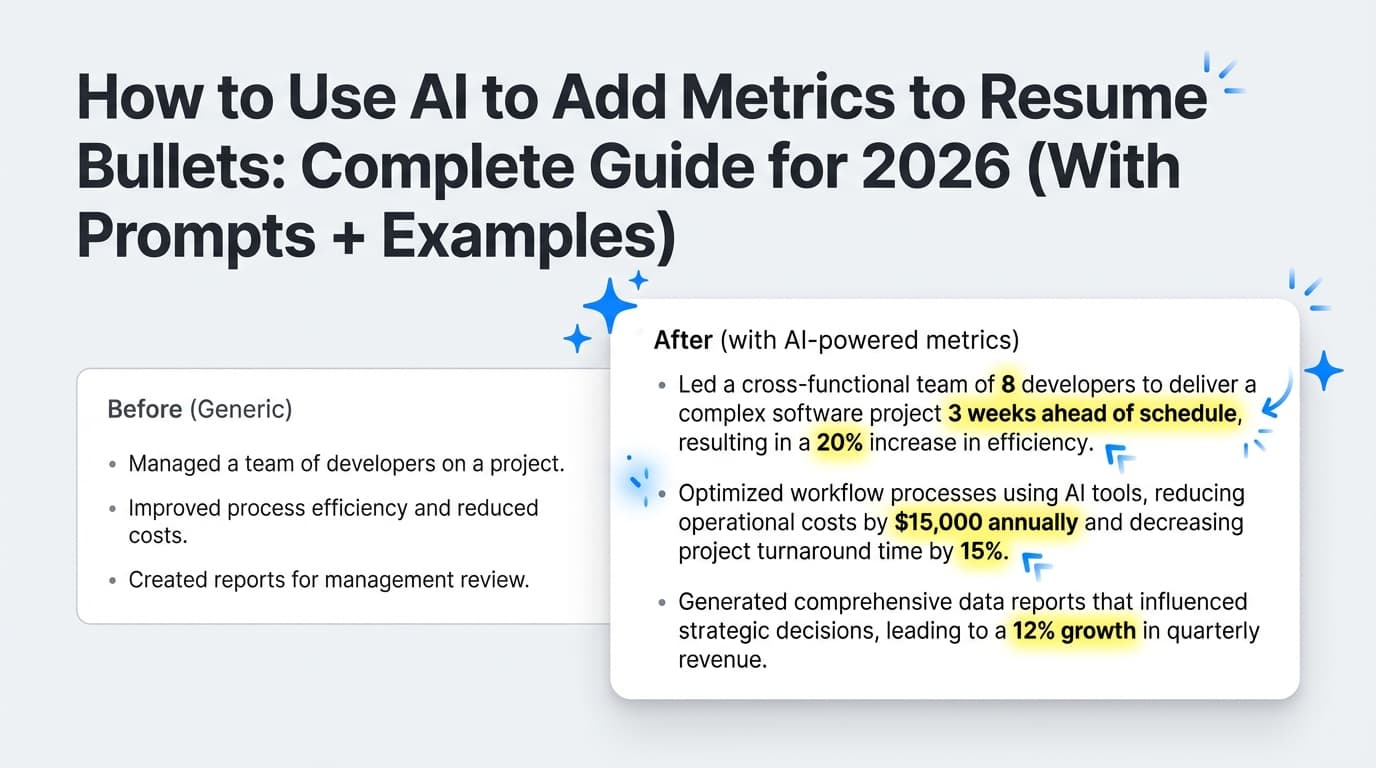
That means your bullets have to communicate value immediately—to both humans and systems. Vague bullets like:
- “Responsible for reporting”
- “Helped improve processes”
- “Worked with stakeholders”
…force the reader to guess your impact.
The goal isn’t to “sprinkle numbers everywhere.” The goal is to use AI to surface real, defensible metrics you’ve already created in your work—and then phrase them clearly.
In this guide, you’ll learn:
- A repeatable AI workflow to quantify any bullet
- Copy/paste prompts that prevent AI from making numbers up
- 25+ examples of strong, metric-backed bullets by role
- How to quantify impact when you don’t have perfect data
- Common mistakes (and how to avoid sounding fake or getting caught)
What does it mean to “add metrics” to resume bullets?
Adding metrics means attaching evidence of scope and impact to a specific action you took.
A “metric” can be:
- Volume: tickets/day, invoices/month, deployments/week, users supported
- Time: cycle time, time-to-resolution, time saved, faster processing
- Money: cost reduction, budget managed, revenue influenced
- Quality: error rate, defect rate, compliance pass rate, uptime
- Growth/Adoption: conversion rate, feature adoption, retention, churn reduction
- Risk: incidents prevented, audit findings reduced
A metric should be:
- Relevant to the role
- Accurate (or clearly estimated)
- Defensible in an interview
Why metrics matter in 2026 (ATS + human reality)
ATS is common—clarity helps both bots and people
Workday states: “more than 98% of Fortune 500 companies use” an applicant tracking system. (Source: Workday ATS page: https://www.workday.com/en-us/topics/hr/applicant-tracking-system.html) Confidence: Medium (credible vendor statement; not a peer-reviewed study)
Separately, many career offices continue to recommend ATS-friendly formatting choices. MIT Career Advising includes ATS-friendly guidance that warns against certain formatting elements that can be unreadable in ATS contexts. (Source: MIT CAPD: https://capd.mit.edu/resources/make-your-resume-ats-friendly/) Confidence: Medium
Metrics help because they’re:
- easy for a human to scan quickly
- easy for an ATS to parse (numbers + units + keywords)
- harder to dismiss as fluff
Most resumes still don’t quantify results
Resume Now reports “Only 1 in 10 resumes include measurable results,” based on an analysis of 18.4M U.S. resumes (per their press coverage/report references). (Source: Resume Now “Resume Results Report”: https://www.resume-now.com/job-resources/careers/resume-results-report) Confidence: Medium (publisher study; useful directional insight)
So if you quantify well—and truthfully—you stand out.
How to use AI to add metrics to resume bullets: a 6-step workflow
This workflow is designed to get you better bullets without letting AI invent numbers.
Step 1: Write the “plain truth” bullet first (no resume-speak)
Start with a simple sentence describing what you did.
Example (plain truth):
“I set up a weekly report for the sales team.”
This is the raw material AI needs.
Pro tip: If you can’t explain it plainly, you’ll struggle to quantify it credibly.
Step 2: Ask AI for a “metric menu” (types of metrics, not fake numbers)
You want AI to suggest categories of metrics and where to find them—not to guess.
Copy/paste prompt (Metric Menu):
You are a resume coach. Here is a plain-English description of something I did at work:
“[PASTE BULLET]”
- List 10 realistic metrics that could quantify this work (volume/time/money/quality/risk).
- For each metric, tell me where the data might live (dashboards, tickets, CRM, analytics, logs, finance reports, emails, calendars).
- Ask me 5 clarification questions to determine the best metric.
IMPORTANT: Do not invent numbers. If you need a number, use a placeholder like [X] or [X%].
Step 3: Gather evidence (or estimate responsibly)
Now pick 1–2 metric directions and find support.
Where metrics commonly live:
- Calendar: trainings delivered, meetings facilitated, launches supported
- Tickets: Zendesk/Jira/ServiceNow throughput, SLA, time-to-resolution
- CRM: accounts owned, pipeline influenced, stage conversion
- Analytics: GA4, Mixpanel, Looker dashboards, product adoption
- Docs: SOPs, runbooks, project status updates, launch notes
- Finance: budgets, vendor spend, cost-saving initiatives
- Engineering tools: APM dashboards, error logs, CI/CD metrics
If you don’t have exact numbers, use:
- ranges (“~20–30/week”)
- time saved (“cut from ~2 hours to 20 minutes”)
- scope (“supported 6 teams”)
Rule: If you can’t defend it, don’t publish it.
Step 4: Have AI rewrite into ATS-friendly, metric-backed bullets
Feed AI your verified numbers/ranges and ask for multiple options.
Copy/paste prompt (Quantified Bullet Builder):
Rewrite this resume bullet into 3 ATS-friendly versions using this formula:
Action verb + what I did + how I did it + measurable outcome + business reason.Bullet: “[PLAIN BULLET]”
Context: role = [YOUR ROLE], industry = [INDUSTRY], audience = [WHO BENEFITED]
Verified metrics I can defend: [PASTE NUMBERS/RANGES]
Tools/skills: [LIST TOOLS]Constraints:
- 1 line if possible (max 2 lines)
- No buzzwords, no exaggeration
- Keep it human-readable (no keyword stuffing)
- Do NOT invent numbers
Step 5: Stress-test credibility (AI as a “skeptical interviewer”)
This is how you catch inflated claims before a recruiter does.
Copy/paste prompt (Credibility Check):
Act like a skeptical hiring manager. For each bullet below:
- Identify any claim that sounds inflated, vague, or hard to verify
- List the follow-up questions you’d ask me in an interview
- Suggest a safer rewrite if needed
Bullets:
- [BULLET 1]
- [BULLET 2]
- [BULLET 3]
If you can’t answer the follow-ups, revise.
Step 6: Tailor metrics to the job description (keep numbers, align language)
Use AI to map your strongest metrics to what the role values.
Copy/paste prompt (Metric-to-JD Mapper):
Here is a job description: [PASTE JD]
Here are my quantified bullets: [PASTE BULLETS]
- Which 3 bullets best match the role’s priorities?
- For each, suggest 1 rewrite that better reflects the job description language while keeping my metrics unchanged.
- List missing keywords I can add naturally (no keyword stuffing).
A bullet formula that works (and how AI helps)
One high-performing structure is similar to Yale’s action-oriented guidance (action + project/problem + result, quantified when possible). (Source: Yale OCS “Writing Impactful Resume Bullets”: https://ocs.yale.edu/resources/writing-impactful-resume-bullets/) Confidence: Medium (career office guidance)
Practical formula:
Action verb + what you did + how you did it + metric + business impact
Example:
- “Automated weekly KPI reporting in SQL/Looker, reducing prep time from ~4 hours to 45 minutes and improving decision-making cadence for Sales leadership.”
AI helps by:
- proposing role-appropriate verbs
- compressing messy notes into a single line
- generating multiple versions so you can choose the most accurate and readable
Best metrics by role + strong examples
Software Engineer / Data / ML
Metric themes: latency, uptime, cost, scale, defects, throughput.
Examples:
- Reduced API p95 latency from 900ms to 220ms by optimizing queries and implementing caching.
- Improved reliability to 99.95% uptime by adding alerting and automated rollback strategies.
- Cut cloud spend ~18% by right-sizing infrastructure and tuning autoscaling.
- Increased ETL throughput 3× by parallelizing ingestion and optimizing batch jobs.
- Reduced defect escape rate by 25% by strengthening CI test coverage and release gates.
If you lack perfect access:
- “Improved endpoint latency by hundreds of milliseconds (validated via APM dashboards).”
Product Manager
Metric themes: adoption, activation, retention, delivery speed, experimentation.
Examples:
- Shipped onboarding changes that increased activation rate from 21% to 29% over 6 weeks.
- Led discovery across 15+ customer interviews; reduced roadmap churn and improved sprint predictability by 20%.
- Improved feature adoption to 35% of active users via in-product education and enablement.
Marketing (growth/content/lifecycle/paid)
Metric themes: conversion rate, pipeline influenced, CAC/ROAS, traffic, engagement.
Examples:
- Increased landing page conversion from 2.4% to 3.1% through A/B testing and copy improvements.
- Drove $480K influenced pipeline via lifecycle nurture and lead scoring updates (Salesforce/HubSpot).
- Reduced CAC ~12% by restructuring paid search campaigns and tightening negative keywords.
- Grew organic traffic +38% YoY by building topic clusters and improving internal linking.
No revenue visibility? Use leading indicators:
- MQLs, demo requests, CTR, CVR, retention, engagement.
Operations / Program Management
Metric themes: cycle time, throughput, error reduction, standardization, compliance.
Examples:
- Reduced procurement turnaround from 12 days to 6 days by redesigning intake and approval workflow.
- Standardized SOPs across 4 teams, reducing rework ~15% (tracked via QA review).
- Managed vendor onboarding for 30+ partners/year while maintaining compliance requirements.
Customer Support / Customer Success
Metric themes: CSAT, SLA, time-to-resolution, escalations, renewals.
Examples:
- Resolved 40–60 tickets/day while maintaining 95%+ CSAT and meeting SLA targets.
- Reduced average resolution time by 22% by improving triage, macros, and internal documentation.
- Managed a book of 25 enterprise accounts, reducing escalations through proactive enablement.
Finance / Analytics
Metric themes: accuracy, close speed, savings, forecasting, scale.
Examples:
- Improved forecasting variance accuracy from ±12% to ±6% by redesigning model assumptions and inputs.
- Automated reconciliation, saving ~10 hours/month and reducing manual errors.
- Managed budget of $1.2M; identified $85K in cost optimizations through vendor analysis.
How to quantify when you don’t know exact numbers (without lying)
Indeed’s guidance on quantifying resumes includes tactics like gathering data and using ranges. (Source: Indeed “How to Quantify Resume Accomplishments”: https://www.indeed.com/career-advice/resumes-cover-letters/how-to-quantify-resume) Confidence: Medium
Here are practical methods:
- Scope: “Supported 6 teams,” “served 3 regions,” “owned 2 systems”
- Volume proxies: tickets/day, reports/week, records/month
- Time saved: before/after task duration
- Ranges + qualifiers: “~,” “approximately,” “15–20%”
- Cadence improvements: monthly → weekly, manual → automated
- Quality signals: fewer errors, fewer escalations, fewer incidents
- Standardization/enablement: created playbooks, dashboards, KPI definitions
Avoid:
- suspiciously precise numbers you can’t source
- big claims with no mechanism (“increased revenue 40%”) unless you can explain attribution
Common mistakes when using AI for resume metrics
Mistake 1: Letting AI invent numbers
Fix: force placeholders ([X], [X%]) until you verify.
Mistake 2: Choosing irrelevant metrics
Fix: pick metrics that match the job’s priorities.
Mistake 3: Over-quantifying every bullet
Fix: quantify your highest-impact 1–2 bullets per role first.
Mistake 4: Missing units/timeframes
Fix: “per month,” “per sprint,” “from X to Y,” “over 6 weeks.”
Mistake 5: Breaking ATS readability with formatting
Even if some ATS parse complex layouts, career guidance (like MIT’s) commonly recommends keeping formatting simple.
Source: https://capd.mit.edu/resources/make-your-resume-ats-friendly/ Confidence: Medium
AI prompt pack (copy/paste)
Prompt 1 — Find where metrics belong
Here are my current resume bullets. Identify which bullets are vague and where metrics would strengthen them.
For each bullet: suggest 3 metric types + ask me 2 questions to uncover real numbers.
Bullets: [PASTE]
Prompt 2 — Turn a project into measurable outcomes (with placeholders)
I’ll describe a project. Identify measurable outcomes across time, cost, quality, volume, risk, and customer impact.
Then suggest 5 resume bullets using placeholders like [X%] or [Y hours]. Do not invent numbers.
Project: [PASTE]
Prompt 3 — Convert responsibilities → accomplishments (facts only)
Rewrite these responsibilities into accomplishment bullets. Use only the facts I provide. Keep ATS-friendly.
Responsibilities: [PASTE]
Facts/metrics I can defend: [PASTE]
Prompt 4 — Build a KPI inventory for my role
For my role as [ROLE] in [INDUSTRY], list 20 common KPIs, where they’re tracked, and which are best for resumes (impressive + defensible).
Prompt 5 — Interview defense test
For each bullet, ask 2 tough follow-ups and tell me what evidence would satisfy you.
Bullets: [PASTE]
Tools to help with quantified bullets (honest recommendations)
JobShinobi (AI resume builder + analyzer + job matching)
JobShinobi can help you iterate faster once you have real metrics:
- AI resume analysis with structured scoring and feedback
- Job description matching (paste a job description or URL) to spot keyword gaps and tailoring opportunities
- AI resume editing agent to help rewrite and refine bullets (you provide the real numbers)
- LaTeX resume editor + PDF compilation for consistent formatting and clean output
Pricing: JobShinobi Pro is $20/month or $199.99/year. Marketing mentions a 7-day free trial, but trial enforcement isn’t clearly verifiable from the available implementation—so don’t assume it always applies.
Internal links: / • /login • /subscription
Other useful tools
- Your source-of-truth systems (Jira, CRM, support desk, analytics dashboards)
- Spreadsheets for calculating deltas and totals
- General-purpose AI chat tools (best for brainstorming and rewriting when you control the facts)
Key takeaways
- Use AI to generate metric ideas and rewrite options, not to generate “facts.”
- Great bullets combine action + method + metric + business impact.
- If you don’t have exact numbers, quantify with scope, ranges, time saved, volume proxies, and quality signals.
- Always run an “interview defense” check before finalizing bullets.
- Keep formatting readable and ATS-friendly so your metrics actually get seen.
FAQ
How do I add performance metrics to my resume?
Attach measurable outcomes (time, volume, money, quality, adoption) to your most important accomplishments. Add units and timeframes, and keep bullets concise.
What if I don’t know the exact numbers?
Use scope, ranges, time saved, volume proxies, and quality signals. Be transparent with “~” and “approximately,” and avoid overly precise numbers.
Is it okay to estimate metrics?
Yes—if estimates are conservative, clearly labeled, and defensible. Be ready to explain how you estimated them.
Do all resume bullet points need metrics?
No. But your strongest bullets should be specific and evidence-based. Quantify the work that shows your highest impact.
Will employers know if I used AI?
Not inherently. What they will notice is generic or exaggerated content. Use AI as an editor and idea generator—keep facts and metrics grounded in reality.